Read the article here.
 “Farecast‘s sale to an unknown buyer is the latest score for superstar University of Washington computer scientist Oren Etzioni, who has watched several of his Internet companies gobbled up at attractive valuations over the past 15 years.
“Those include comparison shopping service NetBot, which was acquired by Excite in 1997, and MetaCrawler, a search engine that is now part of InfoSpace.”
Farecast, like many other UW CSE startups, included Madrona Venture Group and the WRF Capital as early investors. Read more →
Read the article here.
Photosynth, a collaboration between UW CSE’s computer graphics group and Microsoft, has been featured in an episode of CBS’s hit crime drama CSI: NY.
This is a significant move uptown from the graphics group’s other recent television exposure: visualization of “drafting” as part of NASCAR coverage.
Seattle Times article here
Seattle PI article here
Washington Times here
Discover here Read more →
Read the article here.
UW CSE students Julie Letchner and Kate Everitt are among 23 nationwide winners of 2008 Google Anita Borg Scholarships. Google established the Anita Borg Memorial Scholarships “to honor the work of Dr. Anita Borg, a computer scientist who dedicated her professional career to increasing the participation of women and other under-represented minorities in the field of technology.” Read more →
Read the article here.
 “As teenagers, Paul Allen and Bill Gates wandered the University of Washington campus, trying to pilfer free computer time. They let their minds wander to a future when computing power would essentially be free.
“Gates, in the final stop of his last university-speaking circuit as a full-time Microsoft employee, told students and faculty at the UW on Friday about what they imagined then and how much of what they dreamed of is becoming reality …
“A common thread is the UW itself. Gates acknowledged the important relationship he, Microsoft and the Foundation have with the university. It starts with his parents, who met there as students, he said. He took an algebra class there, but the main benefit was finding time to practice his skills on unused mainframe and minicomputers around the campus – before the PC era he helped create … He said the UW has received more Gates Foundation grants than any other university. Microsoft, in a typical year, hires about 100 people from the UW, making it the top source of talent for the company, Gates said … He also highlighted work at the UW on collaboration software and an innovative photo-viewing technology that became a Microsoft product called Photosynth.”
Read more →
Read the article here.
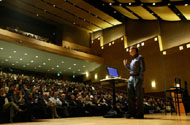 Bill Gates visits UW CSE and speaks to a packed house of students in the final stop on his 2008 tour of six universities.
“With his father and two sisters watching from the front row, Gates recounted for the overflow crowd the well-known story of roaming the University of Washington campus as a boy with Paul Allen, who would become the Microsoft co-founder, looking for research computers that they could use in off-hours. They were ‘stealing computer time, and now I’m giving it back,’ Gates said, to laughter.”
Seattle PI article (vs. blog) here Read more →
Read the article here.
 “University of Washington President Mark Emmert and UW Computer Science & Engineering host Microsoft co-founder Bill Gates for the final stop of his six-university tour, as Gates transitions from Microsoft to the Bill amp; Melinda Gates Foundation.”
A UWTV web archive of Gates’s UW speech and Q&A session. Read more →
The Mobile ASL project is described on KUOW/NPR.
See MobileASL project information here. Read more →
Read the article here.
“Beating the ‘botnets’ – armies of infected computers used to attack websites – requires borrowing tactics from the bad guys, say computer security researchers.
“A team at the University of Washington want to marshal swarms of good computers to neutralise the bad ones. They say their plan would be cheap to implement and could cope with botnets of any size.”
Read UW CSE “Phalanx” paper here Read more →
“University of Washington researchers have developed software designed to let those who can’t work a handheld mouse use their voice instead to navigate the Web.” (See #17)
Project webpage here. Article here. Read more →
Read the article here.
 “The UW will lead a multi-institutional group pushing the limits of computers’ ability to interpret data and ultimately predict the behavior of complex systems. The project, involving seven U.S. universities, has received a $6.25 million, 5-year grant from the Department of Defense.
“‘A complex monitoring system has far too many pieces of information for any one person to look at,’ said principal investigator Pedro Domingos, a UW associate professor of computer science and engineering. ‘This award lets us do the research to develop a system for the military to look at all the available information that might be valuable and use it to predict behavior.'” Read more →