Read the article here.
“The technology, developed by the University of Washington and Microsoft Research, identifies patterns in pictures, then matches these with related photos to produce overlapping montages that users can then navigate in a browser.”
Articles that fail to credit UW appeared in the New York Times (“Photosynth is brought to you by a 15-person team at Microsoft Research …”), the Wall Street Journal (“Microsoft is a little like the General Motors of technology … Photosynth, based on technology Microsoft acquired …”). Read more →
Read the article here.
“Intel has made progress in a … technique for wirelessly powering consumer gadgets and computers, a development that could allow a person to simply place a device on a desktop countertop to power it.”
The work was carried out at Intel Research Seattle by UW CSE Affiliate faculty member Josh Smith. Read more →
Read the article here.
Research by UW CSE professor Arvind Krishnamurthy has yielded dramatic bandwidth conservation for peer-to-peer file sharing. Extensive press coverage of Arvind’s P4P includes:
See the P4P paper here. Read more →
 UW CSE professor Ed Lazowska is featured in UW Medicine’s 2008 Report to the Community. Lazowska contracted a life-threatening spine infection that was successfully treated by a team at Harborview Medical Center led by Dr. Jens Chapman.
“As a patient at Harborview, Lazowska said he received expert care but perhaps the most extraordinary part of the experience was seeing how employees at every level, not just those providing direct patient care, took pride in patients doing well.
“‘After surgery, I was struggling to go up and down the hall with my walker,’ Lazowska said. ‘The custodial staff would stop to cheer for me as I passed. It meant so much for them to stop what they were doing and help motivate me as I recovered – it was utterly remarkable.'”
The article is here (pdf). Read more →
Read the article here.
“There’s no denying that some of the coolest research and projects going on happens right on your campuses by you and your professors … One of my favorite projects going on here at Microsoft’s Live Labs is PhotoSynth … It turns out this project originated at the University of Washington by a graduate student there, Noah, the ‘PhotoSynth Mastermind.’ He joined us in MSR’s fancy new building 99 to talk about how it all works, how he did it, and what’s in store for the future – REALLY cool stuff. You’ll also see Noah’s mentors, the ‘Patent Wizard,’ Rick Szeliski, and the ‘Cool Professor,’ Steve Seitz … Trust me when I say these are some of the best demos I’ve seen …” Read more →
“Ethan John professes to not enjoy writing code. Testing, on the other hand, he enjoys immensely. That makes him my kind of Computer Science graduate: the kind who codes only because it gives him an excuse to test. Ethan currently works for Isilon Systems, who I am sure is happy to have the advantage of his love for testing.
“Here is what Ethan has to say:
“DDJ: What was your first introduction to testing?
“EJ: I was in school, and got a job as a research assistant on a project called UrbanSim. It was an Agile house, minus pair programming, so they were doing test driven and iterative development in Java. I had only heard about TDD a few months prior, and my initial experiences with it had been positive. Unit tested code tended to work more consistently out of the gate than otherwise, and I was sold after just a few weeks on the project …”
Article here. Read more →
Read the article here.
“Ever since Bram Cohen invented BitTorrent, Web traffic has never been the same … Peer-to-peer networking, or P2P, has become the method of choice for sharing music and videos … Experts estimate that peer-to-peer systems generate 50 to 80 percent of all Internet traffic … Tensions remain, however, between users of bandwidth-hungry peer-to-peer users and struggling Internet service providers …
“To ease this tension, researchers at the University of Washington and Yale University propose a neighborly approach to file swapping, sharing preferentially with nearby computers. This would allow peer-to-peer traffic to continue growing without clogging up the Internet’s major arteries, and could provide a basis for the future of peer-to-peer systems. A paper on the new system, known as P4P, will be presented this week at the Association for Computing Machinery’s Special Interest Group on Data Communications meeting in Seattle.” Read more →
Read the article here.
“In its report ‘Cybercities 2008,’ the AeA said that Seattle led the nation in net new technology jobs in 2006, adding 7,800 people to the local tech workforce. Indeed, the Washington offices of Microsoft, Amazon.com, Adobe Systems, Google and Intel say a lot about the opportunities for graduates of the University of Washington.” Read more →
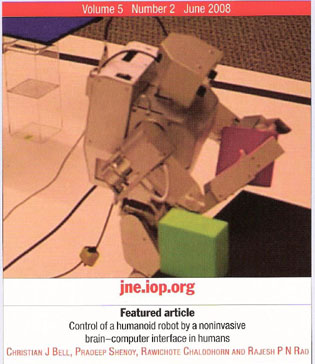
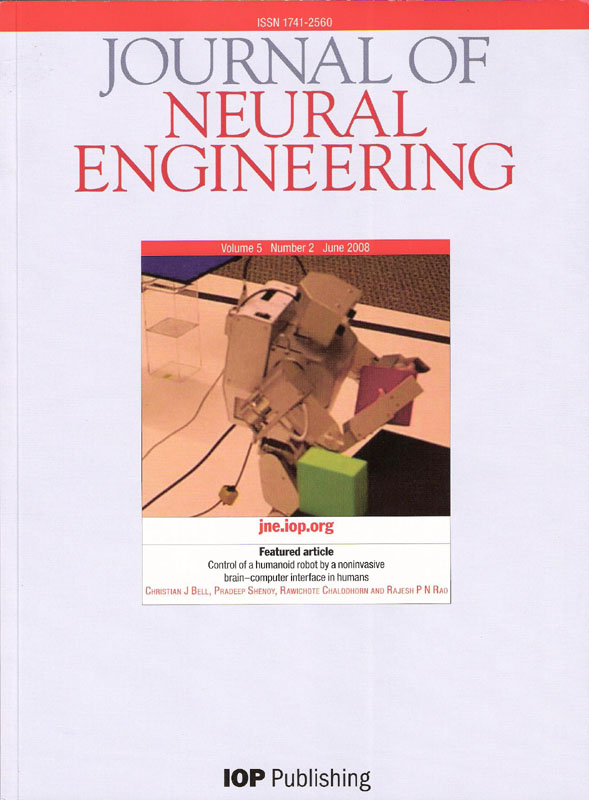
 Christian Bell, Pradeep Shenoy, Rawichote Chalodhom, and Raj Rao’s paper “Control of a humanoid robot by a non-invasive brain-computer interface in humans” was the featured article in the most recent issue of the Journal of Neural Engineering.
Full cover. Read more →
Read the article here.
“When I saw Photosynth for the first time about two years ago, it joined a small handful of new products that really captured my attention. The software arranges sets of photos in 3-D context and allows viewers to navigate fluidly from image to image, moving their gaze from a building’s facade to a detail shot of a specific fresco, for example.
“Photosynth is a distinctly Seattle invention. It emerged from a collaboration of University of Washington graduate student Noah Snavely and computer science professor Steven Seitz, with Microsoft researcher Richard Szeliski, as well as a Ballard startup Microsoft acquired. Now at least part of that team is at it again.
“In a paper presented at this week’s SIGGRAPH (a meeting of the world’s top computer graphics researchers), the UW/Microsoft team described the next iteration of their work …” Read more →