UW CSE’s Shayan Oveis Gharan is Honorable Mention in 2013 ACM Doctoral Dissertation Award competition

ShayanGharan_lgEach year, ACM recognizes a winner and one or two honorable mentions in its Doctoral Dissertation Award competition – the highest-impact dissertations among roughly 2,000 Ph.D.s granted.

UW CSE professor Shayan Oveis Gharan is one of two Honorable Mentions in the 2013 competition, announced this week.

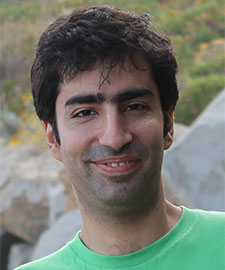
Shayan received his Ph.D. from Stanford last year.  He is spending the current year as a Miller Fellow at UC Berkeley and will join UW CSE during the 2014-15 academic year. His research involves the development of provably efficient algorithms for problems that seem intractable. He has worked on the classical Traveling Salesman Problem, on clustering in massive graphs using spectral methods, and on stochastic optimization. Along the way he has introduced many new techniques, like maximum entropy sampling and the use of higher eigenvalues of graphs, that can be used to tackle an array of other computational tasks.

UW CSE professor Shyam Gollakota won the 2012 ACM Doctoral Dissertation Award.  UW CSE Ph.D. alum Seth Cooper won the 2011 ACM Doctoral Dissertation Award.  UW CSE Ph.D. alum Noah Snavely was Honorable Mention in the 2009 ACM Doctoral Dissertation Award competition.

Go team!

Shayan has just finished his Ph.D. at Stanford.  He will spend next year as a Miller Fellow at UC Berkeley before joining us during the 2014-15 academic year.  His research involves the development of provably efficient algorithms for problems that seem intractable.  He has worked on the classical Traveling Salesman Problem (see an article about this work in Wired), on clustering in massive graphs using spectral methods, and on stochastic optimization.  Along the way he has introduced many new techniques, like maximum entropy sampling and the use of higher eigenvalues of graphs, that can be used to tackle an array of other computational tasks. – See more at: http://news.cs.washington.edu/2013/05/30/uw-cse-welcomes-shayan-oveis-gharan-zach-tatlock-to-faculty/#sthash.7cjQKjm6.dpufShayan has just finished his Ph.D. at Stanford. He will spend next year as a Miller Fellow at UC Berkeley before joining us during the 2014-15 academic year. His research involves the development of provably efficient algorithms for problems that seem intractable. He has worked on the classical Traveling Salesman Problem (see an article about this work in Wired), on clustering in massive graphs using spectral methods, and on stochastic optimization. Along the way he has introduced many new techniques, like maximum entropy sampling and the use of higher eigenvalues of graphs, that can be used to tackle an array of other computational tasks. – See more at: http://news.cs.washington.edu/2013/05/30/uw-cse-welcomes-shayan-oveis-gharan-zach-tatlock-to-faculty/#sthash.7cjQKjm6.dpuf
Shayan has just finished his Ph.D. at Stanford.  He will spend next year as a Miller Fellow at UC Berkeley before joining us during the 2014-15 academic year.  His research involves the development of provably efficient algorithms for problems that seem intractable.  He has worked on the classical Traveling Salesman Problem (see an article about this work in Wired), on clustering in massive graphs using spectral methods, and on stochastic optimization.  Along the way he has introduced many new techniques, like maximum entropy sampling and the use of higher eigenvalues of graphs, that can be used to tackle an array of other computational tasks. – See more at: http://news.cs.washington.edu/2013/05/30/uw-cse-welcomes-shayan-oveis-gharan-zach-tatlock-to-faculty/#sthash.7cjQKjm6.dpuf
Read more →

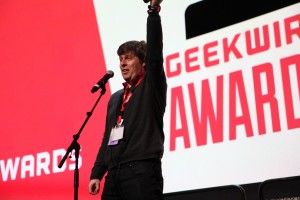
Madrona scores at GeekWire Awards

julie-sandler-largeCSE’s Oren Etzioni, GeekWire‘s “Hire of the Year,” is a long-time Venture Partner at Madrona Venture Group, which has backed several of his startups and more than a dozen UW CSE startups in all.

Additionally, our friend Julie Sandler, Principal at Madrona, is GeekWire‘s “Geek of the Year.”

Gregg-Gottesman-LargeAnd Rover.com, created by our friend Greg Gottesman, Managing Director at Madrona, is GeekWire‘s “Startup of the Year.”

Read about all the GeekWire Awards here. Read more →

CSE’s Oren Etzioni is GeekWire’s “Hire of the Year”

oren.gwLong-time CSE professor Oren Etzioni, recently departed to lead Paul Allen’s new Allen Institute for Artificial Intelligence, is GeekWire‘s “Hire of the Year”:

“Perhaps no one has been more synonymous with the startup ethos at the University of Washington than computer science professor Oren Etzioni, a mainstay on campus for more than two decades and an inspiration for budding entrepreneurs in academia.

“Etzioni moved on from academia after nearly 30 years this past September after Microsoft co-founder Paul Allen asked him to lead an ambitious new undertaking around the study of artificial intelligence, a multi-million dollar effort that could have huge implications for the region’s tech industry and, more importantly, society as a whole.

“Etzioni thanked his mother and wife after accepting the award tonight.

“‘She deserves ‘Wife of the Year,” Etzioni said of his spouse.”

Watch the award announcement and Oren’s acceptance remarks here.  Read the GeekWire article here. Read more →

NSF highlights student projects from UW Center for Sensorimotor Neural Engineering

Unicorb_Screenshot_03_fThe National Science Foundation highlights games created by students in UW’s NSF Engineering Research Center for Sensorimotor Neural Engineering:

“Tech Sandbox: The playground of neural engineering. University of Washington students compete in creating projects that demonstrate the core principles of neural engineering.”

Read more here. Learn about CSNE here. Read more →

What will you look like when you grow old?

iraThe Seattle Times gushes over UW CSE’s age progression software, created by Ira Kemelmacher-Schlizerman, Supasorn Suwajanakorn, and Steve Seitz:

“We also asked the program to age a number of others – from Miley Cyrus to Russell Wilson to Macklemore – to show them in their 60s. It showed us what Jimi Hendrix and Kurt Cobain would have looked like had they lived, to 71 and 47 this year, respectively.

“No wonder so many plastic surgeons get rich.”

Read more in the Seattle Times here.  Learn about the research here.

(Addendum: This was the #1 most-read article in the online Seattle Times!) Read more →

Code.org @ UW

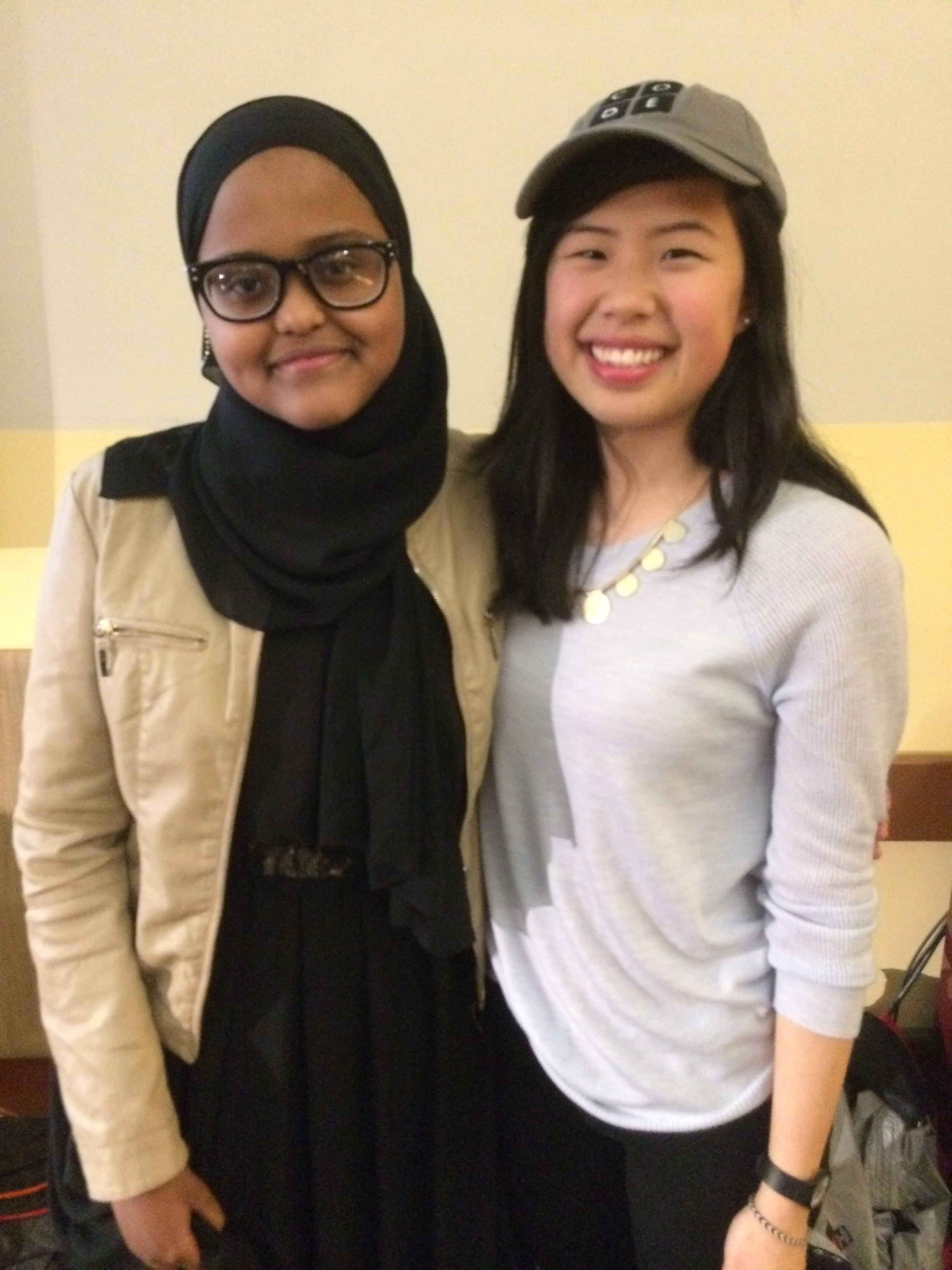
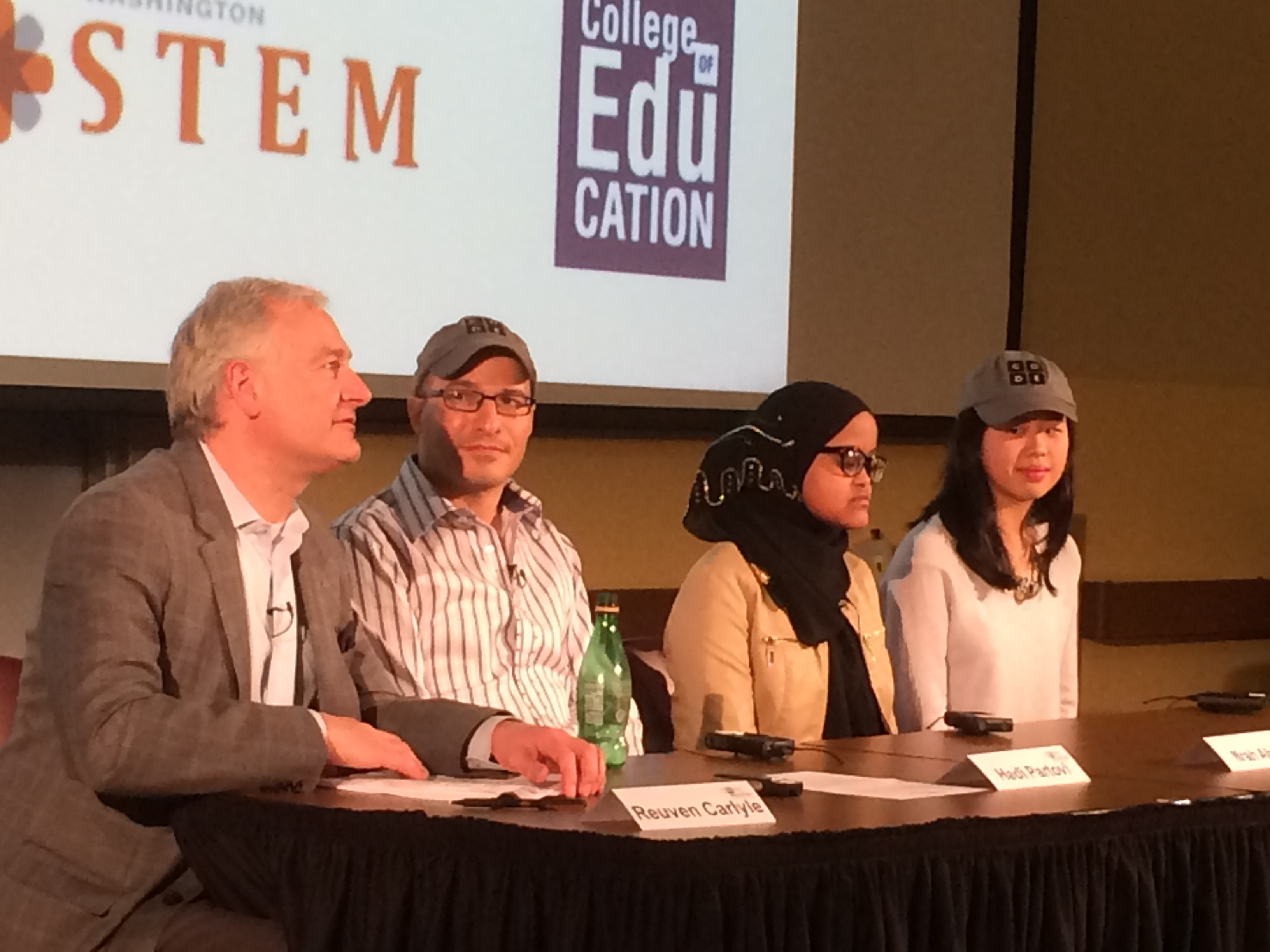
IMG_2841 IMG_2843 IMG_2844This evening UW welcomed Hadi Partovi of Code.org at the Washington Education Innovation Forum, organized by the Center for Reinventing Public Education.  UW CSE, the UW College of Education, and Washington STEM co-sponsored the event.

State Representative Reuven Carlyle – known for advocating policies that pass the common sense sniff test – emceed a panel that included two Seattle-area high school students in addition to Hadi: Ifrah Abshir, a sophomore at Rainier Beach High School, and Megan Fu, a junior at Holy Names Academy (and a counselor at last summer’s UW CSE summer day camps for middle school students).

Hadi and Code.org have not just moved the needle, they have pinned the needle!  Tonight’s conversation was inspiring! Read more →

CSE’s Karl Koscher on WXXI/NPR Connections “Science Roundtable”

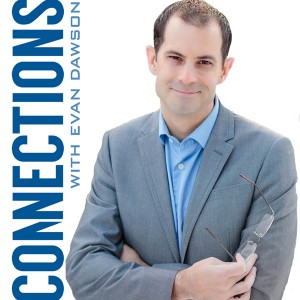
Connections_News_HighlightToday’s monthly “Science Roundtable” on WXXI/NPR Connections featured UW CSE Ph.D. student Karl Koscher discussing online security in the wake of Heartbleed, former UW CSE faculty member (and current University of Rochester department chair) Henry Kautz discussing artificial intelligence, and Henry’s Ph.D. alum (and current Google[x] data scientist) Adam Sadilek discussing trend-tracking via Twitter.

Listen here. Read more →

Seattle: Top of the tech cities for recent college grads

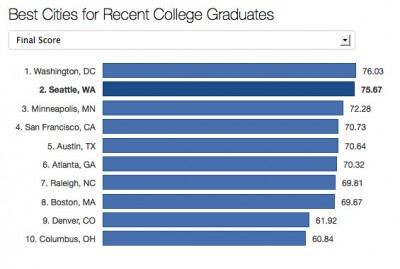
UntitledNerdWallet set about to identify the best cities for recent college graduates.  Seattle, at #2 behind Washington DC, beat out San Francisco (#4), Austin (#5), Atlanta (#6), Raleigh (#7), Boston (#8), San Diego (#11), and San Jose (#13).  New York didn’t make the top 20.

Admission: If we hadn’t ranked at the top, our reaction to this survey would have been “Who the hell is NerdWallet?”  But since we did, check out the survey here! Read more →

Code.org founder Hadi Partovi to speak at UW on May 8

11338404406_e73c309476_z1In December, more than 20 million students around the globe participated in the Hour of Code, organized by Code.org – a Seattle-based non-profit dedicated to expanding participation in computer science. The event allowed students to try their hand at coding and prompted discussions among policymakers and educators about how to provide students with greater access to computer science education.

That discussion – and Hadi Partovi, co-founder and CEO of Code.org – will come to the University of Washington’s Seattle campus May 8 for the Washington Education Innovation Forum.

Join us on Thursday May 8 at Kane Hall Room 110. Doors open at 6:30 p.m., and the event and live-streaming on UWTV will begin at 7 p.m. Free registration is on EventBrite. Read more →

Solving word problems by computer

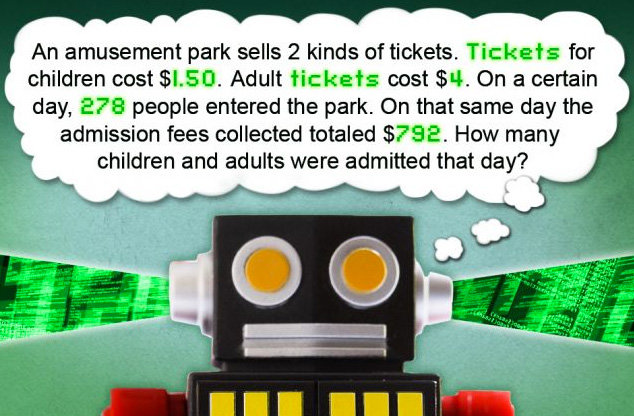
UntitledUW CSE’s Yoav Artzi and Luke Zettlemoyer and MIT CSAIL’s Regina Barzilay and Nate Kushman have developed a new computer system that can automatically solve the type of word problems common in introductory algebra classes.  The work will be presented at the annual meeting of the Association for Computational Linguistics in June.

In the near term, the work could lead to educational tools that identify errors in students’ reasoning or evaluate the difficulty of word problems. But it may also point toward systems that can solve more complicated problems in geometry, physics, and finance – problems whose solutions don’t appear in the back of the teacher’s edition of a textbook.

Read an MIT News post here.  Check out the research paper here. Read more →

« Newer PostsOlder Posts »