
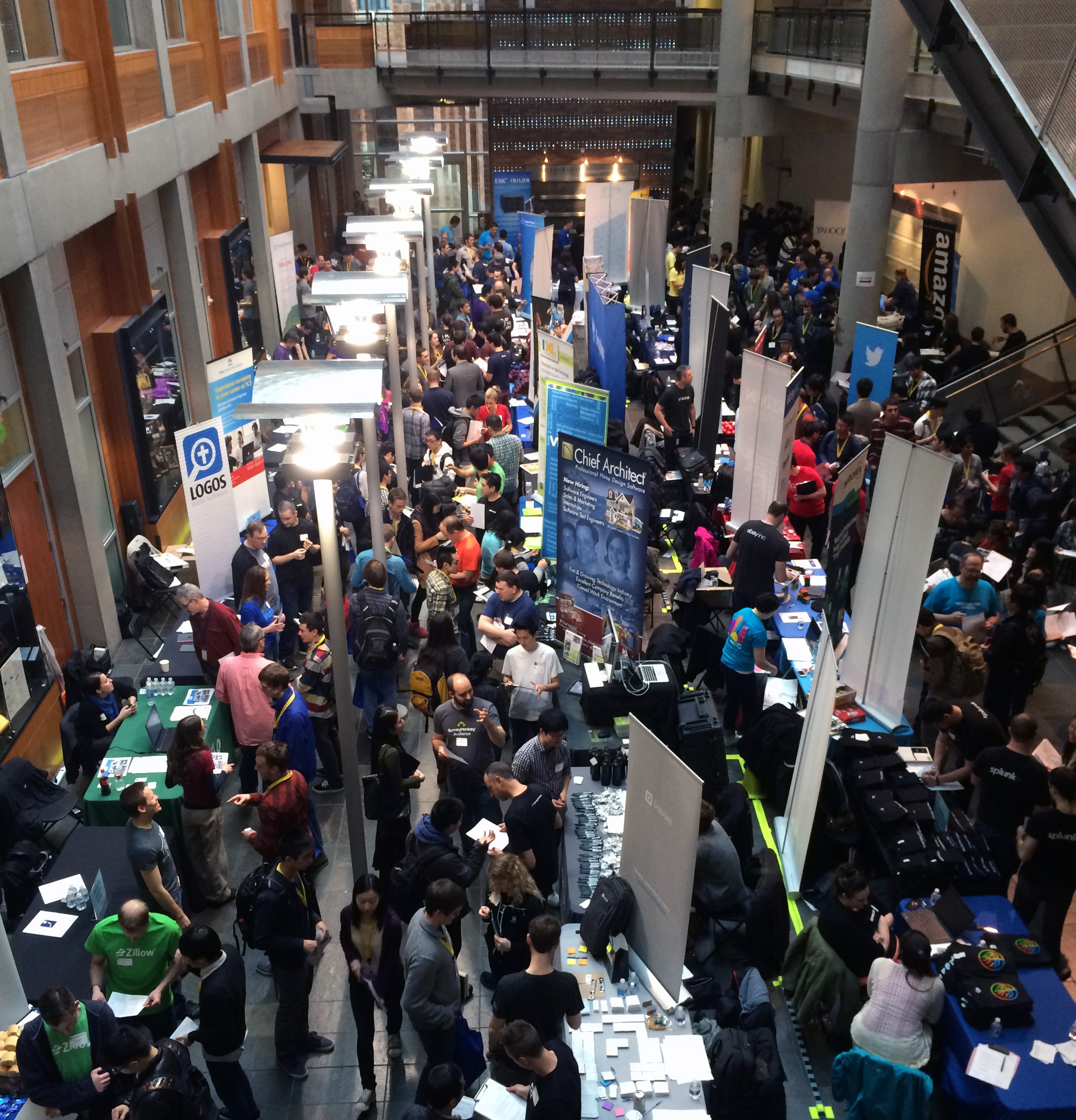
 They’re all here – from Amazon to Zillow. What we need is additional capacity, so that we can enroll all of the great Washington State students who want a UW CSE education and the access it provides to these opportunities. Read more →

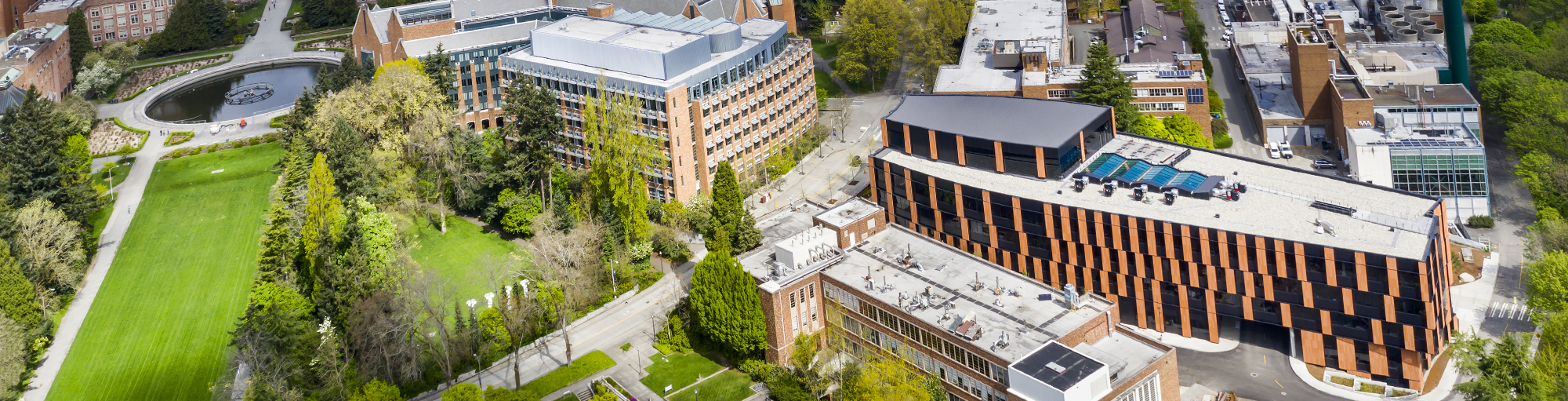
UW CSE winter recruiting event for established companies
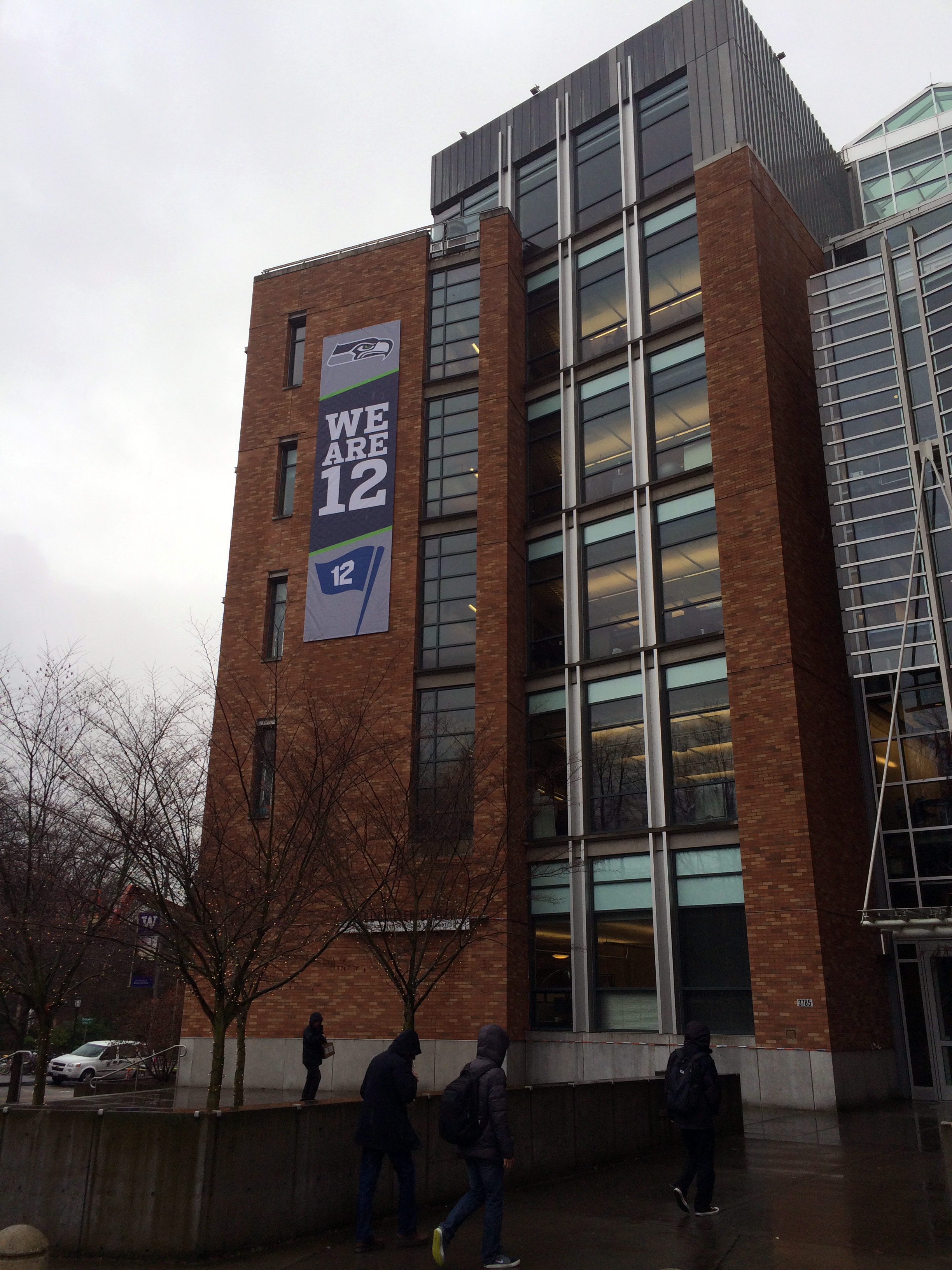
UW CSE winter recruiting event for startups and small companies
 UW CSE runs two recruiting events annually for our students and our industry affiliates – one in October and one in January.
Each lasts two days – one day for startups and small companies, one day for larger established companies.
Today was the winter recruiting event for startups and small companies. Participating companies ranged from a16z (Andreessen Horowitz) to Weebly. (The winter recruiting event for larger established companies – tomorrow – truly runs from A (Amazon) to Z (Zillow).) Read more →
UW CSE bids farewell to UW-Tacoma Chancellor Debra Friedman
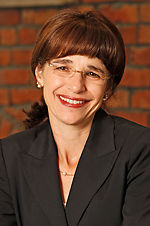 UW-Tacoma Chancellor Debra Friedman succumbed to cancer on Sunday morning.
At UW-Tacoma, and before that on the Seattle campus, Debra was a leader who understood why we’re here, and who worked tirelessly to facilitate the people and programs that were doing it right.
Debra was special. She will be sorely missed.
UW Tacoma memorial page, with links to many tributes, here. Read more →
Shwetak Patel, Dave Eaton in Seattle Times on “Why Tesla?”
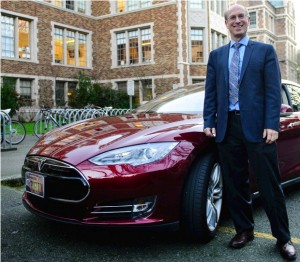
Dave Eaton and his Tesla Model S
UW CSE and EE professor Shwetak Patel and UW Dean of the Graduate School Dave Eaton are two of Washington State’s Tesla Model S owners. They’re interviewed in today’s Seattle Times:
“‘We’re subsidizing the future car,’ said Shwetak Patel … He never thought he’s spend so much on a car, but that was never the only thing they were buying.”
Read more on the Seattle Times website here. Pdf here. Read more →
IEEE to honor UW CSE alumnus Gary Kildall with “Milestone”
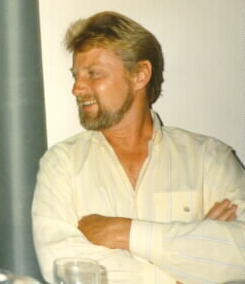 The IEEE Milestones in Electrical Engineering and Computing program honors significant technical achievements in all areas associated with IEEE. It is a program of the IEEE History Committee, administered through the IEEE History Center.
IEEE has formally approved a Milestone recognizing UW CSE alumnus Gary Kildall for the creation of CP/M. The Milestone plaque will be installed in the sidewalk at 801 Lighthouse Avenue in Pacific Grove CA, home of Gary’s Digital Research office, in a ceremony on April 25 2014. The plaque will read:
Birth of the PC Operating System, 1974
Dr. Gary A. Kildall demonstrated the first working prototype of CP/M (Control Program for Microcomputers) in Pacific Grove in 1974. Together with his invention of the BIOS (Basic Input Output System), Kildall’s operating system allowed a microprocessor-based computer to communicate with a disk drive storage unit and provided the software foundation for the personal computer revolution.
As a student at the University of Washington, Gary received three degrees: a Bachelor’s degree in Mathematics in 1967, a Master’s degree in Computer Science in 1968, and a Ph.D. in Computer Science in 1972. He was hired as an assistant professor at the Naval Postgraduate School in Monterey, and later joined Intel Corporation to write programming tools for the Intel 4004 microprocessor.
A pioneer in the computer revolution, Gary developed CP/M, which became the dominant microcomputer operating system of the 1970s. He was one of the first people to recognize that even the early, simple microprocessors could support a complete minicomputer-style operating system, and he created an editor, assembler, linker, and loader, along with the first file system to use floppy disks as a general-purpose storage medium. As personal computers began to be used, he saw that their true potential would be in connectivity, so he developed extensions to CP/M that let computers share files and peripheral devices over a network.
Gary’s company, Digital Research, Inc., introduced operating systems with windowing capability, preemptive multitasking, and menu-driven user interfaces years before Apple and Microsoft. He also created the first practical open-system architecture, which allowed operating systems and application programs to be independent of the specific machines on which they ran. A firm believer that life and work should be fun, Gary also developed an early computer-based arcade game as well as precursors to current interactive multimedia.
Gary passed away in 1994, at the age of 52. Recognition of his extraordinary accomplishments has increased with his inclusion in the wonderful 2004 book and PBS television series They Made America – brief excerpt from the detailed Kildall chapter here. Previous tributes here, here, and here. Recent Facebook tribute page, “Legacy of Gary Kildall,” here.
(Interesting bit of history: Tim Paterson, whose QDOS was purchased by Microsoft as the foundation for MS-DOS when IBM came knocking, also is a UW CSE alumnus – B.S. ’78. So whichever OS IBM chose, it was going to be an OS written by a UW CSE alumnus.) Read more →
CSE’s Crowley, Fiuczynski, Baer, and Bershad honored by International Conference on Supercomputing
 The paper “Characterizing Processor Architectures for Programmable Network Interfaces,” which appeared in the International Conference on Supercomputing in 2000, is one of 35 papers selected for inclusion in the retrospective volume 25 Years of the International Conference on Supercomputing.
The selection committee considered the 100 most cited papers out of approximately 1,800 papers published in the ICS proceedings between 1987 and 2011, selecting the 35 most influential.
Congratulations to authors Patrick Crowley (then a UW CSE Ph.D. student, now a professor at Washington University), Marc Fiuczynski (then a UW CSE Ph.D. student, now Principal Architect at Akamai Technologies), Jean-Loup Baer (then a UW CSE faculty member, now emeritus), and Brian Bershad (then a UW CSE faculty member, now with Google). Read more →
CSE’s Tracy Erbeck paces World’s Largest Kettlebell Workout
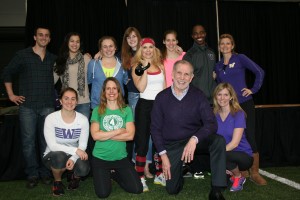
Tracy’s the one in green, next to President Young
We’ve been wondering what Allen Center building manager Tracy Erbeck was doing down in the Allen Center loading dock area at lunchtime every day. And those klunky things sitting on her desk didn’t look quite like curling stones.
Now we know.
Tracy joined University of Washington President Michael Young, his wife Marti Young, and more than 1,000 of their closest friends today in an attempt to set a Guinness record for the World’s Largest Kettlebell Workout – part of UW’s “Whole U” employee engagement initiative.
(If it was Kettlecorn, we’d be there with her …) Read more →
UW startup SNUPI in MIT Technology Review
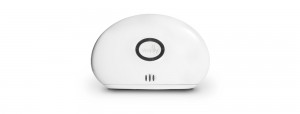 “Earlier this month, as Google was snatching up the smart-thermostat maker Nest for $3.2 billion, a lesser known home sensor company made its own announcement. SNUPI Technologies, a Seattle startup, said it had garnered $7.5 million in funding. That might be pocket change compared to the Nest deal, but it was a significant endorsement just ahead of SNUPI’s first product launch: a low-power wireless sensor network called WallyHome that tracks humidity, water leaks, and temperature throughout a building.”
SNUPI’s “parents” are UW CSE+EE faculty members Shwetak Patel and Matt Reynolds, UW EE graduating Ph.D. student Gabe Cohn, and UW CSE alum Jeremy Jaech.
Read more in MIT Technology Review here. Learn more about SNUPI here. Read more →
Twitter’s Seattle engineering facility
 Seattle is the site of Twitter’s first organically grown engineering office away from the mother ship (the company’s Boston and New York City outposts resulted from acquisitions).
Chris Fry, Twitter’s Senior VP of Engineering, and Raffi Krikorian, VP of Platform Engineering, flew up to Seattle this week to check out the new digs.
Krikorian tells GeekWire that Twitter has always hired people from the Seattle area, so it was only natural to open up a permanent office here. “A lot of people come from the major technology companies here, and we also love University of Washington grads.”
Fry says “Seattle has all the right ingredients: Major tech companies, great universities and a startup scene that does a ton of innovation.”
Read more in GeekWire here. Read more →