

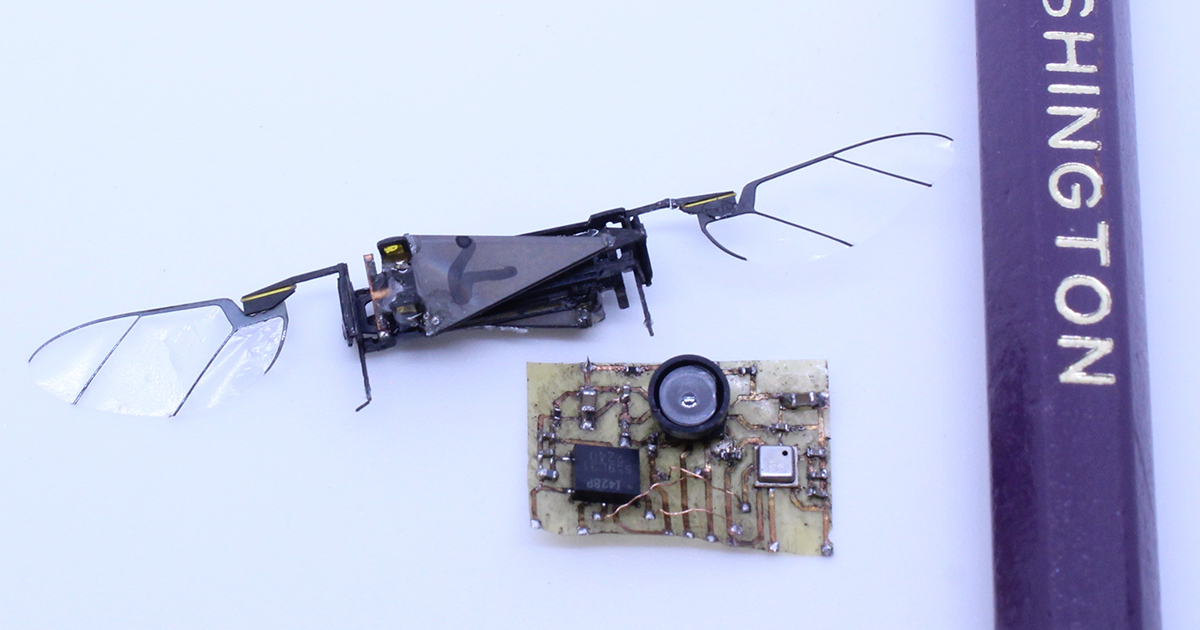
Flying insect robots (FIRs) have the potential for use in search and rescue operations, environmental monitoring and even space missions due to their small size and low material cost. The challenge, however, is finding the minimum sensor suite and computation resources, or avionics, needed for the robot to maintain flight and control.
A team of researchers in the University of Washington’s Autonomous Insect Robotics (AIR) Lab developed TinySense, the current lightest avionics system with the potential for FIR sensor autonomy. Smaller than the size of a penny and less than half the size of the previous lightest avionics system, TinySense features a global shutter camera, a gyroscope and a pressure sensor to help the FIR estimate the different variables needed to control hover — pitch angle, translational velocity and altitude. The team presented their research titled “TinySense: A Lighter Weight and More Power-efficient Avionics System for Flying Insect-scale Robots” at 2025 IEEE International Conference on Robotics and Automation (ICRA) and received the Best Student Paper Award.
“Despite huge progress towards flying insect robots like the UW’s RoboFly and Harvard’s RoboBee, none have yet been able to fly using only sensors carried onboard,” said co-lead author and Allen School undergraduate student Joshua Tran. “The TinySense is light and efficient enough to finally make this feat a possibility, and opens the door to many other tiny flying applications like the TinyQuad and Coincopter, gram-scale propeller drones also from our lab.”

TinySense builds on and improves previous FIR sensor suites from the AIR Lab to create an avionics system that is even better tailored in mass and energy consumption for an insect-scale robot. To help reduce the system’s mass and power needs, the team first replaced the power-hungry laser rangefinder with a lighter and more efficient Bosch BMP390 pressure sensor. They then replaced the bulky optic flow sensor with a novel global shutter camera and a custom-written optic flow algorithm running on a 10 milligram microcontroller — small enough to fly onboard an FIR. TinySense weighs approximately 75 milligrams and uses about 15 milliwatts of power to fly.
“The team made important contributions in a number of areas that hadn’t previously been addressed because nobody has been thinking deeply about how to make flight controllers really efficient and lightweight. They built a new ultra-light flex circuit, their own camera optics and then performed extensive validation on the full system they created,” said senior author Sawyer Fuller, UW Department of Mechanical Engineering professor and Allen School adjunct faculty member.
The team demonstrated the TinySense sensor suite onboard the Crazyflie, the smallest commercially available sensor-autonomous flying robot, and found that TinySense had a comparable performance to the industry-standard sensors on the Crazyflie. In future work, the team aims to integrate TinySense into Robofly so that it will be able to, for the first time, hover without needing external sensors.

“It was exciting to hear the interest in the TinySense project and its future integration with the Robofly at the ICRA conference,” said co-author and Allen School undergraduate student Claire Li.
For co-lead author and mechanical engineering Ph.D. student Zhitao Yu, working on TinySense also gave him the opportunity to help mentor the next generation of researchers.
“Mentoring Josh and Claire was a rewarding experience on this project,” said Yu. “It was great to see them grow into confident researchers and contribute meaningfully to such a challenging and impactful system.”
Additional authors include Yu’s fellow Ph.D. students Aaron Weber and Yash Talwekar.
Read the full paper on TinySense and a related Department of Mechanical Engineering story.