
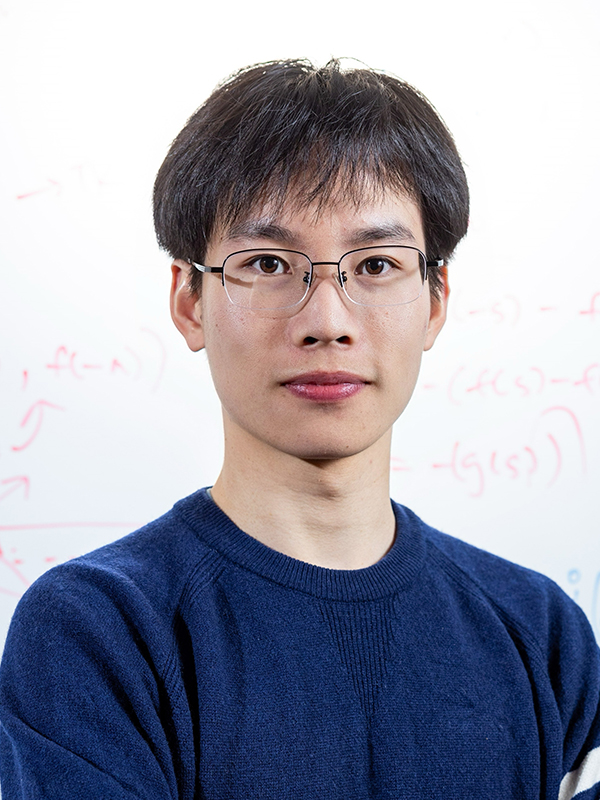
From developing recyclable electronics to leveraging artificial intelligence in estimating carbon footprints, Allen School Ph.D. student Zhihan Zhang is tackling the challenge of sustainability on multiple fronts.
“The goal is to build a new generation of ubiquitous computing that is sustainable by design — from its physical materials to accelerated decision-making by autonomous AI — and in how it values human effort and ultimately augments everyone’s health,” Zhang said. “This is a massive, interdisciplinary problem. Our current computing ecosystem was not designed for this, so we can’t just solve it with better software or AI models.”
In his research, Zhang, who is co-advised by Allen School professors Vikram Iyer and Shwetak Patel, focuses on sustainable ubiquitous computing. He aims to reimagine computing ecosystems by integrating emerging sustainable materials and new sensing paradigms. For his contributions, Zhang was awarded a 2025 Google Ph.D. Fellowship in health research. The fellowship supports exceptional graduate students from around the world who represent “the next generation of scientists focused on critical foundational science.”
Printed circuit boards (PCBs) make up a large portion of the world’s environmentally hazardous electronic waste — almost all electronic devices contain a PCB, and their interconnected parts make them nearly impossible to recycle. As a more sustainable alternative, Zhang and his collaborators introduced a new PCB that can be repeatedly recycled with minimal material loss and performs on par with traditional PCBs made of hard plastic. The team found that these new PCBs could lead to an almost 50% reduction in the global warming potential compared to conventional PCBs.
Beyond reducing electronic waste, Zhang develops AI models to help users better understand the environmental impact of everyday decisions. Life Cycle Assessments (LCAs) provide a framework for evaluating the environmental impact of a product, service or process throughout its entire life cycle, but they can be difficult for non-experts to navigate. To help bridge this gap, Zhang and his team introduced the first autonomous sustainability assessment tool that transforms unstructured natural language descriptions into interactive environmental impact visualizations. He also helped reimagine the labor-intensive process of LCAs in another way through a multi-agent AI system that can autonomously generate life cycle inventories and estimate the environmental impact of electronic devices using public data sources.
For Zhang, however, sustainability extends beyond addressing climate change to encompass issues such as personal health and public well-being. Alongside a team of Google researchers, Zhang helped develop a personal health agent that analyzes data from wearable devices and medical records to provide personalized, evidence-based guidance.
“It’s been incredible to see the breadth and depth of Zhihan’s research on how his work in AI touches sustainability, health, materials, sensing and HCI,” said Patel, who holds the Washington Research Foundation Entrepreneurship Professor in Computer Science & Engineering and Electrical & Computer Engineering.
Next, Zhang plans to launch a startup to help translate his research into more practical, real-world solutions. He is also designing agentic workflows to automate diverse scientific challenges including large AI models for sustainable material discovery and seismological analysis.
In addition to receiving a Google Ph.D. Fellowship, Zhang has also been named a Heidelberg Laureate Forum Young Researcher and has received a Bob Bandes Award honorable mention, which recognizes exceptional teaching assistants in the Allen School.
“Zhihan stands out for his breadth, transcending disciplinary boundaries to tackle hard problems in sustainability across the computing stack,” Iyer said. “He can both fabricate recyclable circuits in a wet lab and build AI systems to automatically calculate a device’s carbon footprint. I’m excited for his next steps applying insights from this work on sustainability to a broader set of impactful problems in health care and accelerating scientific discovery.”
Read more about the Google Ph.D. Fellowship here.