

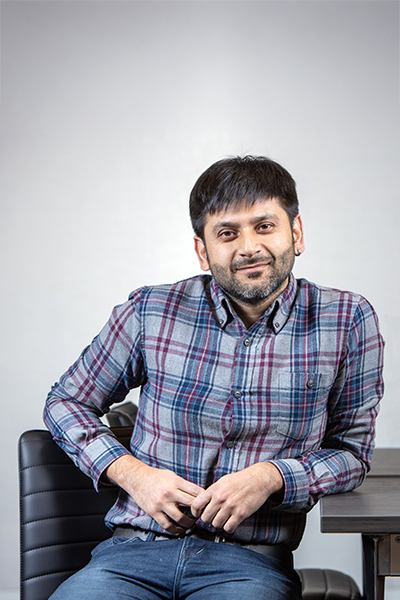
As a computer systems researcher, Allen School professor and alum Ratul Mahajan (Ph.D., ‘05) has helped develop technologies powering the networks that support multiple aspects of modern society — from operating online banking accounts to scrolling social media.
The Association for Computing Machinery (ACM) recognized Mahajan among its 2025 class of ACM Fellows for his groundbreaking “contributions to network verification and network control systems and their transfer to industrial practice.” The ACM Fellows are selected by their peers and represent the top 1% of members who have provided notable technical innovations and/or service to the field of computing.
“I love developing systems with new operational paradigms that can bring about a step change in efficiency or performance and developing techniques that provide strong guarantees about robustness of large-scale systems,” said Mahajan, a member of the Allen School’s Computer Systems Lab and co-director of the UW Center for the Future of Cloud Infrastructure (FOCI). “And I doubly love it when my work has real-world impact and changes practice.”
Mahajan has helped make network verification techniques mainstream across both industry and academia. He introduced Batfish, an open source network configuration analysis tool that proactively ensures that planned network configuration changes operate as intended. His work on Batfish, one of the earliest and most widely-adopted network verification platforms, was recognized with the SIGCOMM Networking Systems Award. In collaboration with colleagues across academia and industry, Mahajan has developed several other control plane analysis technologies. Minesweeper is able to verify the accuracy of all combinations of external routing messages and failures; Bonsai speeds up analysis by leveraging symmetries within large networks; and ARC does that via specialized graph-based encodings.
The technology behind Batfish and his other methods were commercialized by Intentionet, where Mahajan was the co-founder and CEO until the company was later acquired by Amazon. Today, more than 75 companies worldwide rely on Intentionet’s technology to help design and test their networks.
In his other vein of work, Mahajan focuses on developing systems that allow for the direct control of large-scale infrastructure. Historically, the control of large-scale infrastructure has been indirect, requiring engineers to tweak local, low-level parameters for routers to generate global system behavior. However, as more and more cloud operators provide their own global infrastructure, indirect control can lead to poor efficiency and reliability. Before joining the Allen School faculty, Mahajan was at Microsoft, where he and his collaborators developed SWAN. That system increases the utilization of inter-datacenter networks by directly controlling the amount of traffic each service sends, as well as frequently reconfiguring the dataplane to match traffic demands. Prior to SWAN, using indirect control settings, the busiest links had an average utilization of between 40 to 60%; the switch to SWAN achieved an almost 100% utilization rate.
Mahajan has also extended direct control to the entire infrastructure for delivering online services. He and his team introduced the Footprint system, which leverages dynamics of an integrated setting to boost efficiency and performance. In simulations partially deploying Footprint in the Microsoft infrastructure, they found that it could carry at least 50% more traffic and reduce user delays by at least 30% compared to current methods. Mahajan also helped develop Statesman, a network-management service that enables multiple direct-control applications to safely operate over shared infrastructure.
“The centralized management and control of network infrastructure that Ratul developed transformed Microsoft’s cloud infrastructure,” said Victor Bahl, technical fellow and chief technical officer for Azure operations at the company. “SWAN now carries over 90% of the traffic in and out of Microsoft’s datacenters, a footprint spanning over 280,000 kilometers of fiber and over 150 points of presence across all Azure regions; Footprint has evolved into Microsoft’s content distribution network; and Statesman is deployed across most Microsoft datacenters.”
Prior to his elevation to ACM Fellow, Mahajan was recognized as an ACM SIGCOMM Rising Star and Microsoft Research Graduate Fellow. His research has also received the ACM SIGCOMM Test-of-Time Award, the IEEE Communications Society William R. Bennett Prize, and multiple Best Paper awards.
Read more about the 2025 ACM Fellows.