
From a robotic arm that learns how to pick up new objects in real time, to a model that converts 2D videos into 3D virtual reality, to a curious chatbot that adapts to its users, to machine learning techniques for decoding the brain (and so much more), the 2025 edition of the annual Research Showcase and Open House highlighted the breadth and depth of computing innovation coming out of the Allen School.
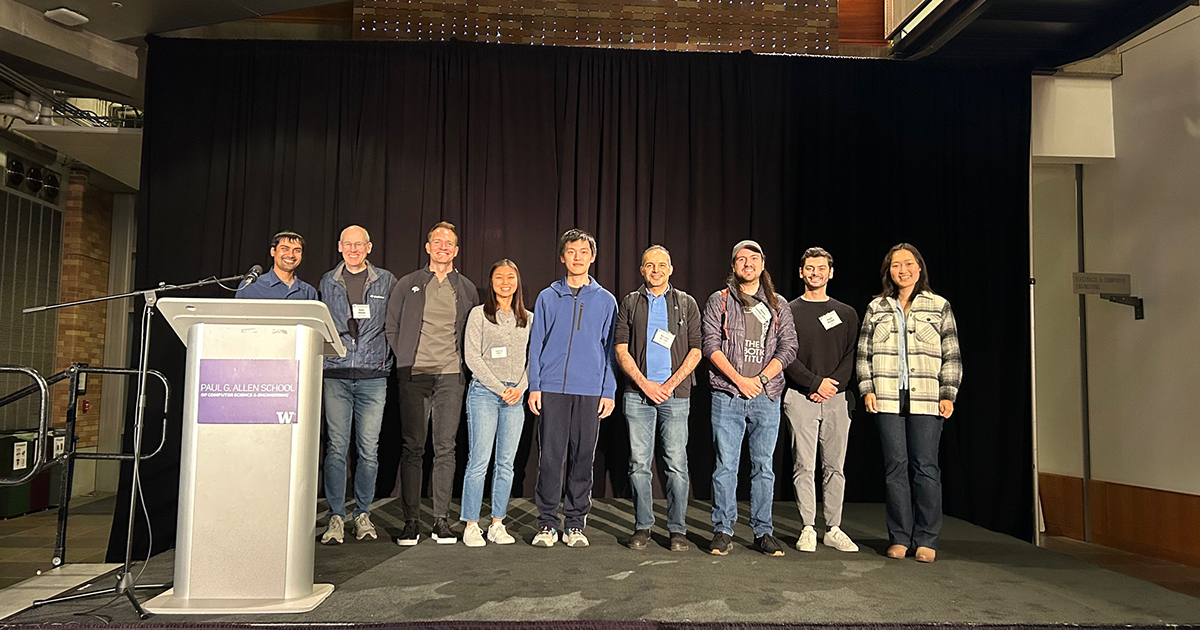
Last week, roughly 400 Industry Affiliate partners, alumni and friends gathered on the University of Washington campus to learn how the school is working toward solutions to a set of “grand challenges” to benefit society, in which the Allen School is uniquely positioned to lead; participate in technical sessions covering a range of topics, from artificial intelligence to sustainable technologies; and explore how researchers are leveraging machine learning to decode causality, learning and communication in the brain during a luncheon keynote; and learn about more than 80 research projects directly from the student researchers themselves at the evening poster session and open house — including those who walked away with the coveted Madrona Venture Prize or People’s Choice Award.
Unlocking the mysteries of brain learning with the help of machine learning
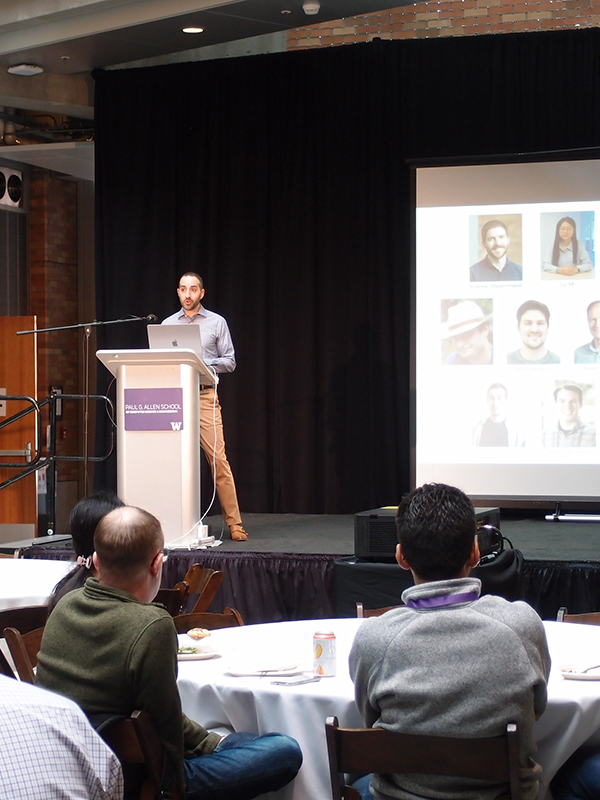
In his luncheon keynote, Allen School professor Matt Golub shared recent research from the Systems Neuroscience and AI Lab (SNAIL) that uses machine learning techniques to better understand how the brain performs computations such as decision-making and learning — insights that could, in turn, inform future developments in AI. Previous work has focused on reconstructing neuron connections ex vivo, or outside of the body, by looking at thin sections of the brain under a microscope. Instead, Golub and his team analyze active neural activity.
“If we can crack these problems, that will set us up in future work to understand how different brain networks perform distributed computation through their connections, through the dynamics of the activity that flows through those connections,” Golub said. “Then, we can ask how the connections change as the brain learns. We might be able to discover the learning rules that govern synaptic plasticity.”
Golub and his collaborators introduced a novel approach for analyzing neural population dynamics with optogenetics and computational modeling. Using lasers, the researchers targeted neurons to stimulate their activity; if they hit one neuron with the laser and another one fired reliably, they inferred a connection between the two. Because these experiments are resource intensive, the researchers designed an active learning algorithm that selected these stimulation patterns, or chose specific neurons to target with the laser, so that they could learn an accurate model of the neural network with as little data as possible.
Zooming out for a higher-level view, Golub and his team also developed a new machine learning method that can identify communication between entire regions of the brain. The technique, called Multi-Region Latent Factor Analysis via Dynamical Systems (MR-LFADS), uses multi-region neural activity data to untangle how different parts of the brain talk to each other. Unlike existing approaches, MR-LFADS observes what unobserved brain regions are likely saying as well — the team’s custom deep learning architecture can detect when a recorded region reflects an unobserved influence. When applied to real neural recordings, the researchers found that MR-LFADS could predict how disrupting one brain region would affect another, which were effects that the system had never seen before.
Moving forward, Golub said that he is thinking about “the nexus of these two fronts.” In particular, he is interested in advancing active learning in nonlinear models and other deep learning models that can help generate AI-guided causal manipulations — experiments where the model can tell researchers what data it needs to improve.
“All of this is aimed at trying to understand how our brains compute and learn to drive our flexible behavior, and advances there can and have inspired innovation in AI systems and for new approaches to improving the health and function of our brains,” Golub said.
‘Quite a lot of amazing research’
The event culminated with the evening poster session and announcement of the Madrona Prize, an annual tradition in which Madrona Venture Group recognizes innovative student research with commercial potential. Past award winners have gone on to raise hundreds of millions of dollars in venture capital and build companies that have been acquired by tech giants such as Google and NVIDIA.
Sabrina Albert, a partner in the firm, presented the 2025 prize to the winner and two runners-up.
“There is quite a lot of amazing research that you guys are working on, so it was quite a challenge to pick which ones were most exciting,” Albert said.
Madrona Prize Winner / Enhancing Personalized Multi-Turn Dialogue with Curiosity Reward
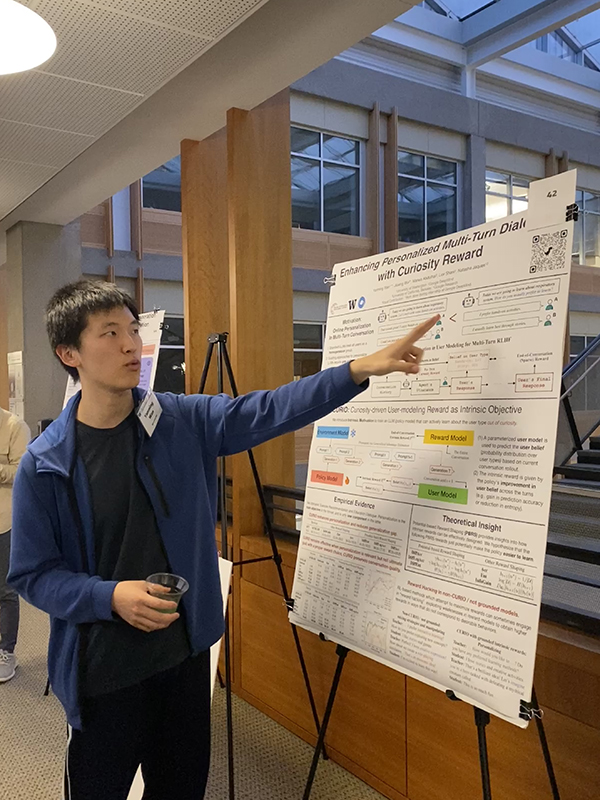
Allen School Ph.D. student Yanming Wan accepted the grand prize for CURIO, or Curiosity-driven User-modeling Reward as Intrinsic Objective. This new framework enhances personalization in large language models (LLMs) on multi-turn conversations.
Conversational agents need to be able to adapt to varying user preferences and personalities as well as diverse domains such as education or health care. However, conventional methods for training LLMs often struggle with personalization because they require pre-collected user data, making them less effective for new or content-limited users.
To solve this problem, Wan and the team introduced an intrinsic motivation reward model that enables LLMs to actively learn about the user out of curiosity and then adapt to their individual preferences during the conversation.
“We propose leveraging a user model to incorporate a curiosity-based intrinsic reward into multi-turn Reinforcement Learning from Human Feedback (RLHF),” said Wan. “This novel reward mechanism encourages the LLM agent to actively infer user traits by optimizing conversations to improve its user model’s belief. Consequently, the agent delivers more personalized interactions by learning more about the user across turns.”
Additional members of the research team include Allen School professor Natasha Jaques, Jiaxing Wu of Google DeepMind, Lior Shani of Google Research and Marwa Abdulhai, a Ph.D. student at University of California, Berkeley.
Madrona Prize Runner-up / VAMOS: A Hierarchical Vision-Language-Action Model for Capability-Modulated and Steerable Navigation
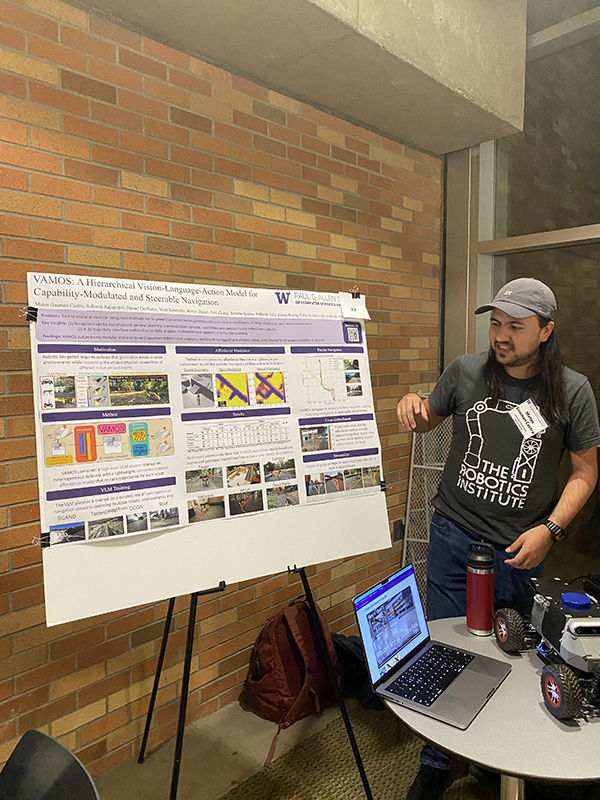
Another research team received accolades for VAMOS, a hierarchical vision language-action (VLA) model that helps robots navigate across diverse environments. In both real-world indoor and outdoor navigation courses, VAMOS achieved a three times higher success compared to other state-of-the-art models.
“Contrary to the belief that simply scaling up data improves generalization, we found that mixing data from many robots and environments can actually hurt performance — since not all robots can perform the same actions or handle the same terrains,” said Allen School Ph.D. student Mateo Guaman Castro, who accepted the award on behalf of the team. “Our system, VAMOS, tackles this by decomposing navigation into a hierarchy: a high-level VLM planner proposes multiple possible paths, and a robot-specific ‘affordance modulator,’ trained safely in simulation, selects the path best suited to the robot’s physical abilities.”
The VAMOS research team also includes Allen School professors Byron Boots and Abhishek Gupta; Ph.D. students Rohan Baijal, Rosario Scalise and Sidharth Talia; undergraduate students Sidharth Rajagopal and Daniel Gorbatov; alumni Matt Schmittle (Ph.D., ‘25), now at OverlandAI, and Octi Zhang (B.S., ‘25), now at NVIDIA; Celso de Melo of the U.S. Army DEVCOM Research Laboratory; and Emma Romig, Robotics Lab director at the Allen School.
Madrona Prize Runner-up / Dynamic 6DOF VR Reconstruction from Monocular Videos
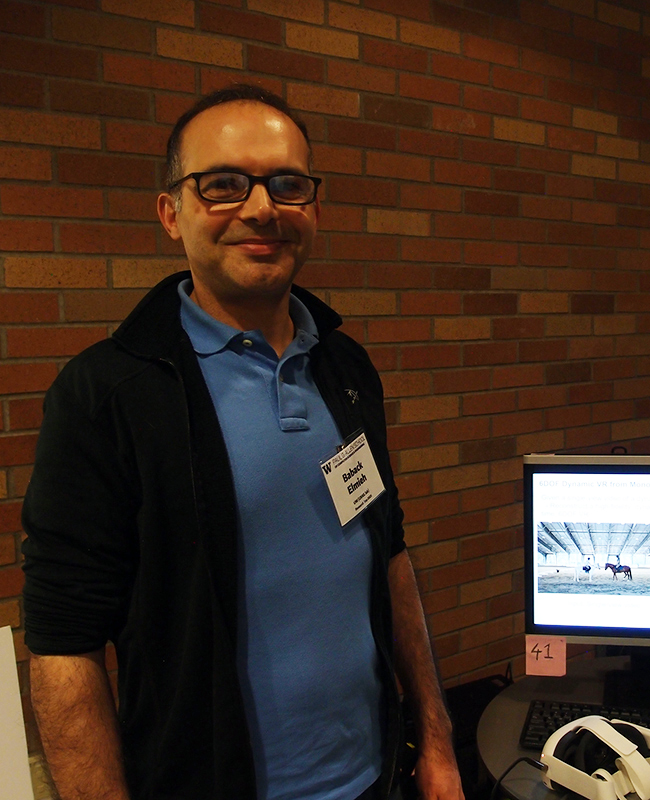
Allen School researchers were also recognized for their research that transforms two-dimensional videos into a dynamic three-dimensional scene that users can experience in immersive virtual reality (VR) — revealing additional depth, motion and perspective.
“A key challenge is figuring out the 3D world from a single, flat video,” said Ph.D. student Baback Elmieh, who accepted the prize. “To address this, we first use an AI model to ‘imagine’ what the scene looks like from many different angles. We then use a new technique that models the scene’s overall motion while simultaneously fine-tuning the details in each frame. This combined approach allows us to handle fast-moving action, making progress towards reliving 2D videos or even historic moments as dynamic 3D experiences.”
Elmieh developed the project working with Allen School professors Steve Seitz, Ira Kemelmacher-Shlizerman and Brian Curless.
People’s Choice Award / MolmoAct
Rounding out the evening was the announcement of the People’s Choice Award, where attendees voted for their favorite poster or demo.
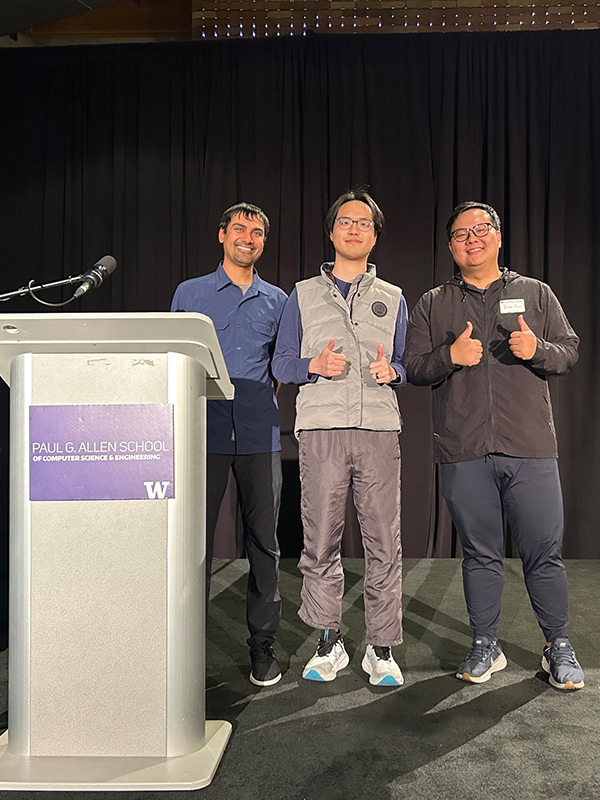
Shwetak Patel, the Allen School’s director for development and entrepreneurship and the Washington Research Foundation Entrepreneurship Endowed Professor in Computer Science & Engineering and Electrical & Computer Engineering (ECE), presented the 2025 award to Allen School Ph.D. student Jiafei Duan and UW Department of Applied Mathematics Ph.D. student Shirui Chen for MolmoAct, an open-source action reasoning model developed by a team of UW and Allen Institute for AI (Ai2) researchers that enables robots to interpret and understand instructions, sense their environment, generate spatial plans and then execute them as goal-directed trajectories.
“MolmoAct is the first fully open action reasoning model for robotics. Our goal is to build generalist robotic agents capable of reasoning before they act — a paradigm that has already inspired a wave of subsequent research,” said Duan, who worked on the project as a graduate student researcher at Ai2.
The researchers invited attendees to test MolmoAct’s reasoning capabilities by putting an object in front of a robotic arm — such as a pen or a tube of lip gloss — and watching the robot learn to pick it up in real time.
The team also includes, on the UW side, Allen School professors Ali Farhadi, Dieter Fox and Ranjay Krishna; Ph.D. students Jieyu Zhang and Yi Ru Wang; master’s student Jason Lee; undergraduate students Haoquan Fang, Boyang Li and Bohan Fang; ECE master’s student Shuo Liu, and recent Industrial & Systems Engineering undergraduate Angelica Wu. Farhadi is CEO of Ai2, where Fox and Krishna also spend a portion of their time leading research initiatives. The team also includes Yuquan Deng (B.S., ‘24), Sangho Lee, Winson Han, Wilbert Pumacay, Rose Hendrix, Karen Farley and Eli VanderBilt at Ai2.
For more about the Allen School’s 2025 Research Showcase and Open House, read GeekWire’s coverage here and the Madrona Prize announcement here.