UW CSE’s David Notkin wins 2013 ACM SIGSOFT Outstanding Research Award

dn.for_.fellowshipSIGSOFT is the Association for Computing Machinery’s special interest group on software engineering.

The SIGSOFT Outstanding Research Award is presented annually to an individual or individuals who have made significant and lasting research contributions to the theory or practice of software engineering.

And the 2013 winner is:  UW CSE’s David Notkin!  Congratulations David!

Here’s a wonderful 30-minute talk by David’s Ph.D. student (and UW CSE professor) Mike Ernst describing David’s many software engineering research contributions.

And here’s information on Notkinfest, an event honoring David held at the University of Washington on February 1.

April 22 2013:  David Notkin succumbed to cancer at 3:30 a.m. Read more →

Crosscut reports on the visit of Northeastern University president Joseph Aoun to NEU-Seattle

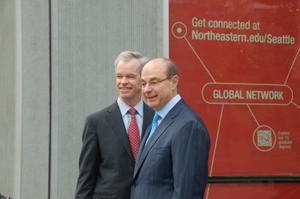
Tayloe_and_Joseph3_10-17-12_fit_300x300Northeastern University president Joseph Aoun is visiting Seattle in connection with the inauguration of Northeastern’s Seattle campus, located in South Lake Union.  Read the Crosscut article here.

This is what UW CSE’s Ed Lazowska sent to the reporter, in its entirety.  (The article represents it perfectly well, but necessarily omits most of the material.)

Our state has a higher education system designed for our 1970 economy. Today, we rank 2nd among the 50 states in the proportion of our workers who are in science and engineering occupations. But we rank 31st in science and engineering Bachelors degree production relative to our population, and 46th in science and engineering graduate program enrollment relative to our population.  (Additional data here.) There’s no doubt about it – we are educationally under-served. So any additional high-quality educational opportunities, such as those that Northeastern will provide, are welcome and needed!

Opening a branch in Seattle is a great business move for Northeastern – there’s for sure a market. And it will benefit the region in two ways.  First, it will expand Masters degree capacity in some high-impact fields. Second, it will increase the placement of Northeastern’s Boston undergraduates in co-op and internship positions with Seattle tech companies, and these students will be more likely to take permanent jobs here when they graduate. Tayloe Washburn was an inspired choice to lead the effort – he has a long history of civic leadership to increase educational opportunities in our state.

I do worry that citizens and policymakers will mistakenly believe that Northeastern is a Santa Claus that will solve our educational access problems. Northeastern’s color is indeed a jolly shade of red, but there is no Santa Claus.  We need to prepare Washington’s students for Washington’s jobs. Before you can get a Masters degree, you need to get a Bachelors degree. How are our kids going to do that? And while it’s good for our tech industry that a greater number of Northeastern’s Boston students are likely to seek employment in Seattle, what about our kids? (Per capita, we are already the #1 state in the nation in the importation of individuals with a Bachelors education or greater!)

At UW, the Computer Science program is ranked among the top ten in the nation, and is a top-five supplier of students to Amazon.com, Google, and Microsoft (as well as being the predominant supplier to many leading-edge smaller companies and startups in the region). Preparing Washington’s students for Washington’s jobs is what we do.  Would we like more students to have access to our educational offerings?  You bet!  There are two dimensions to accessibility: capacity and cost. If our tuition was $40,000/year like Northeastern’s, we’d be able to expand like crazy. But the mission of public universities is to provide a great education at a reasonable cost to students in their regions, driving socioeconomic upward mobility. Historically, taxpayers have felt that subsidizing this education is a great investment in the success of the next generation. Across the nation, though – and most particularly in our state – that contract is being scrapped. To repeat, there is no Santa Claus.

I’d like to emphasize where the gap between supply and demand is greatest in our state: Computer Science. Last year, the Higher Education Coordinating Board (now the Washington Student Achievement Council) did a careful analysis to identify the fields with the greatest gap between workforce demand and educational supply (here – figures 4 and 5). At the Bachelors level, Computer Science was #1, with a gap nearly twice as great as the second place field: all fields of Engineering combined. Third came all of the Health Professions combined, with a gap about half as large as Engineering’s. At the graduate level (Masters and Doctoral), Computer Science and the Health Professions were roughly tied for first, with Engineering third, with roughly half the gap of the first place fields. Information technology – computer science – is a field with all sorts of jobs for all sorts of people with all sorts of educational backgrounds. We, as a state, could choose to prepare more of our kids for these fantastic jobs.  Or we could continue to wait for Santa Claus.

Read more →

UW CSE Ph.D. alums Krzysztof Gajos, Chris Re win 2013 Sloan Research Fellowships

ck

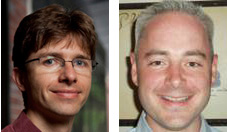
Krzysztof Gajos and Chris Re

Sloan Research Fellowships seek to stimulate fundamental research by early-career scientists and scholars of outstanding promise.  These two-year fellowships are awarded yearly to 126 researchers in the fields of chemistry, computational or evolutionary molecular biology, computer science, economics, mathematics, neuroscience, ocean sciences, and physics, in recognition of distinguished performance and a unique potential to make substantial contributions.

Among the 16 computer scientists selected as 2013 Sloan Research Fellows are two UW CSE Ph.D. alums:

Krzysztof Gajos, an expert in human-computer interaction, is an assistant professor in the School of Engineering and Applied Physics at Harvard.

Chris Re, an expert in data management, is an assistant professor in the Department of Computer Sciences at the University of Wisconsin – Madison.

Congratulations to Krzysztof and Chris!! Read more →

OneBusAway goes national!

OneBusAwayOneBusAway, the popular real-time transit information system in the Puget Sound region developed by UW CSE, has gone national, with deployments in New York City and Detroit, along with experimental deployments in Tampa, Atlanta, and Washington DC.

In New York, MTA is using OneBusAway as the basis for its Bus Time service.  In Detroit, a CodeForAmerica team used it for a text-messaging system, TextMyBus.

But you live in the Puget Sound region – use the original OneBusAway here.

(Brian Ferris, the CSE Ph.D. student who contributed greatly to OneBusAway, now works for Google, which one of these years will roll out a similar service.  But we will crush them like a bug.) Read more →

UW and President Obama’s College Scorecard

During his State of the Union address, President Obama announced a new College Scorecard to help students and parents make better decisions about which college to attend.

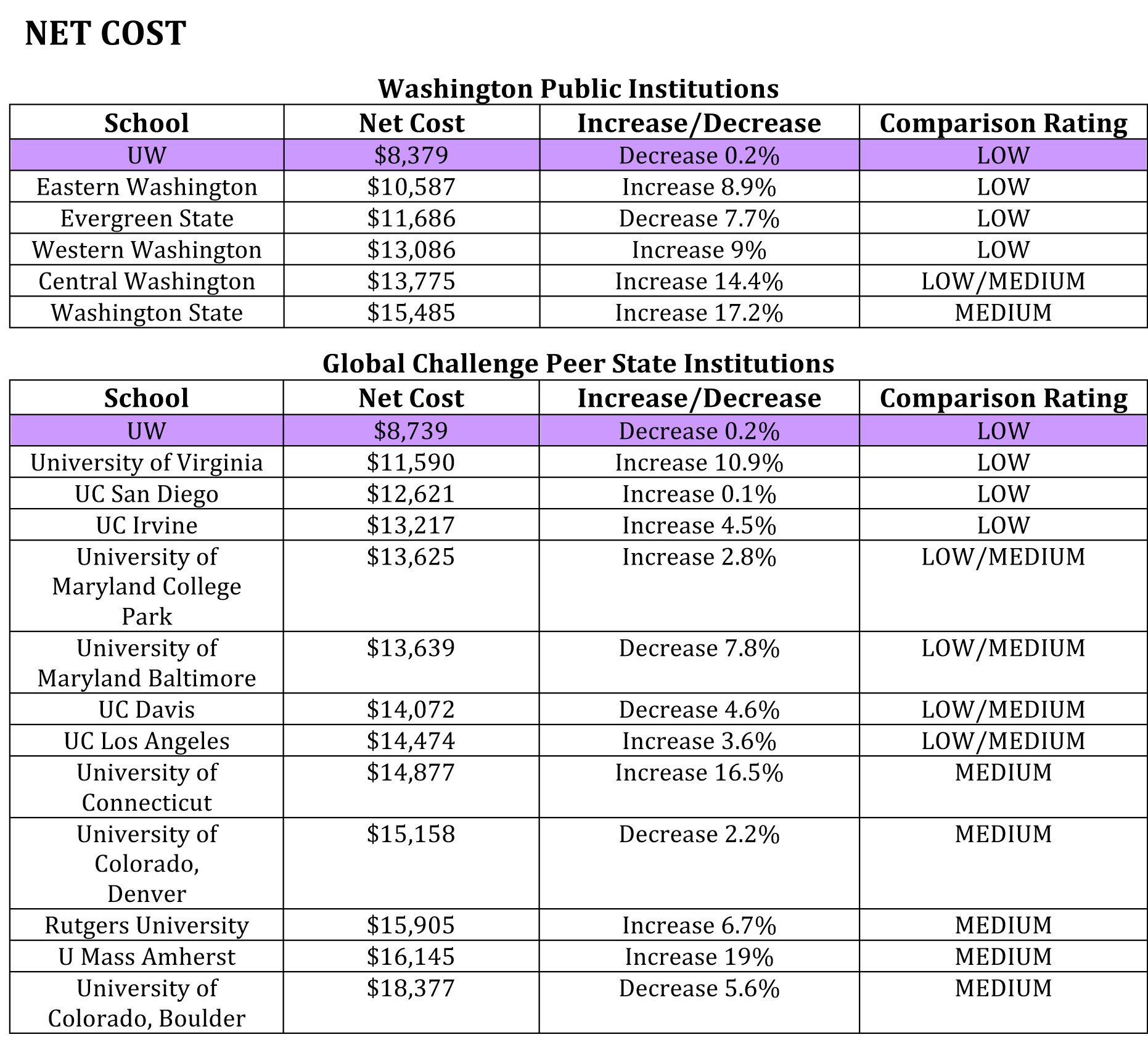
How does the University of Washington stack up compared to other Washington State public institutions, and compared to its state-defined Global Challenge Peer Institutions (a selection of flagship universities with medical schools)?

Check it out!  “Net cost” is shown below.  Additional metrics here.Microsoft Word - NET COST.docx

  Read more →

CSE’s Oren Etzioni on “Dinner Dialogs: The Next Big Ideas”

Oren-Etzioni“Dinner Dialogs” is an innovative video series featuring top Seattle entrepreneurs.  UW CSE professor Oren Etzioni is one of four discussants in the first episode.  Watch it here. Read more →

CSE’s Ed Lazowska testifies to House Science Committee on innovation in information technology

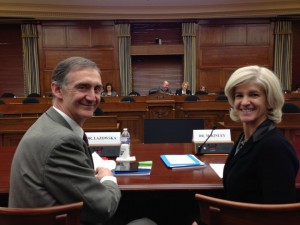
ekUW CSE’s Ed Lazowska, along with Kathryn McKinley (Microsoft Research) and Kelly Gaither (Texas Advanced Computing Center), testified today to the House Science Committee’s Subcommittee on Research and Science Education on the topic of innovation in information technology.

Lazowska sang a familiar refrain:

  •  Research often takes a long time before it pays off – often 15 years or more.
  • Research often pays off in unanticipated ways – we can’t predict what the biggest impact will be.
  • Advances in one sector enable advances in other sectors.
  • The research ecosystem is fueled by the flow of people and ideas back and forth between academia and industry.
  • Every multi-billion-dollar IT industry sector has a clear relationship to Federal research investment. Federal investment doesn’t supplant private sector investment – it complements it.

A transcript of Lazowska’s testimony is here.  Visuals are here.

See coverage in GeekWire, Computing Research Association Policy Blog. Read more →

Tableau CEO Christian Chabot: “Seattle is the promised land in startup America!”

IMG_4548-copy-1024x682GeekWire reports on an interview with Tableau CEO Christian Chabot:

“Building a company here in Seattle over the last 10 years has made us realize that in many ways, I think Seattle is the promised land in startup America. It’s one of the best decisions we ever made.

“We did not make the decision for business reasons. We moved because we wanted to live here. There were a few of us that were best described as Bay Area Burnouts and we saw this promised land of Seattle with a nicer-sized city rather than the Bay Area Silicon Valley sprawl. Much of Silicon Valley is a series of strip malls and it’s sort of disgusting in a certain way. It’s a high cost of living and you spend a fortune on a postage stamp apartment.

“We looked at Seattle as a great place to live with a great outdoors culture and a really vibrant startup and engineering community. We went primarily for personal reasons, but looking back from a business perspective, what a home run.”

Read more here. Read more →

Insecurity of the ORCA regional transit not-so-smart card

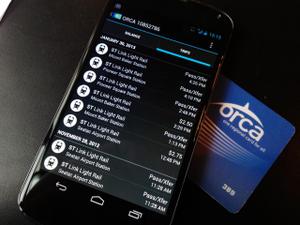
FareBot_and_ORCA_photo_by_Matt_Fikse_Verkerk_fit_300x300Since its inception, UW CSE researchers have raised concerns regarding the security and privacy aspects of Seattle’s ORCA (“One Regional Card for All”) regional transit smartcard.

Now “there’s an app for that” – FareBot, which enables any NFC-equipped Android phone to extract the data from ORCA (and similar transit smartcards in San Francisco, Singapore, and Japan).

FareBot, created by Seattle software developer Eric Butler, builds upon work by UW CSE’s Karl Koscher.

Crosscut reports on the app today in two articles – one headed “Can you say ‘security breach?'”

“The Geeks Who Cracked the ORCA Card”

“Smart card: What your ORCA never forgets”

FareBot Read more →

STEM Out!

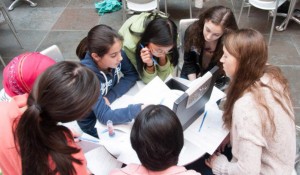
543741_572132312815030_454257099_nOn Saturday, UW CSE once again hosted STEM Out!, a terrific event to get young women excited about STEM careers.  We had more than 50 participants from grades 7-12 representing schools from all over the area.  The event was organized primarily by women engineers from Amazon.com led by 2004 UW CSE alumna Margaux Eng.  Google engineers also assisted, as did a UW CSE DawgBytes team including outreach coordinator Hélène Martin and students Nicole Ford, Caitlin Bonnar, and Patricia McKenzie

The girls heard from three speakers: Jennifer Schleit (UW Medicine), Laura Grit (Amazon.com) and Serena Loftus (UW Foster School of Business).  They participated in activities including sequencing strawberry DNA, solving puzzles and building several structures.

Photos here.  Learn more about UW CSE’s outreach activities here. Read more →

« Newer PostsOlder Posts »