UW CSE professor Ed Lazowska is organizing a public symposium on “Contemporary Topics in the Energy Field,” to be held on March 17th as part of a Regional Meeting of the National Academy of Engineering. A number of the talks — for example one on the Smart Grid — should be of interest to CSE students, faculty, and friends. Further information is available at http://lazowska.cs.washington.edu/nae2009/. Read more →
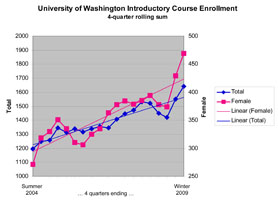
Stimulated by a request from our friends at Google, I plotted enrollment in UW CSE’s introductory course (“CS-1” — called “CSE-142” at UW) over the past 4.5 years. We offer this course every quarter (that is, four times a year); I plotted a 4-quarter rolling sum of course enrollment to smooth the data. (In other words, each point on the graph shows total enrollment during the most recent four academic quarters.)
The results show a dramatic growth in total enrollment, and an even more dramatic growth in the enrollment of women — both of which are important for the health of the field.
Want to know what computer science is like? See the terrific videos and other information here! Read more →
An op-ed by UW CSE’s Ed Lazowska and Sun Microsystems’ Bob Sproull appears today on the website of Scientists and Engineers for America. They write:
“Congress is now debating the American Recovery and Reinvestment Act of 2009. Included in this package is over 10 billion dollars for science facilities, research, and instrumentation.
“The reason for this inclusion is simple: today’s research is tomorrow’s infrastructure.
“When our nation faces immediate challenges, the feasible solutions depend upon the ideas, resources, and designs that are “on the shelf,” ready to deploy …
“Increasingly, information technology is the cornerstone of America’s infrastructure. Today’s information technology research is a cornerstone of tomorrow’s infrastructure.”
Read the full editorial here. A set of white papers describing the role of computing research in meeting the challenges of the 21st century is available here. Read more →
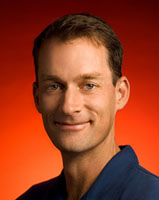
Jeff Dean, 1996 UW CSE Ph.D. alumnus, has been elected to the National Academy of Engineering — one of the highest honors accorded to engineers. Jeff was one of 65 individuals — 12 in the Computer Science & Engineering section — elected to membership in the 2009 class, announced on February 6.
Jeff began his career at DEC WRL, and moved to Google in 1999. At Google, Jeff and MIT EECS Ph.D. alumnus Sanjay Ghemawat — also elected to NAE this year — led the conception, design, and implementation of much of Google’s revolutionary computing infrastructure. Jeff was elected to NAE “for contributions to the science and engineering of large-scale distributed computer systems.”
Also elected in the NAE class of 2009 — both in the Bioengineering section — were UW Dean of Engineering Matt O’Donnell, and former UW Electrical Engineering professor and current UW Bioengineering affiliate professor David Auth. Read more →
 UW CSE startup Skytap was identified as one of “10 start-ups to watch in ’09” by NetworkWorld. Skytap offers cloud-based virtual lab solutions that reduce IT costs, accelerate lab provisioning time, and enable global team collaboration via the Web. Skytap was founded by UW CSE faculty members Brian Bershad, Steve Gribble, and Hank Levy, plus UW CSE graduate student Dave Richardson; it was funded by our friends at Madrona Venture Group, Ignition Partners, Bezos Expeditions, and Washington Research Foundation Capital. Read more →
UW CSE Ph.D. alumnus Mark Squillante (who has spent his career at IBM Research) and UW CSE Affiliate Professor Rick Szeliski (Microsoft Research) were among 44 leading computer scientists named to the 2008 class of Fellows of the Association for Computing Machinery. Squillante was recognized “for contributions to the theory and practice of stochastic modeling.” Szeliski was recognized “for contributions to computational photography.”
Thirteen UW CSE faculty members are Fellows of the ACM. Read more →
Project Lead The Way is offered in nearly 3,000 schools in fifty states and the District of Columbia. The 2008 Model Schools Yearbook highlights the programs in fourteen schools, including Seattle’s Roosevelt High School, where PLTW students paid a visit to UW CSE professor Yoky Matsuoka’s Neurobotics Laboratory.
Read the (PDF) excerpt here and the (PDF) full Model Schools Yearbook here. Read more →
“The human hand is capable of more delicate movement than comparable organs of any other animal. It can wield a tool or weapon as easily as it can make a subtle gesture. So when a human loses her hand, she’s lost a remarkable implement. Yoky Matsuoka wants to ensure a loss like that isn’t permanent. She runs the Neurobotics Lab at the University of Washington. That’s where she and her staff build robots that function like hands and other human body parts. Jeannie Yandel takes a tour of the lab.”
Featured on the KUOW show Sound Focus on November 12, 2008 (originally broadcast January 15, 2008). Read about it and listen to the show here, or listen to the nine-minute segment below.
[audio:sf20081112.mp3]
Read more →
“‘The overall picture for computer science is that both nationally and within the state of Washington, it’s projected as the fastest growing professional occupation between now and 2016,’ wrote Ed Lazowska, the Bill & Melinda Gates Chair in Computer Science & Engineering at UW. ‘With that said, employment is always cyclic …
“‘Major in something you love, and take it seriously,’ Lazowska said. ‘Ten or 15 years down the road, your success will be due to things that the philosophy department teaches just as well as Computer Science & Engineering does: analysis, critical thinking, conflict resolution. If you’re an undergraduate at [UW] for vocational reasons, you’re not taking advantage of what [this] university has to offer …'”
Read the article here. Read more →
“As more of our casual lives are spent online, we need to find a middle ground on security and privacy. Not every transaction and gateway needs the digital equivalent of a scowling paramilitary guard demanding to see our papers. Yet most of us aren’t comfortable letting it all hang out online.
“That’s why I’m intrigued by an easy-access control system called Friendbo, which is being developed by a group of students and professors at the University of Washington.
“It started in early 2007 as a classroom research project by Michael Toomim, a mustachioed 28-year-old Ph.D. candidate from Oakland, Calif. Professors saw potential and helped arrange a $50,000 grant from the UW’s tech transfer program. Now Friendbo‘s a company with patents pending that may release its first application, for Facebook, in a few weeks.”
Read the article here. Read more →


