Read the article here.
The Chronicle of Higher Education interviews UW CSE professor Richard Ladner. “Disabled students face a host of challenges. Mr. Ladner, a professor of computer science and engineering at the University of Washington, has spent much of his career trying to improve their opportunities for success in the discipline. The Computing Research Association recently gave him its A. Nico Habermann Award for advancing underrepresented groups.” Read more →
Read the article here.
 “Junior Koshal Thirumalai, from India, is majoring in computer engineering at the UW. ‘It doesn’t make sense to go anywhere else if you are into computers,’ he says.” Read more →
Read the article here.
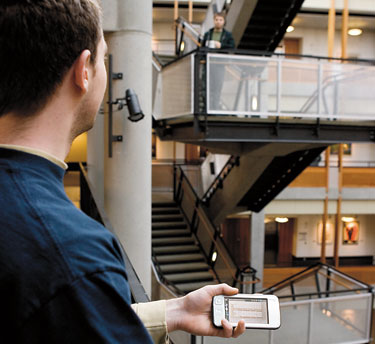
 “Some University of Washington students, faculty and staff are being tracked as they move about the computer-science building, with details of where they’ve been, and with whom, stored in a database.
“Professor Gaetano Borriello checks a computer to find graduate student Evan Welbourne’s last location: on the fourth floor, outside room 452 at 10:38 a.m. Wednesday. He opens another screen to reveal the building’s floor plan, and a blinking green dot representing Welbourne shows him walking down the hall.
“If it seems a bit like Big Brother, that’s the intention. The project is meant to explore both positive and negative aspects of a world saturated with technology that can monitor people and objects remotely.
“‘What we want to understand,’ Borriello said, ‘is what makes it useful, what makes it threatening and how to balance the two.'” Read more →
Read the article here.
“If you need information, the Internet offers a wealth of resources. But if you’re hunting down a person or a thing, a computer’s not much help. That may soon change. Electronic tags promise to create what some call the ‘Internet of things,’ in which objects and people are connected through a virtual network.
“To see what this future world would be like, a pilot project involving dozens of volunteers in the University of Washington’s computer science building provides the next step in social networking …”
A description of UW CSE’s RFID Ecosystem project. Read more →
Read the article here.
“In the past, I’ve written about natural and built environmental sensors, and wondered whether people should be included among the vital signs of an urban ecosystem. But I’ve skirted most of the privacy issues because I don’t have great answers for you, so I’m happy to see that these researchers, led by Magda Balazinska, are trying to come up with good tech or policy solutions, as they put it, ‘before such systems become commonplace.'” Read more →
Read the article here.
 “It’s 2 a.m. Do you know where Evan Welbourne is? …
“While RFID isn’t a household word, the technology behind it has long been a part of the lives of just about every American …
“Now, because the tags can emit individual codes, companies are using them to track specific inventory items, credit cards, and ID badges. Conceivably, sensors could follow people throughout their daily lives.
“But who should track whom? Where, when, and how? And what effect will this constant shadowing have on the trackers and the trackees?
“To get answers, the University of Washington developed the RFID Ecosystem. It is an attempt to ‘create a future world where RFID’s are everywhere,’ says Gaetano Borriello, a professor of computer science. At the moment, 140 antennas that pick up signals and 35 RFID readers that interpret data are monitoring five of the six floors in the university’s Paul G. Allen Center for Computer Science and Engineering.”
A description of UW CSE’s RFID Ecosystem project. Read more →
Read the article here.
A KING-5 Television feature on the tradeoff between technology and privacy for RFID. Features interviews with UW CSE faculty members Magda Balazinska and Gaetano Borriello, as well as with on-leave faculty member Chris Diorio, who is the founder, Chairman, and CTO of CSE-spinoff RFID technology company Impinj. Read more →
Read the article here.
A short commentary by CSE professor Ed Lazowska. “[Markoff] simply observed that Seattle is exhibiting some of the entrepreneurial success of Silicon Valley; he described ome of the evidence and explored some of the reasons … We have managed to develop a tech ecosystem here – a feat that has eluded many other regions of the nation. It’s distinctly our own, and it’s pretty remarkable.” Read more →
Read the article here.
 “Yoshi Kohno, assistant professor of computer science & engineering, has been awarded a Sloan Research Fellowship, given each year to outstanding young scientists … A total of 118 fellowships were awarded this year in seven fields: chemistry, computational and evolutionary molecular biology, computer science, economics, mathematics and neuroscience … Kohno’s research interests are in computer security, electronic privacy and cryptography. Some of his past studies have investigated security concerns related to electronic voting machines and ways to ensure the security of transactions over the Internet. Other research directions include security and privacy of wireless networks, online anonymity and network forensics. Kohno earned his doctorate at the University of California, San Diego and has been at the UW since 2006.” Read more →
This spreadsheet from the University of Virginia tallies ten years of Computing Research Association “Outstanding Undergraduate” awards. In a nutshell:
- Total students recognized: UW #1, tied with CMU
- Number of winners: UW #1, tied with CMU, Dartmouth, Cornell, and Princeton
- Number of runners up: UW #1, tied with CMU and Harvard
- Number of finalists: UW #2, behind CMU and tied with Harvard
- Number of honorable mentions: UW #2, behind UVa
Go team!
See an excellent blog post by CMU Computer Science Department chair Peter Lee here. Read more →