 Each year, ACM recognizes a winner and one or two honorable mentions in its Doctoral Dissertation Award competition – the highest-impact dissertations among roughly 2,000 Ph.D.s granted.
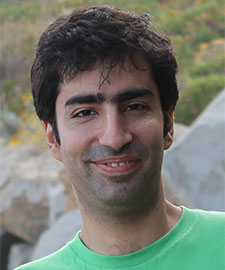
UW CSE professor Shayan Oveis Gharan is one of two Honorable Mentions in the 2013 competition, announced this week.
Shayan received his Ph.D. from Stanford last year. He is spending the current year as a Miller Fellow at UC Berkeley and will join UW CSE during the 2014-15 academic year. His research involves the development of provably efficient algorithms for problems that seem intractable. He has worked on the classical Traveling Salesman Problem, on clustering in massive graphs using spectral methods, and on stochastic optimization. Along the way he has introduced many new techniques, like maximum entropy sampling and the use of higher eigenvalues of graphs, that can be used to tackle an array of other computational tasks.
UW CSE professor Shyam Gollakota won the 2012 ACM Doctoral Dissertation Award. UW CSE Ph.D. alum Seth Cooper won the 2011 ACM Doctoral Dissertation Award. UW CSE Ph.D. alum Noah Snavely was Honorable Mention in the 2009 ACM Doctoral Dissertation Award competition.
Go team!
Shayan has just finished his Ph.D. at Stanford. He will spend next year as a Miller Fellow at UC Berkeley before joining us during the 2014-15 academic year. His research involves the development of provably efficient algorithms for problems that seem intractable. He has worked on the classical Traveling Salesman Problem (
see an article about this work in Wired), on clustering in massive graphs using spectral methods, and on stochastic optimization. Along the way he has introduced many new techniques, like maximum entropy sampling and the use of higher eigenvalues of graphs, that can be used to tackle an array of other computational tasks. – See more at: http://news.cs.washington.edu/2013/05/30/uw-cse-welcomes-shayan-oveis-gharan-zach-tatlock-to-faculty/#sthash.7cjQKjm6.dpufShayan has just finished his Ph.D. at Stanford. He will spend next year as a Miller Fellow at UC Berkeley before joining us during the 2014-15 academic year. His research involves the development of provably efficient algorithms for problems that seem intractable. He has worked on the classical Traveling Salesman Problem (see an article about this work in Wired), on clustering in massive graphs using spectral methods, and on stochastic optimization. Along the way he has introduced many new techniques, like maximum entropy sampling and the use of higher eigenvalues of graphs, that can be used to tackle an array of other computational tasks. – See more at: http://news.cs.washington.edu/2013/05/30/uw-cse-welcomes-shayan-oveis-gharan-zach-tatlock-to-faculty/#sthash.7cjQKjm6.dpuf
Shayan has just finished his Ph.D. at Stanford. He will spend next year as a Miller Fellow at UC Berkeley before joining us during the 2014-15 academic year. His research involves the development of provably efficient algorithms for problems that seem intractable. He has worked on the classical Traveling Salesman Problem (
see an article about this work in Wired), on clustering in massive graphs using spectral methods, and on stochastic optimization. Along the way he has introduced many new techniques, like maximum entropy sampling and the use of higher eigenvalues of graphs, that can be used to tackle an array of other computational tasks. – See more at: http://news.cs.washington.edu/2013/05/30/uw-cse-welcomes-shayan-oveis-gharan-zach-tatlock-to-faculty/#sthash.7cjQKjm6.dpuf
Shayan has just finished his Ph.D. at Stanford. He will spend next year as a Miller Fellow at UC Berkeley before joining us during the 2014-15 academic year. His research involves the development of provably efficient algorithms for problems that seem intractable. He has worked on the classical Traveling Salesman Problem (
see an article about this work in Wired), on clustering in massive graphs using spectral methods, and on stochastic optimization. Along the way he has introduced many new techniques, like maximum entropy sampling and the use of higher eigenvalues of graphs, that can be used to tackle an array of other computational tasks. – See more at: http://news.cs.washington.edu/2013/05/30/uw-cse-welcomes-shayan-oveis-gharan-zach-tatlock-to-faculty/#sthash.7cjQKjm6.dpuf
Read more →

 The lead article in Sunday’s New York Times is about the movement to teach computer science, computational thinking, and computer programming in K-12, driven by Seattle’s Code.org:
 And Rover.com, created by our friend