“Devices Connect with Borrowed TV Signals, and Need No Power Source”

better.smart_.dustx299MIT Technology Review reports on UW CSE’s “Ambient Backscatter” innovation:

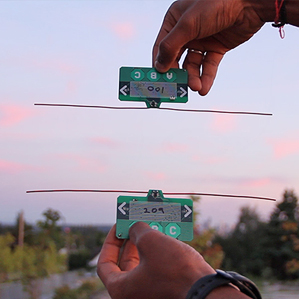
“A novel type of wireless device sends and receives data without a battery or other conventional power source. Instead, the devices harvest the energy they need from the radio waves that are all around us from TV, radio, and Wi-Fi broadcasts.

“These seemingly impossible devices could lead to a slew of new uses of computing, from better contactless payments to the spread of small, cheap sensors just about everywhere.

“‘Traditionally wireless communication has been about devices that generate radio frequency signals,’ says Shyam Gollakota, one of the University of Washington researchers who led the project. ‘But you have so many radio signals around you from TV, Wi-Fi, and cellular networks. Why not use them?'”

Read more (and watch the video demo) here. Read more →

“Lessons from 18 Months in Government”

ef

UW CSE Ph.D. alum Ed Felten – Director of Princeton University’s Center for Information Technology Policy, and Professor of Computer Science and of Public Affairs there, recently returned to Princeton after 18 months as the first Chief Technologist of the U.S. Federal Trade Commission.

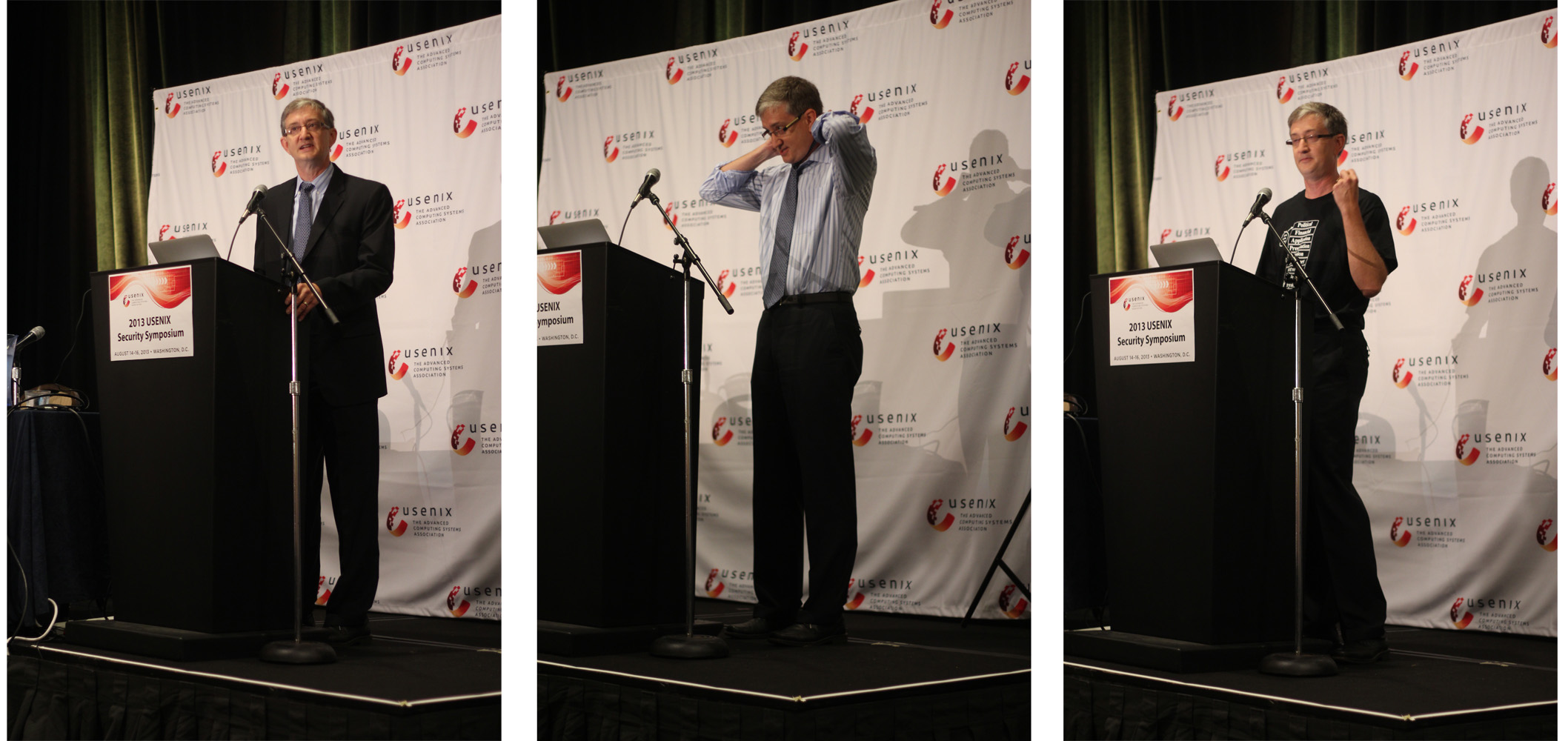
Today Ed delivered the keynote at the 22nd USENIX Security Symposium:  “Dr. Felten Goes To Washington: Lessons from 18 Months in Government.”

One of these days, the video will be online, presumably here.  Meanwhile, you’ll have to content yourself with the three photos here, as Ed progressively strips down from full DC battle armor to an audience-appropriate geeky T-shirt over the course of his presentation. Read more →

Chicken Chicken Chicken: Chicken Chicken

Zongker

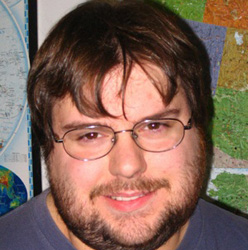
Doug Zongker

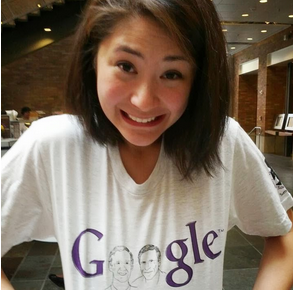
As a UW CSE Ph.D. student more than a decade ago, Doug Zongker (now a Google engineer) first delivered his now-famous parody of unintelligible scientific presentations: “Chicken Chicken Chicken: Chicken Chicken.” (No video of the presentation exists, but the 2002 slides are still on the web here, as is the companion paper here.)

Attention increased in 2007, when Doug presented the work at the annual meeting of the American Association for the Advancement of Science.  Fortunately, cameras were present to capture the moment, here.

Now, the dance radio station of Seattle’s Nathan Hale High School, C89.5, has picked up the mantle.  C89.5 is actually really good.  They have twice as many listeners as KEXP and just won a “Best Dance Station” industry award.  Apparently they were the first to start playing Lady Gaga and even got her to do a concert at Nathan Hale.

Kosher

Karl Koscher

Of course, a long time ago the Seattle Schools largely de-funded the station, so C89.5 now does semiannual pledge drives. During their most recent pledge drive, they had a new “day sponsorship” option: for $1,000 individuals could get their message, up to 50 words in length, played throughout the day.

Current UW CSE Ph.D. student Karl Koscher sent them this tweet: “If I had $1,000 to spend I’d totally be a day sponsor and have all 50 words be ‘chicken'”.  (One of their DJs/instructors has a thing for farm animals …)

They thought it was hilarious, and apparently one of Karl’s friends did as well – without Karl’s knowledge, the friend plunked down the $1,000 to make it happen.

So last Friday, “Chicken Chicken Chicken: Chicken Chicken” took to the airwaves and the Internet on C89.5, here.

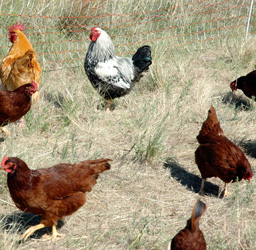
chickens2small

Repeat after me …

Landmark contributions to science live forever.  “That’s why we do what we do.” Read more →

2013 Ubicomp “10 Year Impact Award”

general_view_day-zurichThe 2003 research paper “Inferring High-Level Behavior from Low-Level Sensors” by UW CSE’s Don Patterson, Lin Liao, Dieter Fox, and Henry Kautz has been recognized with the “10 Year Impact Award” from Ubicomp 2013, the 2013 ACM International Joint Conference on Pervasive and Ubiquitous Computing.

The award committee concluded that “The paper … is  an excellent example of how one can learn very useful context information from simple GPS traces and it formed the basis for today’s thriving smart cities/smart transportation work. It is a nice example of how higher order information can be gleaned from everyday sensing – which is an important thread of work at Ubicomp and one of the enduring methods.”

The award will be presented at the Ubicomp 2013 conference in Zurich, Switzerland during the opening session on September 10th.
Read more →

UW News: “Wireless devices go battery-free with new communication technique”

abc_2“UW CSE researchers have created a new wireless communication system that allows devices to interact with each other without relying on batteries or wires for power.

“The new communication technique, which the researchers call “ambient backscatter,” takes advantage of the TV and cellular transmissions that already surround us around the clock. Two devices communicate with each other by reflecting the existing signals to exchange information. The researchers built small, battery-free devices with antennas that can detect, harness and reflect a TV signal, which then is picked up by other similar devices.”

Today this work received the SIGCOMM 2013 Best Paper Award.

Read more here. Read more →

UW CSE @ UW power plant and steam tunnels

IMG_0920Somehow UW CSE’s advancement officer Karen Howard Leikin managed to wangle a 2-hour tour of UW’s power plant and steam tunnels for CSE alums Kirk Glerum and Don Hacherl.  Karen accompanied, along with UW CSE’s Ed Lazowska.

There’s no way to describe how cool this was!  (Well, truth be told, it was actually pretty hot …)

The central power plant supplies steam heat, chilled water air conditioning, compressed air, and emergency power to 174 buildings on the the 643-acre UW main campus and medical center through 8 miles of tunnels.

IMG_0901Five natural gas boilers (with fuel oil backup) provide steam.  UW consumes about 55 megawatts of electrical power; 10% of this is provided by a steam turbine generator (the main goal of which is to provide uninterruptible power for the power plant itself), the rest is purchased from utilities.  There are 5 2-megawatt diesel backup generators to provide emergency power to other critical parts of campus.

Mark Kirschenbaum, Assistant Director of Campus Utilities, was a wonderful tour guide; Mark is a graduate of the U.S. Merchant Marine Academy and spent a number of years dealing with shipboard boilers before joining UW 18 years ago.IMG_0930

Additional photos here. Read more →

UW CSE Ph.D. alum Jeff Dean interviewed on neural networks in Silicon Valley Business Journal

google-london 600“If you’ve ever been mystified by how Google knows what you’re looking for before you even finish typing your query into the search box, or had voice search on Android recognize exactly what you said even though you’re in a noisy subway, chances are you have Jeff Dean and the Systems Infrastructure Group to thank for it.

“As a Google Research Fellow, Dean has been working on ways to use machine learning and deep neural networks to solve some of the toughest problems Google has, such as natural language processing, speech recognition, and computer vision. In this exclusive Q&A, he talks about his work and how it’s making Google more powerful and easy to use.”

Read the article here. Read more →

UW CSE “IT for the developing world” projects featured in The Atlantic

pasteurizingmilkmain.jpgAn article in The Atlantic includes work done with our collaborator PATH. The “Mobile-phone milk pasteurization” section is the work of Rohit Chaudhri and the “Digital video” section is a collaboration between PATH, UW, and Digital Green. Richard Anderson provides the UW-PATH linkages that make these projects possible. We also acknowledge our principal collaborators at PATH, Noah Perin and Kiersten Israel-Ballard (among others).

Read the article here. Read more →

CSE’s Rajesh Rao in Scientific American

logo_new“The notion of a strict cortical hierarchy, especially a feedforward hierarchy of processing layers, is losing ground to a more nuanced view of the cortex as an interconnected and distributed network.”  Read more here. Read more →

Senator Patty Murray @ UW CSE

photo photo2U.S. Senator Patty Murray visited UW CSE today for a discussion of cybersecurity issues with professors Yoshi Kohno and Ed Lazowska. Following the briefing, graduate students Karl Koscher, Franzi Roesner, and Alexei Czeskis demonstrated the security vulnerabilities of modern automobiles by controlling all aspects of a recent-model sedan from an Internet-connected laptop by exploiting vulnerabilities in the car’s telematics unit. Read more →

« Newer PostsOlder Posts »