 “Using CSS3 transforms and HTML5 canvas, the Katamari Hack for Google Chrome (and other compatible browsers) allows you to turn any website into a game of Katamari Damacy! The script was created by Alex Leone, [UW CSE undergrad] David Nufer, and [UW CSE undergrad] David Truong, and won the 2011 Yahoo HackU contest at University of Washington.”
The Yahoo! HackU contest give 3-person undergraduate teams 24 hours to come up with interesting web applications. “Katamari Hack” turns any web page into a game reminiscent of the video game Katamari Damacy. It allows the user to roll a ball around the page, picking up words, images, and other content off of the page and sticking it to the ball. Everything rolls around on the ball in full 3-D. It’s amazing that Alex, David and David were able to do this, especially in just 24 hours; they had to compute all of the 3-D graphical transformations themselves from scratch. You’ve gotta try this thing. It can be found at: http://kathack.com/.
This is the third year running that members of this team have taken the prize. Congratulations to the team!
Katamari Hack site here. Slashdot post here. The Stranger reports on its test here. Woot! blogs about it here. Engadget here. Digg here. Gossipgamers here. IngieGames here. More information on Yahoo! HackU here. Read more →
 UW CSE’s Center for Game Science is featured in the March 2011 issue of Columns, the University of Washington alumni magazine.
“‘We’re focusing not just on scientific discovery games but, in general, games as a primary medium for solving really hard problems that our entire society cares about,’ says Zoran Popović, associate professor at the UW’s Department of Computer Science & Engineering and director of the Center for Game Science. ‘Specifically, problems that people alone or computers alone cannot solve. But together they might be able to.'”
Read the article here. Check out some games: Foldit, Refraction. Visit the Center for Game Science here. Read more →
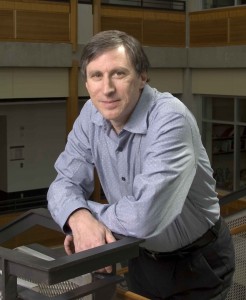 “When Hank Levy, chair of the UW Department of Computer Science & Engineering (CSE), walked into a room in early February, he expected to meet with the dean of engineering and the department executive committee for an emergency conference.
“Levy was instead greeted with a champagne celebration when CSE faculty surprised him with news that he had been elected to the National Academy of Engineering (NAE), which according to the organization’s website is the highest professional honor given to an engineer. …
“The press release from NAE said that Levy’s ‘contributions to design, implementation, and evaluation of operating systems, distributed systems, and processor architectures’ are the grounds for his election.”
Read the article here. Read more →
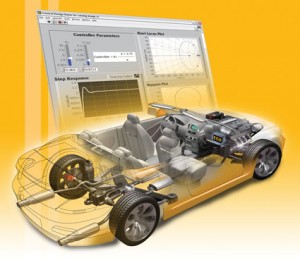 The New York Times reports on research by UW CSE’s Yoshi Kohno, UCSD’s (and UW CSE Ph.D. alum) Stefan Savage, and their colleagues Steve Checkoway, Damon McCoy, Brian Kantor, Danny Anderson, Hovav Shacham, Karl Koscher, Alexei Czeskis, and Franziska Roesner, which was presented on Friday to the National Academy of Sciences’ Transportation Research Board.
“Because many of today’s cars contain cellular connections and Bluetooth wireless technology, it is possible for a hacker, working from a remote location, to take control of various features — like the car locks and brakes — as well as to track the vehicle’s location, eavesdrop on its cabin and steal vehicle data, the researchers said. They described a range of potential compromises of car security and safety.
“‘This report explores how hard it is to compromise a car’s computers without having any direct physical access to the car,’ said [UW CSE Ph.D. alumnus] Stefan Savage of the University of California, San Diego, who is one of the leaders of the research effort.”
Read the article in the Times here. Center for Automotive Embedded Systems Security here. An article in Technology Review is here. ComputerWorld covers this research here. Read more →
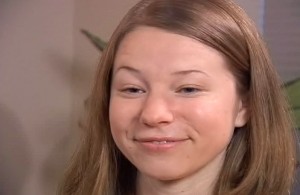 The Washington Post, in a series of articles on computer science enrollment, features UW CSE’s “Power to Change the World” video.
Read the article here. See all of CSE’s award-winning videos here. Read more →
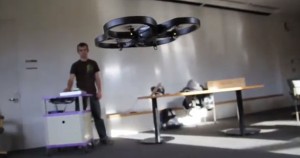 Xconomy covers professor Shwetak Patel’s EE 472 “Embedded Microcomputer Systems” course, in which student teams build controllers for the Parrot AR.Drone.
Read the article (and watch the video) here. Watch course videos here and here.
Seattle Times article here. And don’t miss Dancing with the Drones! GeekWire article here. Read more →
 The New York Times picks up on a point made in the recent report of the President’s Council of Advisors on Science and Technology assessing the Federal Networking and Information Technology R&D program: “performance gains in doing computing tasks that result from improvements in software algorithms often far outpace the gains attributable to faster processors.”
UW CSE’s Ed Lazowska, co-chair of the PCAST NITRD Working Group, is quoted:
“The rate of change in hardware captured by Moore’s Law, experts agree, is an extraordinary achievement. ‘But the ingenuity that computer scientists have put into algorithms has yielded performance improvements that make even the exponential gains of Moore’s Law look trivial,’ said Edward Lazowska, a professor at the University of Washington.
“The rapid pace of software progress, Mr. Lazowska added, is harder to measure in algorithms performing nonnumerical tasks. But he points to the progress of recent years in artificial intelligence fields like language understanding, speech recognition and computer vision as evidence that the story of the algorithm’s ascent holds true well beyond more easily quantified benchmark tests.”
Read this really interesting article here. Followup post in Business Insider here. Read more →
 UW CSE professor Oren Etzioni is featured in a new video describing the UW Foster School of Business Business Plan Competition.
“‘What’s most impressive to me is the incredible creativity of the students… coming together to produce what’s both technically feasible and makes business sense,’ said Oren Etzioni, computer science and engineering professor and entrepreneur.”
Watch the video here. Read more →
 UW CSE’s Oren Etzioni is quoted in this New York Times article:
“But parsing and categorizing language, with its ambiguity and subtlety, remains a formidable hurdle for computers. So the challenge facing Watson was far greater than the one I.B.M. overcame in 1997 with its Deep Blue chess-playing computer, which beat the world champion Garry Kasparov.
“‘It’s a lot more difficult for a computer to understand language at the level of an 8-year-old than to beat a grandmaster at chess,’ observed Oren Etzioni, a computer scientist at the University of Washington in Seattle.”
Read the article here. Read more →
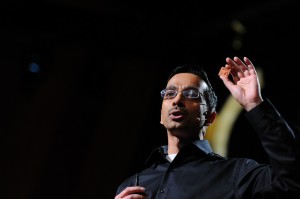 UW CSE professor Raj Rao was one of the headliners at the TED2011 conference, speaking in Session 11, “The Echo of Time,” along with paleontologist Jack Horner, President of the Institute of Medicine Harvey Fineberg, and General Stanley McChrystal. More photos here. Raj the cartoon here. Read more →