 In a post last December, we provided some “straight talk” regarding the impact of state budget cuts on the University of Washington in general, and on UW Computer Science & Engineering in particular. It was covered in Crosscut and elsewhere.
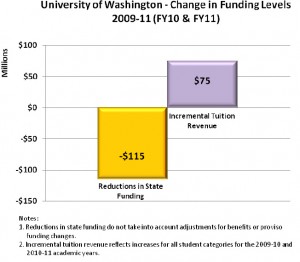
UW has now issued a short document that puts budget cuts and tuition increases in perspective. A significant shift in financial responsibility from the state to individuals is taking place. The increase in tuition, however, falls far short of making up for the reduction in state funds.
Somehow — now, more than ever, given shifts in America’s economy — great public universities such as the University of Washington must continue to serve as engines of socioeconomic upward mobility for the smart youngsters who grow up in their regions. Read more →
 Corensic, a startup founded in 2008 by UW CSE faculty members Luis Ceze and Mark Oskin and backed by Madrona Ventures, the Washington Research Foundation, and Perkins Coie, has rolled out the first release of Jinx, its software quality tool for Linux and Windows that helps developers, testers, and IT organizations improve the reliability of multi-core applications by surfacing hard-to-find concurrency bugs. Read more →
 UW CSE’s Ed Lazowska is interviewed, and UW CSE alums Karen Liu and Hakim Weatherspoon are profiled, in this article on diversity in the computing field.
“’While there are many reasons for striving to increase the representation of women in our field, the selfish reason is the most compelling one: the quality of the solutions we achieve is enhanced by the diversity of the individuals contributing to these solutions.’ Lazowska added, ‘Computer science is a great field for everyone, and computer science, as a field, needs everyone.'” Read more →
 UW’s MobileASL team is developing the first device able to transmit American Sign Language over U.S. cellular networks.
The tool is completing its initial field test, which allows the team to see how people use the tool in their daily lives and what obstacles they encounter. Eleven participants — all students in the UW Summer Academy for Advancing Deaf and Hard of Hearing in Computing — are testing the phones for three weeks. They meet periodically with the research team for interviews and respond to survey questions that pop up after a call is completed.
Read the full UWeek article here.
Additional coverage: TechFlash. Seattle Times. Seattle PI. CNET. Gizmag. Wired. The Engineer. Computer World. TechNewsDaily. TGDaily. King5 news. ReadWriteWeb. Read more →
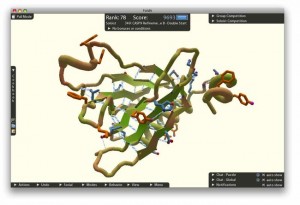 A recent article in Nature concerning the protein folding videogame Foldit — a collaboration between UW CSE professor Zoran Popovic, UW Biochemistry professor David Baker, and their students — has stimulated a great deal of coverage in the popular press. A superb article appears in today’s New York Times.
“The Foldit project was inspired by the volunteers who were contributing the downtime on their home computers to power a protein-folding program called Rosetta@home. The computer donors could see the progress of the program on their screens, and they began to note inefficiencies in the software’s folding approach. That led the scientists to look for ways to systematically harness the skills of the human volunteers.
“The University of Washington researchers have now received a $14 million grant from the Defense Advanced Research Projects Agency, the Pentagon’s arm for supporting science and technology research. This fall Dr. Popovic plans to establish a Center for Game Science, which will pursue technologies for using the skills of both novice and expert human game players on a range of scientific problems.”
Read the complete New York Times article here. Play Foldit here. Read other coverage stimulated by the Nature paper here. Read more →
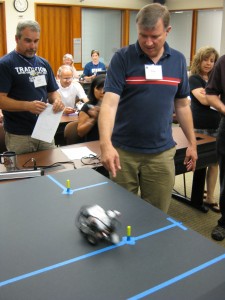 Xconomy reports on UW’s “CS4HS” workshop for high school teachers — including a great synopsis of the “Careers Panel” featuring UW CSE alums Tam Armstrong (Bungie), Krista Davis (Google), Margaux Eng (Amazon.com), and Crystal Hoyer (Microsoft).
“Figuring out how to entice student, parents, and school districts to embrace and support computer science curricula in public education was a topic at center stage at the University of Washington Computer Science & Engineering CS4HS event last week.”
Read the full article here. Learn more about this year’s CS4HS workshop here and here. Read more →
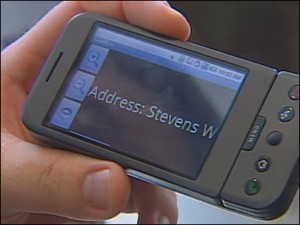 The New York Times chronicles UW CSE undergraduate student projects from Professor Richard Ladner’s “Accessibility Capstone.”
New York Times article here. KOMO News story and video (which inspired the New York Times post) here. Read more →
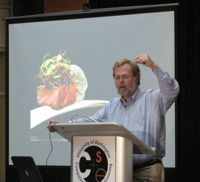 For several years, Nathan Myhrvold has been working on a 6-volume, 2400-page cookbook that “reveals science-inspired techniques for preparing food.”
Myhrvold and co-author Chris Young spoke in UW CSE’s 2009-10 Distinguished Lecturer Series — and brought along a crew of chefs who treated attendees to some amazing ice cream (resulting from the confluence of pistachios, a centrifuge, liquid nitrogen, and a few other ingredients). TechFlash, in describing the unveiling of the website for the cookbook today, links to the video of the talk, and uses photographs taken in CSE. Read the article here. Read more →
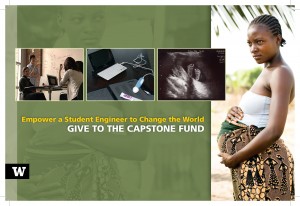 In 2009-10, for the third year, Computer Science & Engineering joined with Human Centered Design & Engineering to offer a year-long senior undergraduate capstone design course on “Designing Technology for Resource-Constrained Environments.”
Students in this year’s course worked to develop a low-cost, easy-to-use portable ultrasound for midwives that will be tested in Uganda — the Midwives’ Ultrasound Project. The course has been featured by the College of Engineering in a video, website, and mailing to promote the College’s “Capstone Fund.”
You can support UW CSE’s capstone courses by giving to our Annual Fund. The CSE Annual Fund is used to support our terrific students and faculty, and our terrific educational innovations and experiences.
“Designing Technology for Resource-Constrained Environments” is a collaboration of CSE’s Richard Anderson, Ruth Anderson, and Gaetano Borriello, with HCDE’s Beth Kolko. You will also be interested in the Change effort, and OpenDataKit. Read more →
 A number of major research conferences offer “Test of Time” awards — typically conferred on the paper presented ten years previously that, in retrospect, has had the greatest impact.
UW CSE’s Magda Balazinska has probably set the record for “youngest person to receive a ‘Test of Time’ award.” Her paper “Advanced Clone-Analysis to Support Object-Oriented System Refactoring,” presented at the 2000 Working Conference on Reverse Engineering, will be recognized at the 2010 WCRE conference in October.
Congratulations Magda! Read more →