 TechFlash interviews 2008 UW CSE alumna Helene Martin, now teaching computer science at Seattle’s Garfield High School.
“Dozens of K-12 math and science teachers gathered this week at the University of Washington campus for a three-day summer workshop called Computer Science for High School, or ‘CS4HS,’ an annual program started by the UW, Carnegie Mellon University and UCLA several years ago to promote computer science education in high schools. Sponsored by Google, the workshops are now held around the country.
“One of the speakers at the Seattle event this week was Hélène Martin, a 2008 UW computer science and linguistics graduate who has a unique perspective on the topic, having just finished her first year teaching computer science at Seattle’s Garfield High School. During a break in the workshop, she talked about CS4HS, what the past year at Garfield has taught her, and her advice for aspiring computer scientists.”
Read the terrific interview here! Read more →
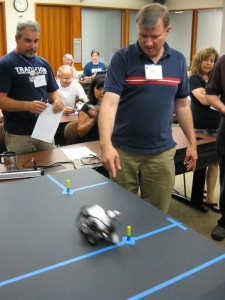
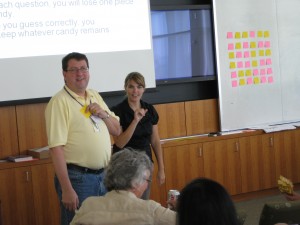 UW CSE hosted 50 high school math, science, and computer science teachers on August 2-4 in our fourth annual “CS4HS” (Computer Science for High Schools) summer workshop. Funded by Google, CS4HS was originally conceived by Carnegie Mellon University, UW, and UCLA, and now involves roughly 20 universities from across the country.
Teachers learn a wide variety of ways in which computer science concepts can be introduced into their courses, and participate in hands-on workshops in Mindstorm robots and visual programming using Scratch. A “Computing Careers Panel” featuring recent UW CSE alums working in the software and gaming sectors is always a highlight.
UW CSE’s CS4HS offering continues to be a collaboration with CMU; many thanks to Tom Cortina for traveling to Seattle once again to help make our program a huge success!
CS4HS website here. Agenda here. Photographs here. Ed Lazowska’s introductory presentation here; Ed’s other slides here (all course materials from all speakers will be posted on the CS4HS website eventually).
Wonderful interview with Helene Martin here. Read more →
 Two years ago, a team from UW including CSE professor Zoran Popovic, CSE grad student Seth Cooper, and UW Biochemistry professor (and adjunct CSE professor) David Baker, launched an ambitious project harnessing the brainpower of computer gamers to solve medical problems.
“The game, Foldit, turns one of the hardest problems in molecular biology into a game a bit reminiscent of Tetris. Thousands of people have now played a game that asks them to fold a protein rather than stack colored blocks or rescue a princess.
“Results published Thursday (Aug. 5) in the journal Nature show that Foldit is a success. It turns out that people can, indeed, compete with supercomputers in this arena. Analysis shows that players bested the computers on problems that required radical moves, risks and long-term vision — the kinds of qualities that computers do not possess.”
Read the UW News article here. TechFlash here. Nature here.
Additional coverage: Wired. CosmicLog on MSNBC.com. Discover Magazine. Ars Technica. TechNewsDaily. Popular Science. Science News. Scientific American. Seattle Times. Los Angeles Times. The Economist. PC World. CNET. CBS News. UPI. Gizmag. HPCwire. NewScientist. Die Presse. Physics Today. Forbes. The Economist. The Economist: Technology Babbage blog. Macleans.ca. Read more →
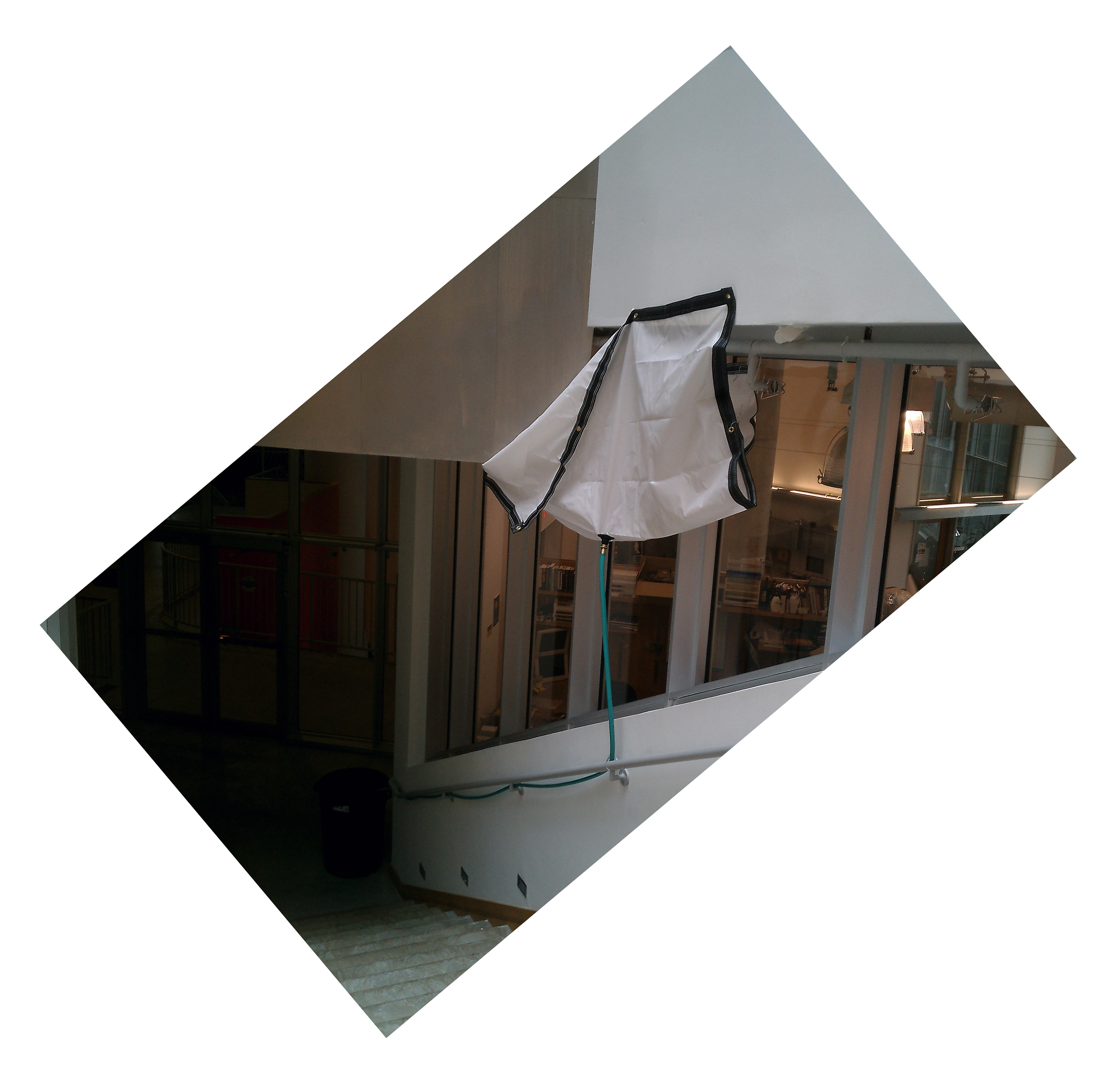
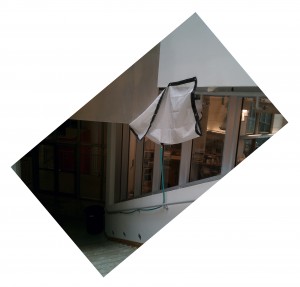 In the latest desperate attempt to deal with leaks, a plastic bag collects water that drips through a 4th floor skylight and directs it to a hose, attached to a stairway railing by means of cable ties, which terminates at a trash can at the foot of the stairs. Engineering ingenuity in action! Read more →
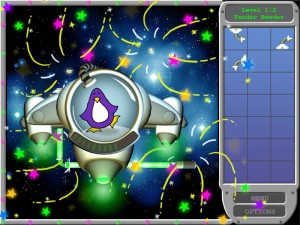 Refraction, an online puzzle game for teaching fractions created by UW CSE professor Zoran Popovic and his students, has won the Grand Prize in the Disney Learning Challenge!
Refraction is a research project of UW CSE’s Center for Game Science — focused on games for learning and for science. Read more →
 We’ve known for years that the Web allows for unprecedented voyeurism, exhibitionism and inadvertent indiscretion, but we are only beginning to understand the costs of an age in which so much of what we say, and of what others say about us, goes into our permanent – and public – digital files.
UW CSE computer scientist Yoshi Kohno, who helped develop the system Vanish to make online data that self-destructs, is quoted.
Read the NYT article here. A recent ZDNet article on the Vanish system is here. Read more →
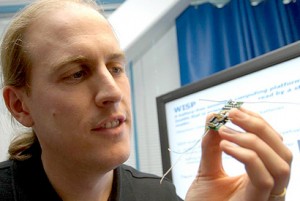 In a story in the Novelties column on the New York Times, reporter Anne Eisenberg looks at work that’s being done to entirely eliminate batteries from very low-power wireless systems.
UW Electrical Engineering Professor Brian Otis explained that researchers are working on the problem from two directions, and are now starting to meet in the middle, delivering practical applications. His work is on reducing the amount of power such systems require, while others, such as UW CSE affiliate professor Joshua Smith, are working on harvesting useful amounts of power from ambient radiation.
Smith, who is a principal engineer at Intel Labs Seattle, and his research collaborators have demonstrated a system that harvests enough power from a nearby television broadcast station to run a simple wireless weather station. Says Smith, “Silicon technology has advanced to the point where even tiny amounts of energy can do useful work.”
Read the full story at the New York Times online here. CSE News earlier reported on media coverage of Smith’s work here. Read more →
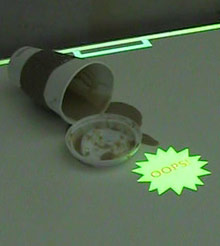 A depth-sensing camera and a palm-top projector turn an ordinary work surface into an interactive one. UW CSE graduate student Ryder Ziola developed this system, dubbed Oasis, with researchers at Intel Labs Seattle, led by Intel senior scientist and CSE affiliate faculty member Beverly Harrison.
“If you put, for example, a steak on the surface, it will recognize the steak and come up with a recipe,” says Ziola. “It may also come up with nutritional information.'” The camera can also track the motion of a person’s hand, and discern when he is touching the surface or not, allowing the surface to be interactive.
Read full Technology Review article here. Read more →
UW CSE Ph.D. student Brian Ferris saw the need for better public transit information. So in his spare time, he wrote code that’s now used for OneBusAway — an open source application that aggregates bus data in real time.
King County officials hope others will also take advantage of their raw data to build useful apps, like Ferris did, and plan to make hundreds of additional data sources available.
Ferris is now studying how his app has changed transportation behavior as part of his Ph.D. work. “OneBusAway users are more satisfied with public transit, spend less time waiting, take transit more frequently and feel safer at bus stops,” he said. “People actually reported walking more.”
Read the full article in Government Technology here. Read more →
 Search engines have a dark side, and they form a vital part of hackers’ toolkits. For instance, once a potential website vulnerability emerges, a quick web search can gather a list of all sites which have that security flaw in their web code.
How better to hunt down hackers than by setting the search engines themselves on them, asks UW CSE Ph.D. student John John. With colleagues at Microsoft Research Silicon Valley, John has developed SearchAudit, a system that uses the Bing search engine – and the hackers’ own known malicious queries – as guides to malicious sites and forums.
Reach the NewScientist article here. Read more →