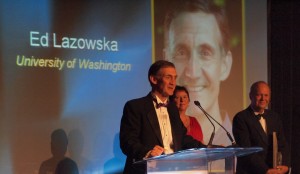
Ed Lazowska accepts the ACM Distinguished Service Award (other photos to follow)
UW CSE was well represented at the annual ACM Awards Banquet, held this year at the Westin St. Francis in San Francisco on the evening of Saturday June 26th.
UW CSE professor Ed Lazowska received the ACM Distinguished Service Award “for more than two decades of wide-ranging and tireless service to the computing community, especially in advocacy at the national level.”
UW CSE professor Gaetano Borriello and UW CSE Ph.D. alumni Jeff Dean (now a Google Fellow) and Chandu Thekkath (now a Director and Principal Researcher at Microsoft Research Silicon Valley) were inducted as ACM Fellows, a distinction awarded to roughly 1% of ACM’s members.
UW CSE Ph.D. alumnus Noah Snavely (now on the computer science faculty at Cornell University) was recognized with an Honorable Mention in the ACM Doctoral Dissertation Award competition.
UW CSE bachelors alumni John Davis (now a Researcher at Microsoft Research Silicon Valley) and Thomas Kwan (now Director of Research Operations at Yahoo! Research) also were in attendance. Read more →
 Corensic (formerly PetraVM) is a UW CSE startup that provides tools for eliminating concurrency bugs from multicore software — launched by faculty members Luis Ceze and Mark Oskin, and backed by our friends at Madrona Ventures, the Washington Research Foundation, and Perkins Coie.
Today Corensic launched Windows and Linux versions of Jinx, its first tool. Read about it here. Read more →
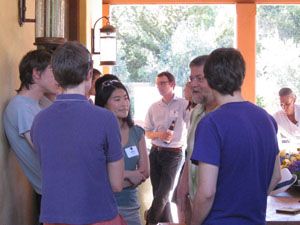 On June 27, more than 60 UW CSE Bay Area alums gathered at the home of Jeff Dean and Heidi Hopper, joined by UW CSE faculty members Gaetano Borriello, Dan Grossman, and Ed Lazowska. Many thanks to Jeff and Heidi for hosting a terrific event! Photos here. Keep in touch here. Read more →
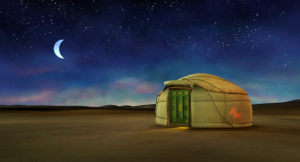 “Threads,” UW CSE’s 2009 computer animation capstone production, has been invited to be screened at the 15th Annual 1 Reel Film Festival (September 4 – September 6, 2010), part of Bumbershoot, Seattle’s Music and Arts Festival, which annually draws over 150,000 people to the grounds of the Seattle Center to celebrate the arts.
Congratulations to Barbara Mones and the entire Threads crew!
See all of UW CSE’s animation productions here. Read more →
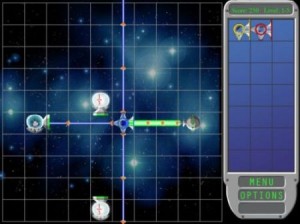 “Refraction,” a game to teach fractions to youngsters, has been named a finalist in the Disney Research Learning Challenge. Learn more about Refraction here. Read more →
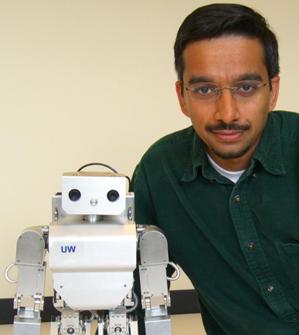 UW CSE researchers have developed a mind-controlled robot (called Mitra) that is directed by human brainwaves. Discovery News’ Kasey-Dee Gardner interviews UW CSE’s Raj Rao, undergrad Mike Chung, and grad Johnathan Lyon as they demonstrate Mitra to find out the human benefits of such a robot.
See the video here. Read more →
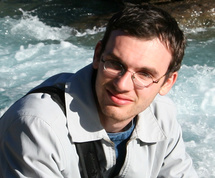 UW CSE Ph.D. alumnus Noah Snavely, now a faculty member at Cornell University, received Honorable Mention in the 2009 ACM Doctoral Dissertation Award competition. Noah’s dissertation, “Scene Reconstruction and Visualization from Internet Photo Collections,” provides much of the technology behind Microsoft’s Photosynth offering, as well as the “Rome in a Day” project.
Congratulations Noah! Read more →
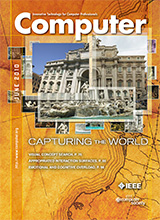 The June 2010 issue of IEEE Computer magazine is devoted to the theme of “Capturing the World.” The cover article describes UW CSE’s “Building Rome in a Day” project; the article, “Reconstructing Rome,” was authored by Sameer Agarwal (UW CSE -> Google), Yasutaka Furukawa (UW CSE -> Google), Noah Snavely (UW CSE -> Cornell University), Brian Curless (UW CSE), Steve Seitz (UW CSE), and Rick Szeliski (Microsoft Research; UW CSE affiliate professor).
“Community photo collections like Flickr offer a rich, ever-growing record of the world around us. New computer vision techniques can use photographs from these collections to rapidly build detailed 3D models.” Read more →
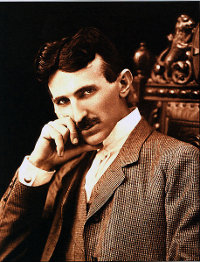 More than a century ago, a startup— funded by J. P. Morgan with technology from Nikola Tesla— envisioned a future where energy would be delivered over the air from power stations to consumers. That vision wasn’t realized, but now researchers have revived the vision on a nano scale.
The Economist reports on research by Josh Smith (UW CSE adjunct faculty and principal engineer at Intel Labs Seattle) with collaborators Scott Southwood (UW CSE undergrad) and Alanson Sample (a researcher at UW Electrical Engineering and at Intel Research Seattle) demonstrating practical application of Tesla’s idea. The researchers have successfully powered a simple weather station using power harvested from “ambient energy” such as that harvested from a television broadcast tower several miles away.
“There is something magical about it,” says Smith, but the science is sound.
Other researchers are already looking at commercial applications of power-harvesting technologies, such as using WIFI signals to charge cellphones.
Read the story at The Economist here. Or view the ten-minute video. An interview with UW researchers starts at about the five-minute point.
Update: The New York Times also reports on Smith’s work in the Novelties column,
Bye-Bye Batteries: Radio Waves as a Low-Power Source, on 16 July 2010. Read more →
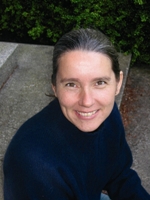 Professor Anne Condon – a UW CSE Ph.D. alum – has been appointed Head of the University of British Columbia Department of Computer Science.
Condon is internationally recognized for her research in complexity theory and bioinformatics, and a leading Canadian proponent for women in science and technology. Her four-year term begins on July 1, 2011.
Earlier this year, Condon was awarded the Computing Research Association A. Nico Habermann Award for her “long standing and impactful service toward the goal of increasing the participation of women in computer science research.”
Read the UBC announcement here. Read more →