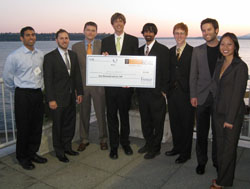
 HydroSense — a team led by UW CSE graduate student Jon Froehlich and advised by UW CSE faculty members Shwetak Patel, James Fogarty, and James Landay — finished 3rd out of 90 entrants in the 2009 University of Washington Business Plan Competition. HydroSense received the $5,000 WRF Capital Finalist Prize, and was named the “Best Clean-Tech Idea.”
Hopes were high as HydroSense won the $10,000 UW Environmental Innovation Challenge in early April, then made it to the Round of 16 and the Round of 5 in the 90-entrant Business Plan Competition. Much of the $10,000 Environmental Innovation Challenge prize was spent by Fogarty purchasing his first suit in the hopes of influencing the final judging of the Business Plan Competition, but wearing it over a t-shirt with an orange tie probably doomed the outcome.
HydroSense attacks the problem of water leakage in the United States, which accounts for 10 percent of average household water used. As part of their strategy, the team developed a device that screws onto a single water faucet and uses an analysis of acoustic vibrations and pressure differential signatures of water flow to determine usage.
Congratulations to Jon and his team! Read more →
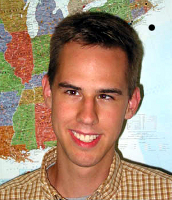
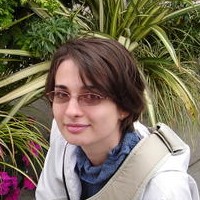 UW CSE graduate students Roxana Geambasu and Michael Piatek are among 13 exemplary Ph.D. students from across the nation who have been named recipients of the inaugural Google Fellowships.
Leading graduate programs in computer science and related fields were invited to nominate two students each. The students could be studying any of 20 different technical areas.
Both of UW’s nominees were awarded Google Fellowships. Roxana received the 2009 Google Fellowship in Cloud Computing. Her research focuses on the challenges, as well as the untapped opportunities, created by today’s rapid move to cloud computing.
Mike received the 2009 Google Fellowship in Computer Networking. His research interests span problems involving networks, distributed systems, and peer-to-peer systems.
More information on these fellowships may be found here.
Congratulations Roxana and Mike! Read more →
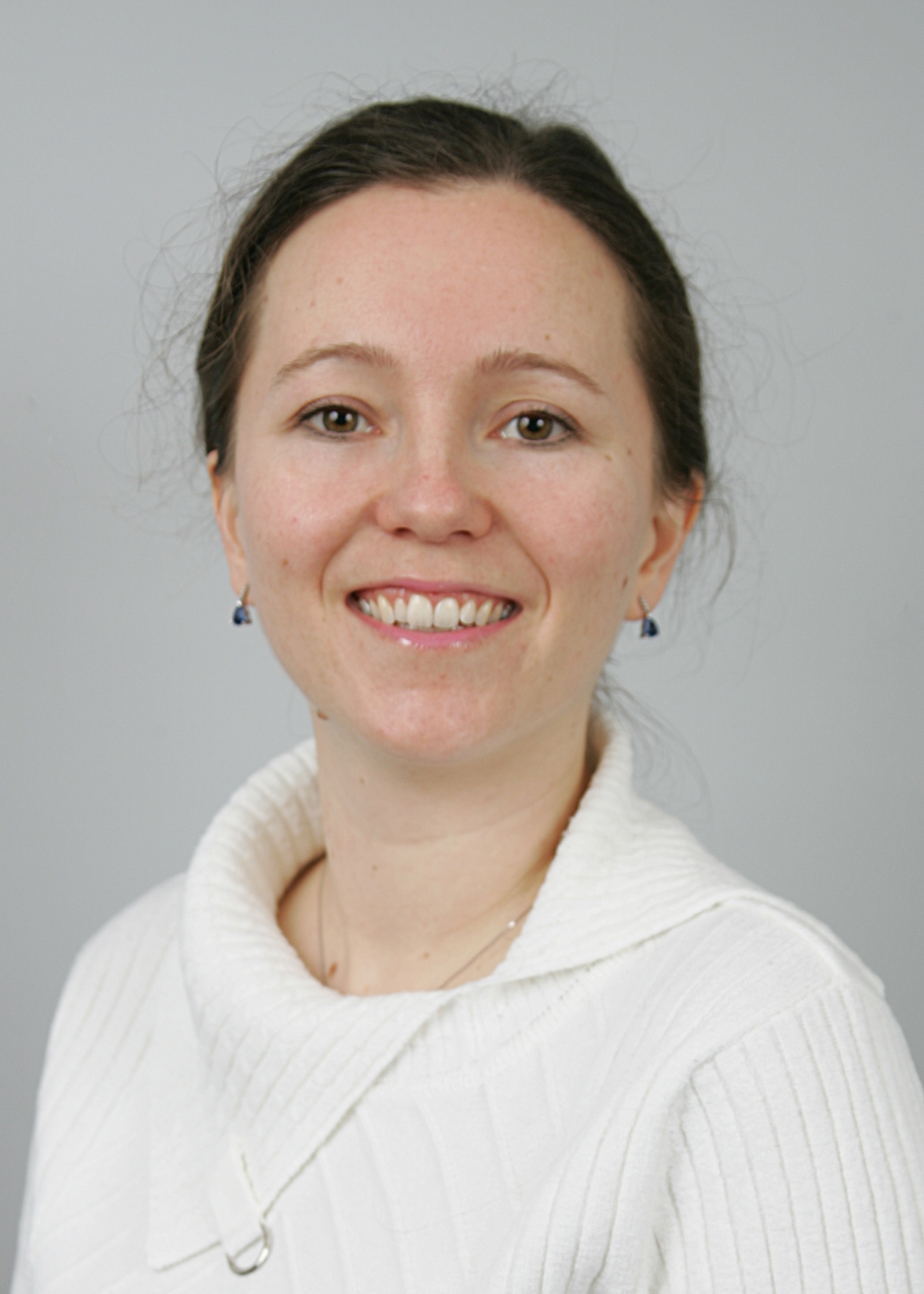 UW CSE faculty member Magda Balazinska has won a 2009 NSF Faculty Early Career Development (CAREER) Award. Magda’s award is for her work developing new techniques for large-scale data management aimed at cloud-computing environments and scientific data analysis applications. In addition to efficient query processing techniques, she is also developing new query management tools that provide runtime query control, intra-query fault tolerance, query composition support, and seamless query sharing.
Magda joins CSE’s Luis Ceze and Yoshi Kohno as 2009 NSF CAREER Award recipients. Magda, Luis and Yoshi are among twenty seven current CSE faculty members who have won CAREER or NSF/Presidential Young Investigator Awards. Read more →

Xconomy reports on the OVP Venture Partners Technology Summit.
“Seattle can be a very politically correct place, and one very un-PC thing to say is that we’re a second-rate burg when it comes to spawning innovative industries of the future. But Ed Lazowska, one of Seattle’s gutsiest public intellectuals, let it rip yesterday in front of a small gathering of about 100 technology elites at the Four Seasons Hotel.
“‘We’re very smug and self-satisfied,’ said Lazowska, the Bill & Melinda Gates Chair of Computer Science & Engineering at the University of Washington … ‘We think of ourselves in the innovation big leagues, but we are, in fact, in the minors compared to the real big leagues of the San Francisco Bay Area and Boston’ …
“This was easy to say in front of an audience of venture capitalists and entrepreneurs who travel a lot, and know all these points to be true. One of the things that baffles me about Seattle – after having lived in Boston and San Francisco – is that so few public officials here would ever dare utter such an obvious truth about how far Seattle lags behind the world-leading clusters for biotech and high tech. If they can’t do that, there’s no way they can engage in serious discussion with the general public about systemic ways this region can improve.”
Read the full Xconomy article here. Read more →
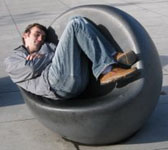 UW CSE Ph.D. student Jeff Bigham has been recognized as the 2009 UW College of Engineering “Student Innovator: Research” in the Community of Innovators award competition.
UW CSE Ph.D. alumnus Scott Hauck, now a faculty member in UW EE, has been recognized as the “Faculty Innovator: Teaching and Learning.”
Congratulations to Jeff and Scott! Read more →
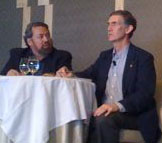 “University of Washington computer science professor Ed Lazowska is known as a straight talking rabble-rouser who doesn’t pull many punches. And he certainly lived up to that reputation today at the OVP Venture Partners Technology Summit …
“Lazowska – who appeared on stage with the equally opinionated Mark Anderson of the Strategic News Service – reserved his toughest comments for a Lake Wobegon mentality in the state where everything appears to be above average.
“‘It seems to me that the issue with this state is that we are one big happy family in which everybody is doing extremely well. Everyone’s college program is above average. And everyone’s company is above average. And everyone’s venture fund is above average. And if you go a little bit more above average than the next guy, then they get all Dirty Harry and whack you down. It’s the State of Whac-a-Mole … I worry that those who excel, and excel honestly, aren’t celebrated in this state'”
Read the full TechFlash article here. Read more →
UW’s Foldit protein folding game received nice coverage in a Computerworld article on human computation (and more generally the importance of human-computer symbiosis).
“You can play a video game called Foldit on the Web while making important contributions to science. Understanding how 3-D proteins ‘fold’ into their optimum structures is critical to understanding disease, but it’s difficult computationally because there are an astronomical number of possible folds for most proteins.
“The thousands of people who play Foldit use their pattern-recognition and puzzle-solving skills to predict protein structures in a way computers can’t easily duplicate. ‘Teenaged gamers are beating the pants off Ph.D. biochemists,’ says Ed Lazowska, a computer science professor at the University of Washington, where Foldit was created.”
See the full Computerworld article here. Read more →
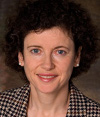 TechFlash has published its inaugural list of of top women in the Seattle technology industry. Among those listed is UW CSE’s Emer Dooley. The list includes many other women who have close ties to UW CSE:
- Connie Bourassa-Shaw, who runs the UW Center for Innovation and Entrepreneurship.
- Amanda Camp from Google Seattle, who has participated in many of our outreach and educational activities.
- Suzan DelBene, who had been the CEO of UW CSE startup Nimble Technologies.
- Maria Klawe, our close friend from Harvey Mudd College who recently joined the Microsoft board.
- Janis Machala and Linden Rhoads from UW Tech Transfer.
- Susannah Malarkey from the Technology Alliance (on whose Executive Committee Ed Lazowska has served for many years).
Read the complete list here. Read more →
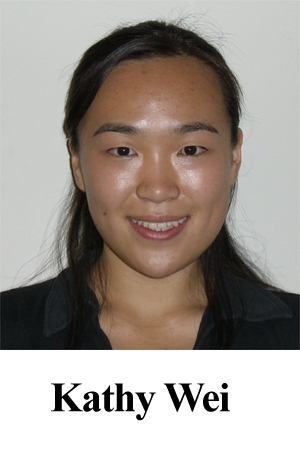 Congratulations to Kathy Wei! Kathy, a dual major in CSE and BioE, was selected as the 2009 College of Engineering Dean’s Medalist from a very competitive pool of applicants.
The Dean’s Medal is awarded to a graduating student in recognition of outstanding academic achievement, research activities, and campus and extra-curricular involvement. The medal is scheduled to be presented at the Community of Innovators Awards ceremony on June 4, 2009, 3:30-5:00 p.m., in the Don James Center. Read more →
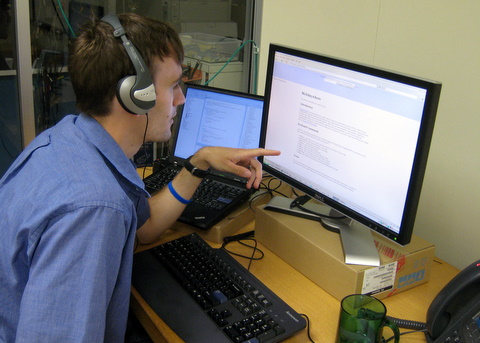 UW CSE’s Jeff Bigham‘s team is one of five teams awarded the 2009 NCTI Technology in the Works award. His team was selected to examine web browsing made accessible for blind students— Enabling More Effective Use of the Web Anywhere with WebAnywhere and TrailBlazer.
The National Center for Technology Innovation (NCTI) assists researchers, developers, and entrepreneurs in creating innovative learning tools for all students, with special focus on students with disabilities. NCTI sponsors this annual competition to inform the development of learning and assistive technologies that can improve educational results for all students, particularly those with disabilities. Five exceptional teams of researchers and vendors have been selected to examine the impact of innovative assistive technologies for students with special needs.
Findings will be presented at the 2009 Technology Innovators Conference in Washington, D.C., November 16-17. Read more →

 HydroSense — a team led by UW CSE graduate student Jon Froehlich and advised by UW CSE faculty members Shwetak Patel, James Fogarty, and James Landay — finished 3rd out of 90 entrants in the 2009 University of Washington Business Plan Competition. HydroSense received the $5,000 WRF Capital Finalist Prize, and was named the “Best Clean-Tech Idea.”