Lance Fortnow calls UW CSE PhD candidate Prasad Raghavendra‘s paper Optimal algorithms and inapproximability results for every CSP? the best computational complexity paper of the year in a Computational Complexity blog entry 2008 Complexity Year in Review. Prasad is advised by Venkat Guruswami. Read more →


ITWorld: NSA patents a way to spot network snoops
This article in ITWorld reports on a recently-revealed 2005 patent application by the National Security Agency for a newly-described technique for detecting tampering with network communication, based upon network delays. CSE’s Tadayoshi Kohno is quoted.
“The neat thing about this particular patent is that they look at the differences between the network layers… This whole problem space has a lot of potential, [although] I don’t know if this is going to be the final solution that people end up using.” Read more →
EE Times on DARPA
 Anthony Tether, the head of the Defense Advanced Research Projects Agency, spoke about his nearly eight years at DARPA in an interview with the EE Times. Tether states he has reinvigorated DARPA’s innovative spirit during his tenure; critics claim he has cut back on basic research. CSE’s Ed Lazowska commented, “there was tremendous deterioration in the agendas of specific agencies and DARPA is a prime example. DARPA’s focus became transitioning existing research results into products for the military.”
Read the full article here. Read more →
Cell Phones with Sensors Aid Fitness, Environmental Awareness

Joint dub (UW Human-Computer Interaction and Design Laboratory) and Intel Research Seattle research projects UbiFit and UbiGreen are the Computing Research Highlight of the Week at the Computing Community Consortium. Both projects use visual feedback on a cellphone screen– UbiFit to promote sticking with your personal excercise program, UbiGreen to promote environmentally-friendly transportation choices.
We reported on local media attention attracted by UbiFit in November here. Read more →
“Where Humans and Robots Connect” on UWTV
In October, CSE Professor Yoky Matsuoka presented a lecture called Where Humans and Robots Connect in the University of Washington College of Engineering Fall Lecture Series. UWTV will air video of the talk three times in early January (Monday,January 5 at 5:00 PM, Thursday, January 8 at 9:00 AM, and Saturday, January 10 at 2:30 AM, all times Pacific).
You can also download MP3 audio or MPEG-4 video from the UWTV site, or stream video in Quicktime or Windows Media. Read more →
CRA Awards for Undergrad Research, 1999-2009
Each year, the Computing Research Association recognizes undergraduates from across North America who have excelled at research in their CRA Outstanding Undergraduate Awards program. Our friends at University of Virginia have compiled a list of the number of students who have been recognized over the past ten years. We’re Number One!!! Congratulations to all of UW CSE’s superb undergraduates. Read more →
Recipients of Third Annual Mellon Awards for Technology Collaboration Announced
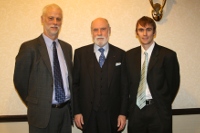 The Andrew W. Mellon Foundation awarded prizes to ten not-for-profit institutions. UW CSE’s own WebAnywhere was one of this year’s recipients. Vint Cerf, presenting these awards at the Fall Task Force meeting of the Coalition for Networked Information (CNI) said the following:
“The MATC Awards have a history of recognizing projects that improve accessibility for people with visual or other impairments, and this year is no exception. The next awardee is the University of Washington, for Project WebAnywhere. By providing a screen-reader as a Web server component, WebAnywhere allows an institution to provide screen-reading functionality to any computer, anywhere in the world, as long as it has speakers, an Internet connection, and a Web browser. Because screen readers can cost thousands of dollars per machine and cannot be moved easily, the total benefit to an institution can be considerable—and the improved mobility for persons with visual impairments generates substantial benefits for students and faculty.
Accepting the award for UW is Jeff Bigham, a PhD candidate in Computer Science and the creator of WebAnywhere.”
Additional information on the awards may be viewed here. More information on the awards ceremony, including podcast interviews with recipients, may be viewed at the CNI website which should be available around December 10, 2008. Read more →
Amazon hopes to cash in on research market
Andrea James’ article and blog (Seattle P-I Seattle Tech Report) highlight how Amazon has had to overcome its public perception as an online bookseller so that developers and researchers would take it seriously as a technology provider.
“Last week, Amazon unveiled a new offering that would make its ‘cloud computing’ service even more appealing to researchers. Amazon will make large data sets available free — some of which are so large they would take hours to download.
“Amazon’s pricing model is attractive enough to make it take off, said Ed Lazowska, the Bill & Melinda Gates Endowed Chair in Computer Science at the University of Washington.
“Making public data available is ‘transformative,’ Lazowska said. ‘If you’re one of the very few companies or scientists who keeps a large cluster of computers going constantly at 95 percent utilization, it’s not for you. But for anyone else, it’s a win.'”
Read the full article here and Andrea’s blog here. Read more →
Zoetrope in the News
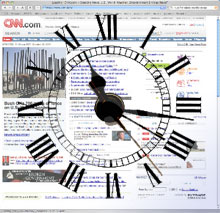
Zoetrope, an application that is designed to help users easily search the historical web, is in the news this week. This tool is featured as the research highlight of the week by the Computing Community Consortium, and is also profiled by Technology Review‘s Erica Naone.
Technology Review coverage here.
“Computing Research Highlight of the Week” here.
We reported earlier on Zoetrope coverage here and here. Read more →
Julia Schwarz and Jessica Leung recognized by CRA
UW CSE undergraduates Julia Schwarz and Jessica Leung were among 66 students from across the country recognized in the 2009 Computing Research Association Outstanding Undergraduate Award competition. Read more →