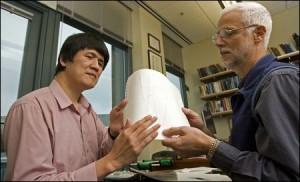
Richard Ladner, UW CSE professor, was one of 15 recipients of the 2008 Purpose Prize, an award for social innovators over 60. Ladner has shifted his focus from computer science theory to developing better technologies for disabled people. He and his students and colleagues have developed such applications as WebAnywhere, software to allow the blind to use the internet on the go, MobileASL, an application for deaf people to use video communication on cell phones, and a faster way to translate textbook graphics into Braille for blind students. The Purpose Prize, now in its sixth year, is awarded by Civic Ventures and funded by The Atlantic Philanthropies and the John Templeton Foundation.
A group of University of Washington researchers are working on MobileASL (American Sign Language) which would allow the hearing-impaired to use sign language on cellphones. The MobileASL project is led by Eve Riskin, a UW professor in electrical engineering; co-leaders include Computer Science & Engineering professor Richard Ladner, and Information School professor Jacob Wobbrock.
We reported earlier on UW News coverage of MobileASL here.
“For Richard Ladner, it isn’t so much about helping people who are blind or deaf get better use of technology as it is about working with people who have disabilities to help us all get better use out of technology.
“‘Few people seem to be aware that a lot of mainstream technologies started out as access technologies,’ the University of Washington computer scientist said.” …
“Absolute Software and Brigadoon Security Group have long been leaders of the laptop-tracking pack. But in July, a new offering emerged: Adeona. Developed by University of California Ph.D. students Gabriel Maganis and Thomas Ristenpart with University of Washington faculty Tadayoshi Kohno and Arvind Krishnamurthy, the software is open source and, get this, free.”…
A joint project with Adobe Systems, other researchers working on the project include CSE professor James Fogarty, CSE graduate student Eytan Adar, and Adobe researcher and CSE alumna Mira Dontcheva.
We reported earlier on UW News coverage of Zoetrope here. You can view a five-minute video on Zoetrope at UW News here. Read more →
“Sharing photos online can be a bit scary for Facebook and MySpace
users because they don’t necessarily want everyone to see
everything. But new technology developed by UW students [including CSE graduate student Michael Toomim ] could soon change online social
networking.” Read more →
“Opportunities for social networking abound on the Internet, but not when it comes to one standard job: using a browser and search engine to comb the Web for information. That task is still typically done solo, because browser displays and search procedures have traditionally been designed for a single user.
“Now tools are being developed by Microsoft and other companies that let people at different computers search as a team, dividing responsibilities and pooling results and recommendations in a shared Web space on the browser display as they plan a family vacation, for instance, or research a medical problem.
“When the federal government needs the best scientific information on any subject, it turns to the National Academy of Sciences.
“Now, the state of Washington will be able to do the same thing with a group of local luminaries. … The Washington group is modeled after the National Academy of Sciences, established by President Lincoln in 1863 to ‘investigate, examine, experiment and report upon any subject of science or art.’ …
“‘An increasing number of public-policy questions require scientific input,’ UW computer scientist and founding board member Ed Lazowska said in an e-mail. ‘WSAS is a place for the governor and the legislature to turn for this advice when they need it.'”
“Researchers at the University of Washington and Intel have created a new cell phone application that could help you keep those holiday pounds off. UbiFit helps you track your workouts using a colorful display… [using] a sensing device, clipped to the user’s waist, which determines what the user is doing based on how it gets jiggled around.” Read more →

 Richard Ladner, UW CSE professor, was one of 15 recipients of the 2008 Purpose Prize, an award for social innovators over 60. Ladner has shifted his focus from computer science theory to developing better technologies for disabled people. He and his students and colleagues have developed such applications as WebAnywhere, software to allow the blind to use the internet on the go, MobileASL, an application for deaf people to use video communication on cell phones, and a faster way to translate textbook graphics into Braille for blind students. The Purpose Prize, now in its sixth year, is awarded by Civic Ventures and funded by The Atlantic Philanthropies and the John Templeton Foundation.

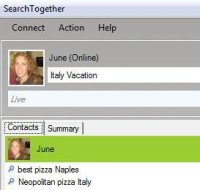 “Opportunities for social networking abound on the Internet, but not when it comes to one standard job: using a browser and search engine to comb the Web for information. That task is still typically done solo, because browser displays and search procedures have traditionally been designed for a single user.