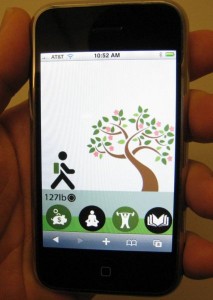
 “Planning on gobbling a few extra treats this holiday season? Soon, your cell phone may be able to help you maintain your exercise routine and keep the pounds off over the winter months, without your having to lift a finger to keep track.”
“Researchers at the University of Washington and Intel have created two new cell phone applications, dubbed UbitFit and UbiGreen, to automatically track workouts and green transportation. The programs display motivational pictures on the phone’s background screen that change the more the user works out or uses eco-friendly means of transportation.”
See press release here. Read more →
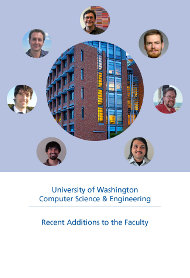 UW CSE welcomes new faculty members Luis Ceze, Michael Ernst, Mausam, Shwetak Patel, Georg Seeling, and Emo Todorov.
See brochure here. Read more →
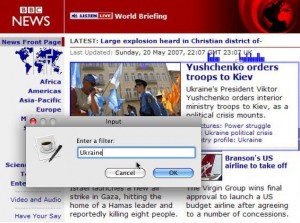 “The Internet contains vast amounts of information, much of it unorganized. But what you see online at any given moment is just a snapshot of the Web as a whole — many pages change rapidly or disappear completely, and the old data gets lost forever.”
” ‘Your browser is really just a window into the Web as it exists today,’ said Eytan Adar, University of Washington computer science and engineering doctoral student. ‘When you search for something online, you’re only getting today’s results.’ “
“Now, Adar and his colleagues at UW and Adobe Systems Inc. are grabbing hold of the fleeting Web and storing historical sites that users can easily search using an intuitive application called Zoetrope.”
Read the press release here . Read more →
Project Lead The Way is offered in nearly 3,000 schools in fifty states and the District of Columbia. The 2008 Model Schools Yearbook highlights the programs in fourteen schools, including Seattle’s Roosevelt High School, where PLTW students paid a visit to UW CSE professor Yoky Matsuoka’s Neurobotics Laboratory.
Read the (PDF) excerpt here and the (PDF) full Model Schools Yearbook here. Read more →
“The human hand is capable of more delicate movement than comparable organs of any other animal. It can wield a tool or weapon as easily as it can make a subtle gesture. So when a human loses her hand, she’s lost a remarkable implement. Yoky Matsuoka wants to ensure a loss like that isn’t permanent. She runs the Neurobotics Lab at the University of Washington. That’s where she and her staff build robots that function like hands and other human body parts. Jeannie Yandel takes a tour of the lab.”
Featured on the KUOW show Sound Focus on November 12, 2008 (originally broadcast January 15, 2008). Read about it and listen to the show here, or listen to the nine-minute segment below.
[audio:sf20081112.mp3]
Read more →
“‘The overall picture for computer science is that both nationally and within the state of Washington, it’s projected as the fastest growing professional occupation between now and 2016,’ wrote Ed Lazowska, the Bill & Melinda Gates Chair in Computer Science & Engineering at UW. ‘With that said, employment is always cyclic …
“‘Major in something you love, and take it seriously,’ Lazowska said. ‘Ten or 15 years down the road, your success will be due to things that the philosophy department teaches just as well as Computer Science & Engineering does: analysis, critical thinking, conflict resolution. If you’re an undergraduate at [UW] for vocational reasons, you’re not taking advantage of what [this] university has to offer …'”
Read the article here. Read more →
“As more of our casual lives are spent online, we need to find a middle ground on security and privacy. Not every transaction and gateway needs the digital equivalent of a scowling paramilitary guard demanding to see our papers. Yet most of us aren’t comfortable letting it all hang out online.
“That’s why I’m intrigued by an easy-access control system called Friendbo, which is being developed by a group of students and professors at the University of Washington.
“It started in early 2007 as a classroom research project by Michael Toomim, a mustachioed 28-year-old Ph.D. candidate from Oakland, Calif. Professors saw potential and helped arrange a $50,000 grant from the UW’s tech transfer program. Now Friendbo‘s a company with patents pending that may release its first application, for Facebook, in a few weeks.”
Read the article here. Read more →
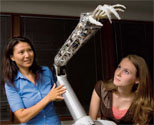
“The call came out of the blue to Yoky Matsuoka, associate professor of Computer science & Engineering. An official from the John D. and Catherine T. MacArthur Foundation instructed Matsuoka to sit down and put down her week-old baby. Then he revealed she had won a 2007 MacArthur Fellowship, the so-called “genius award” with a $500,000 no-strings-attached prize …”
Read the (PDF) article in Trend in Engineering. Read more →
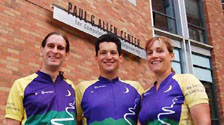
“What’s not to like about young alumni who work hard, pedal hard, and can point you to the best bakeries in the region? And, they contributed to the Campaign UW pie by establishing a fellowship to support “a starving grad student” through surely the most creatively named endowment in UW history. Meet CSE alumni Lauren Bricker (M.S. 1993, Ph.D. 1998), Ruben Ortega (M.S. 1994), and Paul Franklin (M.S. 1993, Ph.D. 1998).”
Read the (PDF) article in Trend in Engineering. Read more →
“RFID tags used in two new types of border-crossing documents in the U.S. are vulnerable to snooping and copying … United States Passport Cards issued by the U.S. Department of State and EDLs (enhanced driver’s licenses) from the state of Washington contain RFID (radio-frequency identification) tags that can be scanned at border crossings …”
Extensive media coverage of research by CSE professor Yoshi Kohno and his students includes:
New York Times
Wall Street Journal
KOMO TV
KING TV
Slashdot
RSA Laboratories
Read the research paper here (pdf). Read more →