Read the article here.
PC Week describes the Adeona service, created by UW CSE undergraduate Gabriel Maganis.”Lose your laptop these days and you lose part of your life: You say good-bye to photos, music and personal documents that cannot be replaced, and if it’s a work computer, you may be the source of a very public data breach.
“But now, researchers at the University of Washington and the University of California, San Diego, have found a way to give you a shot at getting your life back …
“Here’s how it works: A user downloads the free client software onto a laptop. That software then starts anonymously sending encrypted notes about the computer’s whereabouts to servers on the Internet. If the laptop ever goes missing, the user downloads another program, enters a username and password, and then picks up this information from the servers …”
See Slashdot here
See SC Magazine here Read more →
Read the article here.
“Insert your key in the ignition of a luxury car and the seat and steering wheel will automatically adjust to preprogrammed body proportions … But open any computer program and you’re largely subject to a design team’s ideas about button sizes, fonts and layouts … A new approach to design, developed at the University of Washington, would put each person through a brief skills test and then generate a mathematically-based version of the user interface optimized for his or her vision and motor abilities.”
Supple project website here. Read more →
 CSE’s Yoky Matsuoka is profiled by PBS’s Nova science series. “A former tennis prodigy aims to create advanced prosthetic limbs controlled by human thought. Learn how a self-described ‘airhead’ came to embrace her inner scientist, and what she’s doing to encourage young women to pursue scientific careers.”
View the video at Nova. Read more →
Read the article here.
CSE’s Ed Lazowska in the Chronicle of Higher Education. Read more →
Read the article here.
 Mikhail Manyak, 20, a University of Washington Computer Engineering student, died Sunday after suffering a massive allergic reaction to medications prescribed following oral surgery. Read more →
Read the article here.
“WebAnywhere, launched today, lets blind and visually impaired people surf the Web on the go. The tool, developed at the University of Washington, turns screen-reading into an Internet service that reads aloud Web text on any computer with speakers or headphone connections.” Read more →
Read the article here.
“Forty years ago, while an eighth-grader at the private Lakeside School in Seattle, Gates was introduced to his first computer. He was immediately smitten, as was fellow student Paul Allen.
“The two became fast friends, says Ed Lazowska, who holds the Bill & Melinda Gates Chair in Computer Science & Engineering at the University of Washington.
“‘They did the scheduling for Lakeside School – there are rumors they and their friends got into the classes of their choice,’ says Lazowska. ‘It was just a couple of brilliant guys who got captured by this cool field.'” Read more →
Read the article here.
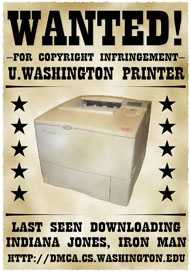 “A new study from the University of Washington suggests that media industry trade groups are using flawed tactics in their investigations of users who violate copyrights on peer-to-peer file sharing networks …
“The paper finds that there is a serious flaw in how these trade groups finger alleged file-sharers. It also suggests that some people might be getting improperly accused of sharing copyrighted content, and could even be purposely framed by other users.”
Slashdot (“Why would a printer, an inanimate object with no reproductive organs, be downloading pornography? It doesn’t fit … if the toner cartridge won’t fit, you must acquit.”) here. Read more →
Read the article here (Microsoft Word).
Harada was recognized for his “‘Hands-Free Voice-Driven Drawing and Diagram Creation Method for People with Motor Impairments,’ a voice activated speech recognition technology that allows the user to create diagrams and drawings on the computer. This technology successfully bridges the gap that has existed between voice activated technology for dictation and hands free control of the computer. It also serves as a low cost method of drawing and designing via the computer. Harada was mentored by Dr. Jacob Wobbrock, a previous first place award winner in the National Scholar Award program.” Read more →