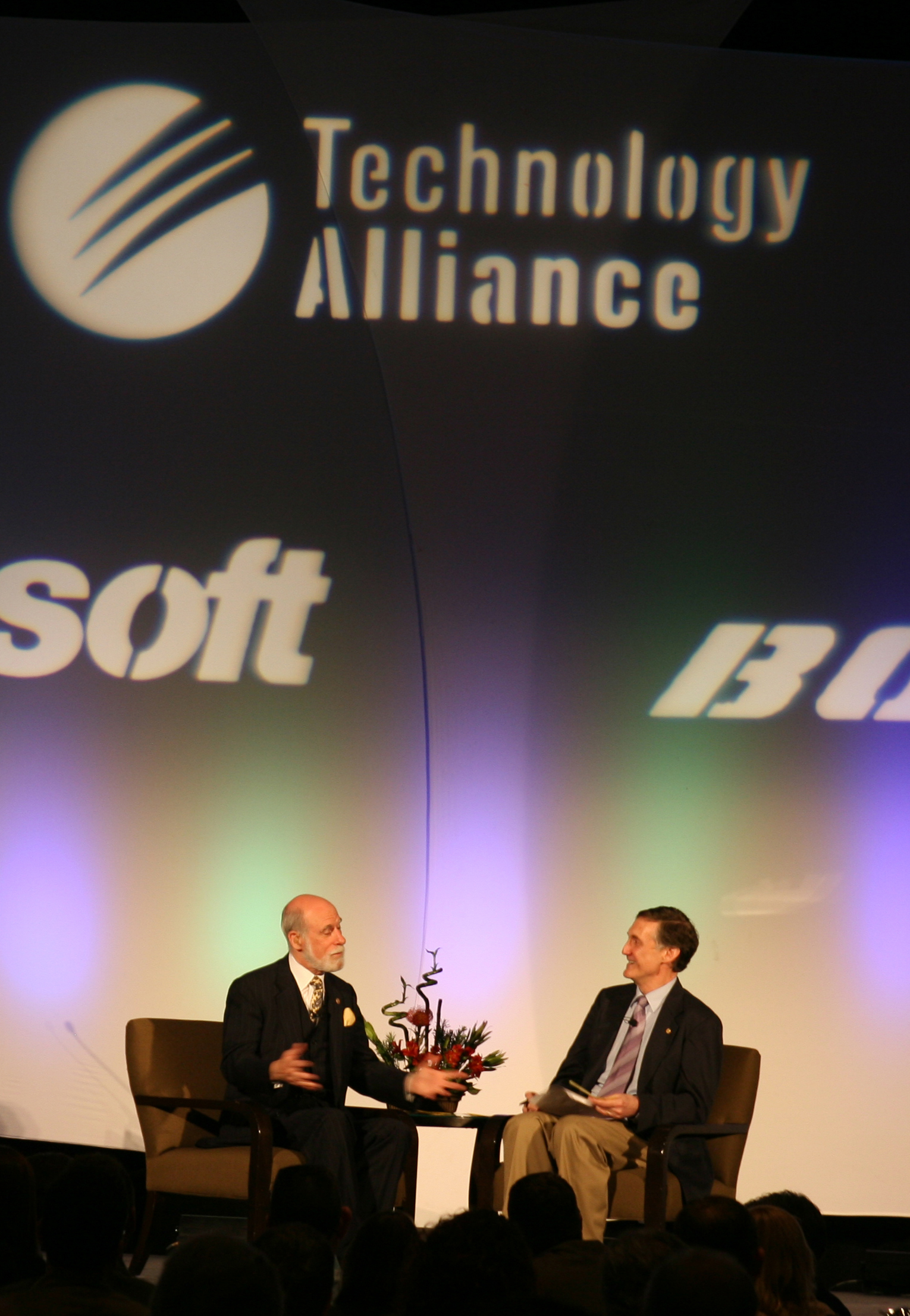
Read the article here.
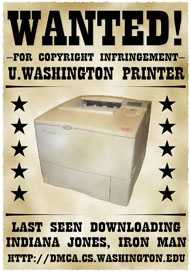 “A new study from the University of Washington suggests that media industry trade groups are using flawed tactics in their investigations of users who violate copyrights on peer-to-peer file sharing networks …
“The paper finds that there is a serious flaw in how these trade groups finger alleged file-sharers. It also suggests that some people might be getting improperly accused of sharing copyrighted content, and could even be purposely framed by other users.”
Slashdot (“Why would a printer, an inanimate object with no reproductive organs, be downloading pornography? It doesn’t fit … if the toner cartridge won’t fit, you must acquit.”) here. Read more →
Read the article here (Microsoft Word).
Harada was recognized for his “‘Hands-Free Voice-Driven Drawing and Diagram Creation Method for People with Motor Impairments,’ a voice activated speech recognition technology that allows the user to create diagrams and drawings on the computer. This technology successfully bridges the gap that has existed between voice activated technology for dictation and hands free control of the computer. It also serves as a low cost method of drawing and designing via the computer. Harada was mentored by Dr. Jacob Wobbrock, a previous first place award winner in the National Scholar Award program.” Read more →
Photographs and videos from the 2008 UW Computer Science & Engineering commencement ceremony. Read more →
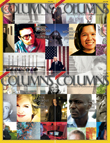 Columns, the UW alumni magazine, celebrates its 100th year by highlighting the accomplishments of 100 distinguished living alumni. Among those included with ties to CSE are:
- Tim Paterson, author of QDOS, which became MS-DOS
- Brad Fitzpatrick, creator of LiveJournal
- Chris DeWolfe but inexplicably not Aber Whitcomb, co-founders of MySpace
- James Sun, founder of Zoodango
- Jeremy Jaech, co-founder of Aldus, Visio, and Trumba, and board member of RealNetworks
- Loren Carpenter, part of the Pixar founding team and Academy Award winner
Article is here. Read more →
Columns, the UW alumni magazine, interviews CSE professor and MacArthur “Genius” Award winner Yoky Matsuoka here. Read more →
Read the article here.
ACM will present the 2007 Eugene Lawler Award to Randy Wang and the Digital Study Hall team for innovative use of cost-effective digital technology that helps improve the education of underserved children in South Asia. Wang’s vision was for a system that harvested community-generated videos of the best grassroots teachers to help schools in urban slums and rural areas in India.
Wang was a Ph.D. student of UW CSE professor Tom Anderson. A number of the concepts of Digital Study Hall were framed during Wang’s visits to UW, and a number of UW students and faculty participated in the project in various ways. Read more →
Read the article here.
The Seattle PI describes the “Foldit” videogame, a collaboration involving UW CSE’s Zoran Popovic, David Salesin, and Adrien Treuille, and UW Biochemistry’s David Baker. “Benjamin Baker is a 13-year-old middle school student who, like most boys his age, probably thinks his father is kind of a geek, if not a dork.
“His father, David Baker, is, after all, a scientist. He is the type of wild-haired, frequently disheveled deep thinker who could play the role of a scientist in one of those schlocky, adolescent-targeted movies in which smart people are included only when the main characters need special help to solve problems involving girls, money or the police.
“Given all this, and that Ben is now working hard on the home computer trying to help solve his father’s real-life problem – that of protein structural analysis – is strong evidence that Baker and his colleagues at the University of Washington may have discovered something revolutionary, something huge:
“How to make complicated science into a fun video game!” Read more →
Read the article here.
“When Jeff Bigham started developing a Web-based screen reader for people who are blind, he had no idea his work would bring him international recognition as one of the brightest young stars of computer science and accessible technology. He was just trying to help people.
“Bigham, 27, and a Ph.D candidate in computer science at the University of Washington, won the first-ever Accessible Technology Award for Interface Design in the 2008 Imagine Cup technology competition sponsored by Microsoft …”
Visit the WebAnywhere research project website here! Read more →
Read the article here.
“A group at the University of Washington developed a clever new way to get the public’s help with the massive computing challenge of researching cures for conditions such as HIV and Alzheimer’s.
“They created a free, downloadable video game called FoldIt! that ‘turns protein folding into a competitive sport.’
“I was skeptical, too, but after I downloaded it and played for awhile, it became addictive. The game draws out any latent obsessive-compulsive disorder you may have, encouraging you to wiggle, shake and pull 3D proteins to ‘fix’ their shapes.”
Science Daily here
UW News & Information here
The Economist here
Technology Review here
Nature here
Howard Hughes Medical Institute here
Mother Jones here
Popular Science here
Discovery Channel here Read more →
Read the article here.
 A web archive of the TVW live broadcast of the interview. Read more →