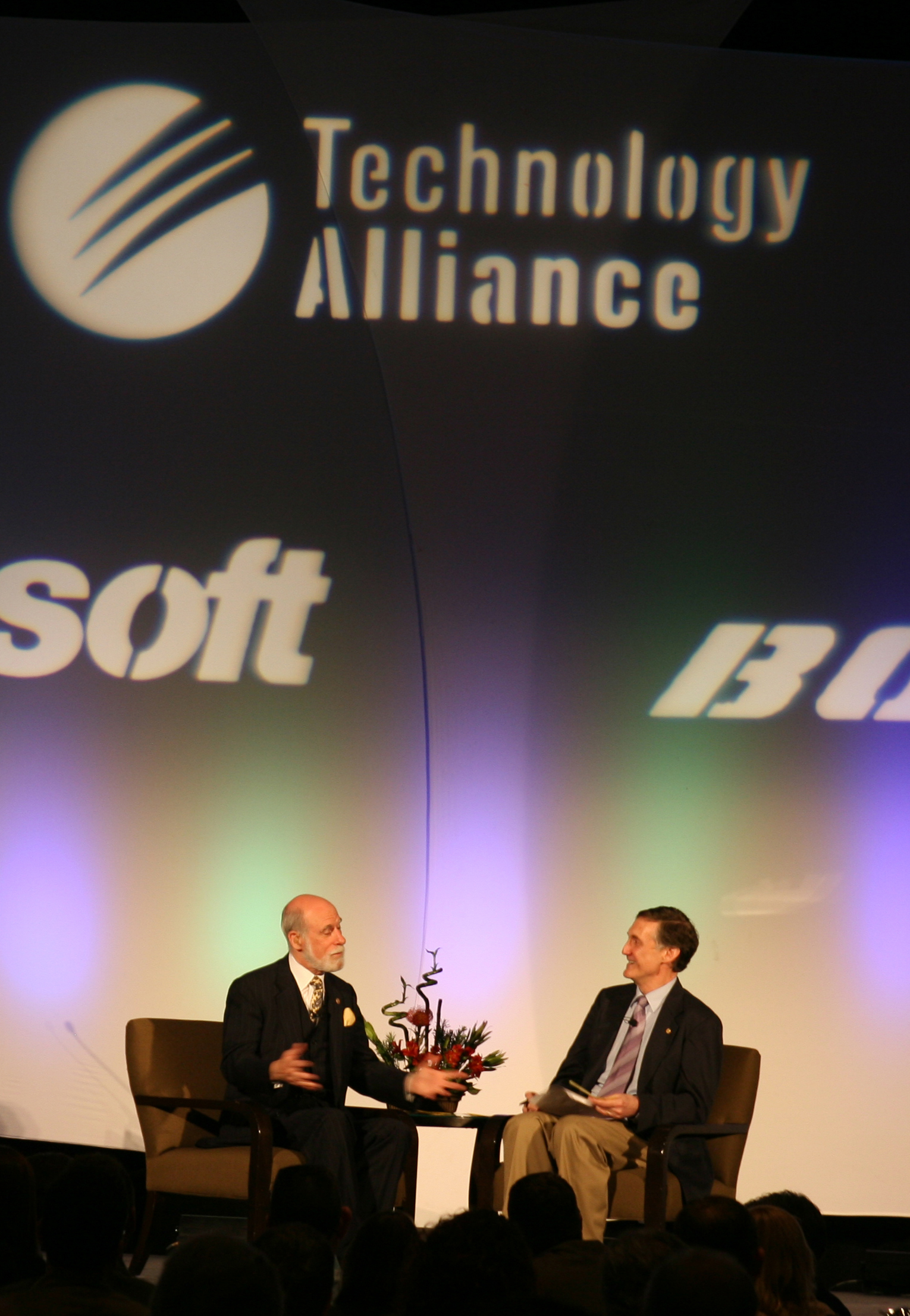
“Etzioni’s spinout companies include airfare prediction website Farecast, just bought by Microsoft for a reported $115M.”
Story here. Read more →

“Etzioni’s spinout companies include airfare prediction website Farecast, just bought by Microsoft for a reported $115M.”
Story here. Read more →
Read the article here.
 A conversation between Vint Cerf and CSE’s Ed Lazowska highlights the Technology Alliance annual luncheon.
IT World here Read more →
Read the article here.
UW CSE Ph.D. student Prasad Raghavendra has been named co-winner of the Best Paper Award (and winner of the Best Student Paper Award) at the 2008 ACM Symposium on the Theory of Computing. Read more →
“We can take turns guessing the source of that next great thing. One guy to watch is Oren Etzioni, a University of Washington computer scientist who has a knack for inventing ideas that become highly valued businesses.”
Story here. Read more →
Read the article here.
The Imagine Cup is an annual year-long student software competition with awards in 9 major categories. UW CSE’s WebAnywhere project has been named the worldwide winner of the “Interface Design Accessible Technology” division. WebAnywhere is the project of UW CSE Ph.D. student Jeff Bigham. WebAnywhere is a web-based screen reader for the web. It requires no special software to be installed on the client machine and, therefore, enables blind people to access the web from any computer they happen to have access to that has a sound card. WebAnywhere runs on any machine regardless of what operating system it is running and regardless of what browsers are installed. Read more →
Read the article here.
“Join us for a fascinating afternoon of lectures by five of the College of Engineering’s rising stars. In an unprecedented year, the MacArthur Foundation and MIT Technology Review honored three faculty members, an alumnus, and a student for their exceptional contributions to society. Learn more about their inspiring work.” (The College of Engineering seems to have ignored CSE Ph.D. alumna Karen Liu and CSE Affiliate faculty member Desney Tan, both of whom also were recognized by Technology Review.) Read more →
Read the article here.
“Today’s event will also include the announcement of the Jim Gray Chair, which drew contributions from up and down the West Coast.
“Microsoft Chairman Bill Gates, Google Chief Executive Eric Schmidt, and Marc Benioff, CEO of Microsoft rival Salesforce.com, each donated $250,000 within a few hours of being asked, according to Ed Lazowska, a University of Washington computer science professor who helped with the fundraising. A fourth donor, Mike Stonebraker, also donated $250,000. He is a Berkeley professor and founder of Ingres, a database system.
“Their donations are being matched by $1 million from the Hewlett Foundation, as in Hewlett-Packard. A mix of additional gifts includes $75,000 from Google and $200,000 from Microsoft, which is passing on a prize that Gray won.
“‘It’s another indication of how Jim spans all kinds of differences and brings people together,’ Lazowska said.”
Brier Dudley blog posts (excellent!): here, here, here, here, and here.
Joseph Joy blog post here.
O’Reilly Radar blog post here. Read more →
Read the article here.
“‘He was one of the world’s great listeners,’ said Ed Lazowska, a University of Washington computer scientist who in recent years had collaborated with Dr. Gray on a series of projects designed to provide powerful computational tools to scientists. ‘I thought we had a special relationship,’ he said, only to realize that there were 500 special relationships of the same kind.
“Several speakers quoted Jimi Hendrix, who once noted, ‘Knowledge speaks, but wisdom listens,’ to try to explain Jim Gray’s special qualities.
“The object lesson taught by Dr. Gray, said Dr. Lazowska, was that while there is nothing you can do about improving your I.Q., it is possible to work at becoming a terrific human being.
“‘Jim was the world’s greatest connector,’ he said. ‘He connected ideas and people and he didn’t understand boundaries, either corporate or national.'” Read more →
Read the article here.
 “Farecast‘s sale to an unknown buyer is the latest score for superstar University of Washington computer scientist Oren Etzioni, who has watched several of his Internet companies gobbled up at attractive valuations over the past 15 years.
“Those include comparison shopping service NetBot, which was acquired by Excite in 1997, and MetaCrawler, a search engine that is now part of InfoSpace.”
Farecast, like many other UW CSE startups, included Madrona Venture Group and the WRF Capital as early investors. Read more →