Read the article here.
Three UW CSE graduate students and three recent UW CSE bachelors alums have been named recipients of 2008 National Science Foundation Graduate Research Fellowships, the top award for graduate students in engineering and the sciences. UW CSE graduate student recipients are Laura Effinger-Dean, Brian DeRenzi, and Jessica Chang. UW CSE bachelors alum recipients are Annie Liu (now a graduate student at Caltech), Gabriel Maganis (now applying to graduate schools), and Kurtis Heimerl (now a graduate student at UC Berkeley). Read more →
Read the article here.
UW CSE students Julie Letchner and Kate Everitt are among 23 nationwide winners of 2008 Google Anita Borg Scholarships. Google established the Anita Borg Memorial Scholarships “to honor the work of Dr. Anita Borg, a computer scientist who dedicated her professional career to increasing the participation of women and other under-represented minorities in the field of technology.” Read more →
Read the article here.
CSE undergraduates Julia Moore and Kathy Wei have been awarded 2008 Goldwater Scholarships. Goldwater Scholarships are the premier award for undergraduates majoring in engineering and the sciences. Read more →
Read the article here.
Photosynth, a collaboration between UW CSE’s computer graphics group and Microsoft, has been featured in an episode of CBS’s hit crime drama CSI: NY.
This is a significant move uptown from the graphics group’s other recent television exposure: visualization of “drafting” as part of NASCAR coverage.
Seattle Times article here
Seattle PI article here
Washington Times here
Discover here Read more →
Read the article here.
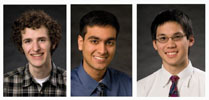 Each year, the University of Washington awards medals to the students who had the strongest academic record in their class during the previous year. This year, in an unprecedented clean sweep, CSE students won all three medals. The Freshman Medalist (the top student in last year’s class of 5500 freshmen) is Chad Klumb. The Sophomore Medalist is Pavan Vaswani. The Junior Medalist is Ting-You Wang. Congratulations! Read more →
Read the article here.
“Whether you’re a frustrated songwriter or a shower-time crooner, you may long to hear your lyrics put to music. New software from Microsoft promises to provide just that: instant musical accompaniment to singing.
“The software, called MySong, was developed by Dan Morris and Sumit Basu at Microsoft’s research lab in Redmond, Washington, US, and Ian Simon at the University of Washington in Seattle.” Read more →
Read the article here.
“You’re trying to log on to a Web site and it’s not working. You try again and again. But persistence doesn’t pay off. The site you want is inexplicably, frustratingly, out of reach.
“The other computer might just be turned off, but the causes could be more mysterious. At any given moment, a proportion of computer traffic ends up being routed into information black holes. These are situations where a path between two computers does exist, but messages — a request to visit a Web site, an outgoing e-mail — get lost along the way.
“A University of Washington system named Hubble looks for these black holes and maps them on a Web site, providing an ever-changing constellation of the Internet’s weak points. The Hubble map lets visitors see a map of problems worldwide or type in a specific Web page or network address to check its status. The work is being presented next week in San Francisco at the Usenix Symposium on Networked Systems Design and Implementation.
“‘There’s an assumption that if you have a working Internet connection then you have access to the entire Internet,’ said Ethan Katz-Bassett, a UW doctoral student in computer science and engineering. ‘We found that’s not the case.'” Read more →
Read the article here.
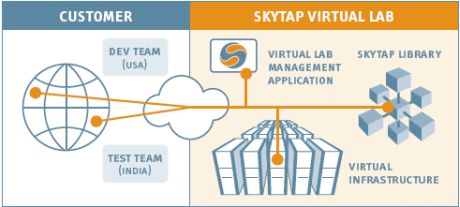 “The secretive Seattle virtualization startup Illumita has changed its name to Skytap and unveiled details around its first product, dubbed Skytap Virtual Lab … Started as a project by University of Washington computer scientists, Skytap’s goal with its first product is to create an easy and cost-efficient manner by which companies can test Web applications or software code in a virtual lab.”
According to CSE professor and company co-founder Hank Levy, the domain name Spinaltap was already taken.
See also Seattle Times. Read more →
Read the article here.
“Ethan Katz-Bassett, a graduate student in computer science at the University of Washington, and his advisor, Arvind Krishnamurthy, designed a program to continuously search for strange Internet gaps, when a request to visit a Web site or an outgoing e-mail gets lost along a pathway that was known to be working before.”
Hubble project web here
Parody from The Spoof! here.
LiveScience here
Fox News here
“Connected” interview (KJR FM) here
Computerworld here
Ars Technica here
Boing Boing here
Digg here
Slashdot here
Wired.com here
UW News & Information here Read more →
Read the article here.
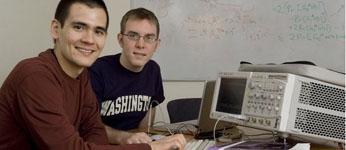 “A Seattle computer scientist who helped expose how hackers can mess with electronic voting machines is part of a team that has shown how new, wireless cardiac devices implanted in thousands of heart patients also are vulnerable to electronic attack … “[UW CSE’s Yoshi] Kohno and others have shown they can wirelessly extract personal medical information from an implantable cardiac defibrillator as well as reprogram or disrupt the device. The team includes Harvard University cardiologist Dr. William Maisel and Kevin Fu of the University of Massachusetts-Amherst, also a computer scientist.”
Additional information here
UW press release here
New York Times here
Wall Street Journal here
Boston Globe here
Science Daily here
University Week here
The Osgood File (CBS Radio) here
Australian Broadcasting Corporation here Read more →