Skip to main content
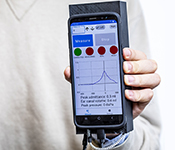 According to the World Health Organization, more than 430 million people around the globe live with a disabling hearing loss — including 34 million children. Tympanometry is a test of middle ear function that can be used in conjunction with other tests to diagnose middle ear disorders that could lead to permanent hearing loss. Although it is a relatively simple test, there are barriers for widespread use in resource-constrained communities. In a paper published in Nature Communications Medicine, researchers present a lightweight alternative to conventional tympanometry devices that is also lighter on the wallet… Read more →
June 16, 2022
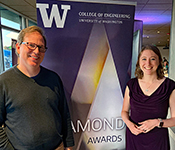 Stefan Savage (left) and Justine Sherry. Ed Lazowska
Each year, the University of Washington’s College of Engineering recognizes alumni and friends who have made outstanding contributions to the field of engineering through its Diamond Awards. Among the 2022 honorees are two Allen School alumni whose cutting-edge research has helped steer the future of computer networking with far-reaching impacts: Stefan Savage (Ph.D., ’02), recipient of the Distinguished Achievement in Academia Award, and Justine Sherry (B.S., ‘10), recipient of the Early … Read more →
Stefan Savage (left) and Justine Sherry. Ed Lazowska
Each year, the University of Washington’s College of Engineering recognizes alumni and friends who have made outstanding contributions to the field of engineering through its Diamond Awards. Among the 2022 honorees are two Allen School alumni whose cutting-edge research has helped steer the future of computer networking with far-reaching impacts: Stefan Savage (Ph.D., ’02), recipient of the Distinguished Achievement in Academia Award, and Justine Sherry (B.S., ‘10), recipient of the Early … Read more →
June 2, 2022
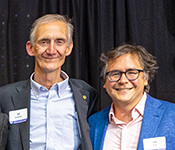 Ed Lazowska: “This is a community in which we lift one another up.” Matt Hagen
In 2020, four couples who are longtime friends of the Allen School joined forces to create a new endowed professorship fund named for professor Ed Lazowska to honor his wide-ranging impact on the field of computing, Washington higher education, and the technology community. They seeded the fund with a combined gift of $1 million, and then began inviting other friends and alumni of the school… Read more →
Ed Lazowska: “This is a community in which we lift one another up.” Matt Hagen
In 2020, four couples who are longtime friends of the Allen School joined forces to create a new endowed professorship fund named for professor Ed Lazowska to honor his wide-ranging impact on the field of computing, Washington higher education, and the technology community. They seeded the fund with a combined gift of $1 million, and then began inviting other friends and alumni of the school… Read more →
June 1, 2022
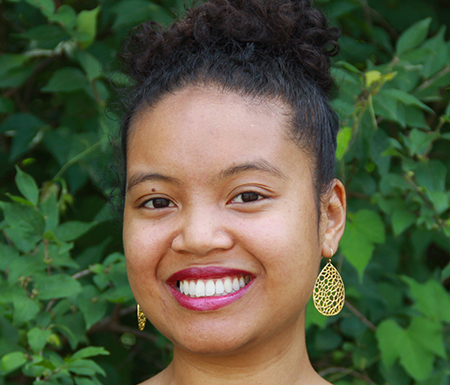 Allen School professor and alumna Leilani Battle (B.S., ‘11) is building a career out of building better ways to deal with data. Her research, which looks beyond conventional data management techniques to incorporate human behavior and preferences, enables analysts to spend more time engaging with the data they need, and less time searching and waiting for it to load. Recognizing the transformational impact and future potential of Battle’s work, the IEEE Computer Society’s Technical Committee on Data Engineering recently recognized… Read more →
May 31, 2022
 Ph.D. students participating in the Meta AI Mentorship Program will spend part of their time working alongside researchers in Meta’s Seattle office. Credit: Netta Conyers-Haynes
The University of Washington and Meta are launching a new partnership today that will support graduate student research while providing opportunities to collaborate with industry-leading scientists and engineers. The Meta AI Mentorship Program is designed to enable Allen School Ph.D. students who are interested in artificial intelligence, machine learning or natural language processing to advance… Read more →
Ph.D. students participating in the Meta AI Mentorship Program will spend part of their time working alongside researchers in Meta’s Seattle office. Credit: Netta Conyers-Haynes
The University of Washington and Meta are launching a new partnership today that will support graduate student research while providing opportunities to collaborate with industry-leading scientists and engineers. The Meta AI Mentorship Program is designed to enable Allen School Ph.D. students who are interested in artificial intelligence, machine learning or natural language processing to advance… Read more →
May 18, 2022
 Eight years ago, Allen School professor Jennifer Mankoff and a group of like-minded researchers who cared about, or needed, accessibility put their heads together after coming to a realization about SIGCHI, the Association for Computing Machinery’s Special Interest Group on Computer-Human Interaction. While a growing swath of researchers in the community had begun to focus on the design and evaluation of technologies for diverse users, including those with disabilities, Mankoff and her colleagues noted that the venues for showcasing… Read more →
May 17, 2022
 One is defying traditional gender-based norms through her choice of career path while making it easier for her peers to do the same. Another was motivated to turn tragedy into triumph and dedicate his research to making the world more accessible to people with disabilities. And still others are working to unlock the mysteries of disease, empowering communities through data, and questioning how we can ensure that emerging technologies are designed to serve diverse people and communities.
What all five… Read more →
One is defying traditional gender-based norms through her choice of career path while making it easier for her peers to do the same. Another was motivated to turn tragedy into triumph and dedicate his research to making the world more accessible to people with disabilities. And still others are working to unlock the mysteries of disease, empowering communities through data, and questioning how we can ensure that emerging technologies are designed to serve diverse people and communities.
What all five… Read more →
May 11, 2022
 “Nothing about us without us.”
That statement has become a rallying cry for people with disabilities to ensure they have a direct voice in shaping the policies and conditions that, in turn, shape their access to employment, education, and lately, technology. With the growing proliferation of human-centered applications powered by artificial intelligence, it has become clear that the question of who will benefit from these emerging technologies will be determined in no small part by who makes them.
Venkatesh Potluri… Read more →
“Nothing about us without us.”
That statement has become a rallying cry for people with disabilities to ensure they have a direct voice in shaping the policies and conditions that, in turn, shape their access to employment, education, and lately, technology. With the growing proliferation of human-centered applications powered by artificial intelligence, it has become clear that the question of who will benefit from these emerging technologies will be determined in no small part by who makes them.
Venkatesh Potluri… Read more →
May 9, 2022
 When Sewon Min first arrived at the University of Washington as an exchange student in the fall of 2016, little did she know how those three months would change the course of her academic career. After completing a brief stint as an undergraduate research assistant under the guidance of Allen School professors Hannaneh Hajishirzi and Ali Farhadi, she returned to Seoul National University in Korea to complete her bachelor’s degree. In the interim, Hajishirzi “tried really hard” to convince… Read more →
April 27, 2022
 When he was a student in high school, computer science major Alex Mallen had what he describes as a “rough” introduction to research. Fortunately, the Bellevue, Washington, native didn’t let that experience deter him at the University of Washington, where as a freshman he decided to try again as a step toward pursuing a Ph.D. after graduation. Mallen’s persistence has paid off in the form of multiple, positive research experiences that have helped him to solidify his plans to enroll… Read more →
April 12, 2022
« Newer Posts — Older Posts »