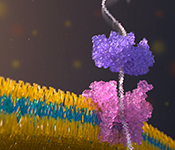
 Determining protein sequences, or the order that amino acids are arranged within a protein molecule, is key to understanding their role in different biological processes and diseases. In a recent paper published in the journal Nature, a team of University of Washington researchers introduced a new approach to long-range, single-molecule protein sequencing using commercially available devices from Oxford Nanopore Technologies. The team, led by senior author and Allen School research professor Jeff Nivala, demonstrated how to read each protein molecule by pulling it through a nanopore sensor multiple times to increase sequencing accuracy. Read more →

Singular sensation: Allen School researchers develop new method for sequencing proteins using nanopores
Determining protein sequences, or the order that amino acids are arranged within a protein molecule, is key to understanding their role in different biological processes and diseases. In a recent paper published in the journal Nature, a team of University of Washington researchers introduced a new approach to long-range, single-molecule protein sequencing using commercially available devices from Oxford Nanopore Technologies. The team, led by senior author and Allen School research professor Jeff Nivala, demonstrated how to read each protein molecule by pulling it through a nanopore sensor multiple times to increase sequencing accuracy. Read more →
MONET helps paint a clearer picture of medical AI systems
 In a recent paper published in the journal Nature Medicine, a team of researchers at the University of Washington and Stanford University co-led by Allen School professor Su-In Lee introduced a medical concept retriever, or MONET, that can connect images of skin diseases to semantically meaningful medical concept terms. Beyond annotating dermatology images, MONET has the potential to improve transparency and trustworthiness throughout the entire AI development pipeline, from data curation to model development. Read more →
Pushing beyond the silos: Allen School’s Jon Froehlich aims to build a unified approach to urban science as part of new NSF-funded project
 Urban communities are vibrant centers of economic, cultural and civic activity. Such vibrancy yields a lot of data that could provide a window onto how our urban environments function, but it’s difficult to extract usable insights when the data is stored in different formats, spread across different systems and maintained by different agencies. Allen School professor Jon Froehlich is pursuing a more unified approach that will democratize data analysis and exploration at scale and empower urban communities as part of a new, five-year project dubbed OSCUR — short for Open-Source Cyberinfrastructure for Urban Computing — that recently earned a $5 million grant from the National Science Foundation. Read more →
Looking into places others are not: Allen School’s Miranda Wei receives 2024 Karat Award for contributions to usable security and privacy
 When Miranda Wei attended her first Symposium on Usable Privacy and Security (SOUPS) conference in 2017, she had little experience in the field; she had only recently graduated with a degree in political science from the University of Chicago. But the community of researchers at the conference welcomed her in. That experience paved the way for her to continue doing research on privacy and security and, eventually, to pursue a Ph.D. at the Allen School. Seven years after her first foray into the SOUPS community, Wei received the 2024 John Karat Usable Privacy and Security Student Research Award at the conference for her interdisciplinary contributions to the field, efforts to mentor others and community service.
Read more →
When Miranda Wei attended her first Symposium on Usable Privacy and Security (SOUPS) conference in 2017, she had little experience in the field; she had only recently graduated with a degree in political science from the University of Chicago. But the community of researchers at the conference welcomed her in. That experience paved the way for her to continue doing research on privacy and security and, eventually, to pursue a Ph.D. at the Allen School. Seven years after her first foray into the SOUPS community, Wei received the 2024 John Karat Usable Privacy and Security Student Research Award at the conference for her interdisciplinary contributions to the field, efforts to mentor others and community service.
Read more →
Marvelous mutants: Allen School’s René Just and Michael Ernst receive FSE Most Influential Paper Award for showing the validity of mutants in software testing
 In the Marvel Universe, mutants known as the X-Men wield superhuman abilities ranging from shape-shifting to storm-summoning. In the software universe, mutants may not bring the thunder, but they are no less marvelous. In 2014, Allen School professors René Just and Michael Ernst, along with their collaborators, demonstrated that mutants function as an effective substitute for real defects in software testing. Their work earned them the Most Influential Paper Award at the recent ACM International Conference on the Foundations of Software Engineering (FSE 2024). Read more →
Mind over model: Allen School’s Rajesh Rao proposes brain-inspired AI architecture to make complex problems simpler to solve
 When you reach out to pet a dog, you expect it to feel soft. If it doesn’t feel like how you expect, your brain uses that feedback to inform what you do next. For Allen School professor Rajesh Rao, perception and action are closely intertwined, and their relationship can be mapped using a computational algorithm. In a paper published in the journal Nature Neuroscience, Rao suggested that the brain uses active predictive coding (APC) to understand the world and break down complicated problems into simpler tasks using a hierarchy. This artificial intelligence-inspired architecture could be used to help train AI algorithms on increasingly complex problems with less data.
Read more →
When you reach out to pet a dog, you expect it to feel soft. If it doesn’t feel like how you expect, your brain uses that feedback to inform what you do next. For Allen School professor Rajesh Rao, perception and action are closely intertwined, and their relationship can be mapped using a computational algorithm. In a paper published in the journal Nature Neuroscience, Rao suggested that the brain uses active predictive coding (APC) to understand the world and break down complicated problems into simpler tasks using a hierarchy. This artificial intelligence-inspired architecture could be used to help train AI algorithms on increasingly complex problems with less data.
Read more →
NSF CAREER Award recipients Vikram Iyer and Adriana Schulz seek to expand capabilities in robotic sensing and computer-aided design with AI
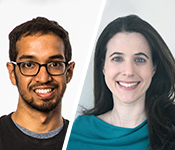 When it comes to miniature robots, Allen School professor Vikram Iyer has big ideas about autonomous navigation and the applications that will enable — applications for which he seeks to ditch the batteries and add onboard perception and computation with the help of artificial intelligence. Meanwhile, his faculty colleague Adriana Schulz has designs on a different kind of power problem: how to use AI to supercharge a new era of creativity and eco-consciousness in computer-aided manufacturing. Schulz and Iyer recently earned National Science Foundation (NSF) CAREER Awards for research that promises to fundamentally alter the way we create and interact with objects and our environment. Read more →
For these nationally recognized Allen School undergraduates, research impact is its own reward
 Earlier this year, the Computing Research Association honored a select group of undergraduate students from around the country who have made notable contributions to the field through research. The CRA Outstanding Undergraduate Researcher Awards competition historically has been good to Allen School students. To the four most recent honorees — award winner Kianna Bolante, finalists Claris Winston and Andre Ye, and honorable mention recipient Nuria Alina Chandra — even more rewarding than national recognition is realizing the impact their contributions can have on individuals and communities in Washington and beyond. Read more →
Allen School alum Hakim Weatherspoon scores a College of Engineering Diamond Award for tackling diversity, equity and inclusion in computing
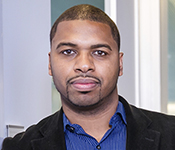 Hakim Weatherspoon (B.S., ‘99) was a rare breed of computer engineering student. As a Husky football player — and one who was named to the Pac-10 All-Academic team, at that — Weatherspoon’s grit and determination on the gridiron was matched by his grit and determination in the classroom. A quarter century after he last took the field for the University of Washington, Weatherspoon scored a College of Engineering Diamond Award from his alma mater for “embracing the power of diversity, equity and inclusion” in his role as Associate Dean for Diversity, Equity and Inclusion in the Cornell Bowers College of Computing and Information Science. Read more →
‘You write your own story’: Allen School celebrates the graduating class of 2024
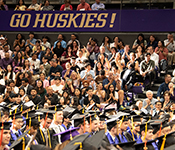 A crowd of roughly 5,000 packed the Hec Edmundson Pavilion at the Alaska Airlines Arena on June 7 to honor the achievements of the Allen School’s 2024 graduating class. Joining the celebration with family and friends was graduation speaker Andy Jassy, President and CEO of Amazon and — for this evening, at least — honorary member of the Dawg Pack. Read more →