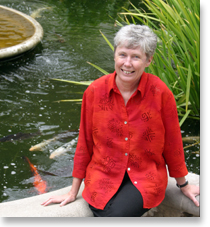
 Xconomy interviews Maria Klawe, a new addition to the Board of Directors of Microsoft Corporation.
Klawe, the President of Harvey Mudd College, is a computer scientist who was previously Dean of Engineering at Princeton University, Vice President and CS head at the University of British Columbia, and a group leader at IBM Research.
Klawe makes a number of interesting comments on innovation in the Pacific Northwest. “I had an interesting conversation with Google. Google wanted to invest more in the Northwest corridor because they were getting better work out of that area than any other site around the world. It’s partly the presence of really good universities, like UW and UBC.”
She also comments on UW CSE’s role in helping to strengthen UBC’s computer science program. “UW and UBC both deliberately built a culture of support. Take any faculty member there, and you’ll get a good human being.”
UW CSE’s Ed Lazowska is quoted: “‘She’s impatient and persistent in the best sense – she wants things to be done right, and she wants them to be done right now. She’s very strong on gender equity, which will be good medicine for Microsoft — although she’s by no means a one-issue person. Her only idiosyncrasy is that she paints watercolors during meetings.'” Read more →
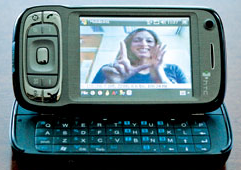
Photo: Mary Levin
Columns, the magazine of the University of Washington Alumni Association, reports on the long and fruitful work that Boeing Professor in Computer Science and Engineering Richard Ladner has done making technology and opportunity more available to blind and deaf people.
Dr. Ladner had two deaf parents, which helped him understand the challenges faced by those with sensory disabilities and motivated him to work to help lower barriers
A notable project to come out of Ladner’s advocacy work is WebAnywhere (previous CSE News reporting here), which allows blind users to have web pages read to them using a standard PC, eliminating the requirement for an expensive “screen reader” program. This project is developed by CSE PhD student Jeffrey Bigham. Another is MobileASL (previous CSE News reporting here), a collaboration with Electrical Engineering professor Eve Riskin, which allows deaf users to have American Sign Language conversations using unmodified cellphones. Another: the cross-disciplinary Tactile Graphics project, which has developed software to speedily create tactile versions of visual graphics, which are accessible to unsighted users.
Read the full article here. Read more →
 TechFlash contributor Roni Ayalla reports on recent developments with UW CSE graduate student Brian Ferris‘ OneBusAway project. The open-source project now has a home at Google Code, is seeking grant funding, and has attracted faculty sponsorship from UW CSE’s Alan Borning, one of the principal investigators on the cross-disciplinary Urbansim Project. Ferris is quoted
We’re working on building a complete open-source transit traveler information system that would combine route maps/timetables, trip-planning, real-time tracking, and real-time service alerts … into a user-friendly package that would be accessible across the web, phone, Twitter, whatever. Basically, (OneBusAway) to the next level.
We’ve reported on press coverage of OneBusAway several times.
[Update 4 March: follow OneBusAway on twitter here. -SMR]
[Update 7 March: OneBusAway was covered on WorldChanging Seattle. -SMR] Read more →
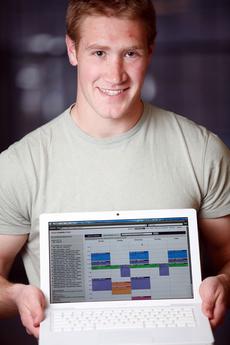 Going to UW certainly has its advantages, but at registration time, it can be exhausting and frustration. UW CSE’s senior Rylan Hawkins understands this too well. Hawkins created a web site called Visual Schedule Finder (VSF) — at vsfinder.com — to help students find available classes. VSF began as an engineering class group project last spring. Rylan now manages the site, making it much more than a class project, using his summer and holiday breaks to tweak the program.
The program allows students to search for schedules based on starting time, ending time, departments, credits, or teachers. The web site stores chosen classes and allows students to view their schedules visually to ensure they have no problems when it comes time to register. The site is powered with UW’s current time-schedule data, is free for all students, and is updated daily.
Read the full article in The Daily here. Read more →
 We need a new language for artificial intelligence, writes UW CSE’s Pedro Domingos. He proposes a new mathematical language that combines logic and probability.
“The goal of artificial intelligence (at least according to the field’s founders) is to create computers whose intelligence equals or surpasses humans’. Achieving this goal is the famous ‘AI problem.’ To some, AI is the manifest destiny of computer science. To others, it’s a failure: clearly, the AI problem is nowhere near being solved. Why? For the most part, the answer is simple: no one is really trying to solve it.”
Read the full article in Technology Review here. Read more →
UW CSE graduate student Tamara Denning has been named one of ten winners of the inaugural Microsoft Research Graduate Women’s Scholarship. Congratulations Tamara! Read more →
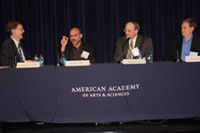 CNET News reporter Charles Cooper reports in his Coop’s Corner blog on a panel that looked at the impact of information technology on democracy. UW CSE professor Ed Lazowska organized the panel, which included Princeton University professor and 1993 UW CSE PhD Ed Felten and two others. The panel was held as part of a meeting of the American Academy of Arts & Sciences exploring the information technology and the public good.
Ed Felten offered some hopeful comments:
There will be many fewer newspapers…partly due to fact that people can read newspapers from far away. We’ll see smaller outlets which focus on the local and operate in a low-budget way, more like a community paper than a big city newspaper. And we’ll see a lot of non-profit or low-profit punditry.
Read more →