A GeekWire post on UW CSE’s EnerJ project, to be presented next week at PLDI:
“University of Washington researchers have come up with a way to reduce energy consumption in computers and mobile devices by 50 percent or more by segmenting software code into areas that require high levels of accuracy — and therefore high levels of energy — and those that don’t.”
Read the GeekWire post here. Read the PLDI paper here. Read a UW press release on the work here. ACM TechNews here.
And don’t miss the Engadget post with numerous reader comments about Luis Ceze’s resemblance to Harry Potter and other luminaries, here. Read more →
 MerchantCircle, co-founded by UW CSE alum Wayne Yamamoto, has been acquired by Reply! Inc. MerchantCircle is the largest online network of local business owners in the nation, combining social networking features with free marketing tools that enable merchants to maximize their online visibility. Press release here. Read more →
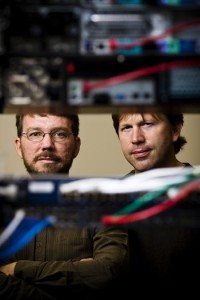
Geoff Voelker and Stefan Savage purchase Viagra for science
An editorial in today’s New York Times follows up on an article ten days ago describing work led by UW CSE Ph.D. alums Stefan Savage and Geoff Voelker. Savage, Voelker, and 13 collaborators carry out an end-to-end analysis of the spam value chain, and determine that 95% of spam-advertised pharmaceutical, replica and software products are monetized using merchant services from just a handful of banks.
The New York Times editorial states: “The Times’s John Markoff reported that computer scientists at two University of California campuses have found another vulnerability: spammers’ banks. To track the flow of information, the researchers made hundreds of purchases. Buying Viagra from the Pharmacy Express group in Russia involved computers in Brazil, China and Turkey. The Viagra came from India. But 95 percent of the purchases were handled by three banks — in Azerbaijan, Latvia and St. Kitts and Nevis. This suggests that if banks or credit card companies refused to settle payments for some transactions with these banks, they could deliver a blow to the spam economy. After Congress moved to suppress online gambling, Visa and Mastercard blocked payments for American players. Similarly, Congress might require them to block, say, card-not-present pharmaceutical purchases on the grounds that it is illegal for individuals to import drugs. Though spammers might be able to change banks, the process would be cumbersome. The concentration of business in three banks suggests there aren’t that many willing to deal with spammers. It’s certainly worth pursuing.”
Read the New York Times editorial here. Read John Markoff’s New York Times article here. The Oakland paper by Savage, Voelker, and their collaborators is here. NPR interview with Savage here. Read more →
 Will Johnson, a senior majoring in Computer Science and in Mathematics, has been awarded the 2011 UW College of Arts & Sciences Dean’s Medal for the Sciences, recognizing the most accomplished graduating student in the natural sciences.
Will has a remarkable record of accomplishment and recognition: he recently won an NSF Graduate Research Fellowship; he was celebrated in the Washington State Senate and in the Seattle Times for being named a Putnam Fellow (for finishing among the top five students in the nation — from among 4,036 competitors — in the William Lowell Putnam Mathematical Competition); he was named the 2010 University of Washington Junior Medalist, recognizing the most accomplished student among UW’s roughly 7,000 juniors. (No reason to go back further than 12 months …)
Will is the 13th CSE student to be recognized with a UW Dean’s Medal. Most recently, Eric Arendt received the 2010 Dean’s Medal in Engineering, Kathy Wei received the 2009 Dean’s Medal in Engineering, and Pavan Vaswani received the 2009 Dean’s Medal in the Sciences. Sixteen CSE students have been University Medalists. Most recently, Krysta Yousoufian received the 2010 Junior Medal, Mark Bun received the 2009 Sophomore Medal (when Will received the Junior Medal), and Pavan Vaswani received the 2009 President’s Medal (recognizing the most accomplished graduating student at the University of Washington).
Congratulations to Will, and to all of CSE’s terrific students – UW’s best! Read more →

 ACM TechNews and ITBusinessEdge have both picked up UW CSE professor Ed Lazowska’s recent Xconomy article on the Computer Science job market.
“Meanwhile, in this post at Xconomy, Lazowska reports that his seniors are being offered salaries straight out of college as high as $105,000. The emails he quotes in that piece will just blow you away at the opportunities these kids are offered, such as this:
“‘I’m a senior who transferred to UW from Shoreline Community College. My employment history is zilch – a little retail, that’s it. Yet [top tech company] offered me a $30/hr internship just based on the fact that I’m in UW CSE.’
“And this one:
“‘Last summer I worked for [top tech company] in Seattle. At some point I realized that they had offices in awesome cities all over the world: Sydney, Dublin, Zurich, Paris, London. I told the recruiters I wanted to work at one of these offices. They were able to secure me a position in London. I’ve always wanted to study abroad, but I was worried how well it would fit with computer science. As it turns out, I got a better deal than studying abroad: working abroad.'”
Meanwhile, Xconomy reports today on a new study by the job search site Dice ranking Seattle among the top cities for tech workforce crunch, here. Read more →
 OneBusAway, a transit app by UW CSE’s Brian Ferris and collaborators, is praised in this Seattle Times article:
“One of Seattle’s least-known secrets is a magical app for your phone.
“It can make you more efficient, reduce stress, give you more time, save you money and help the environment.
“Best of all, it’s free.
“You don’t even need an expensive smartphone or one of those wireless plans that cost as much as a car payment.
“I’m talking about OneBusAway, an app that tells people when their bus is arriving. It started in 2006 as the side project of a University of Washington student and grew into a transit app platform used by software developers, researchers, transit agencies and 50,000 commuters a week.”
Read the rest of the article here. Read more →
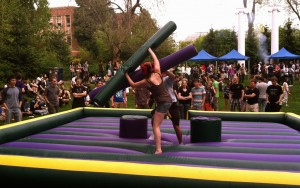
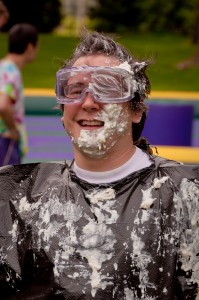 UW CSE faculty, staff, and students gathered in the Sylvan Grove on Friday for the annual ACM Spring BBQ. As if on cue, the Seattle temperature reached 70 for the first time during this most miserable Spring in recent memory. (But by 6 a.m. on Saturday it was raining again …)
Many terrific Bruce Hemingway photographs are here, including the annual pieing of Luis Ceze. Read more →
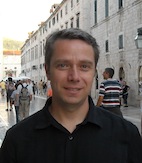 UW CSE professor Dieter Fox is one of six AI researchers elected in 2011 as Fellows of the Association for the Advancement of Artificial Intelligence (AAAI). Dieter was elected “for significant contributions to probabilistic state estimation and its application to the fields of robotics and ubiquitous computing.” He joins UW CSE faculty members Dan Weld, Oren Etzioni, and Pedro Domingos as Fellows of AAAI.
Dieter’s research interests lie in artificial intelligence, robotics, and probabilistic state estimation. He grew up in Bonn, Germany, and received a B.Sc. in 1990, an M.Sc. in 1993, and a Ph.D. in 1998, all from the Computer Science Department at the University of Bonn. He is the director of UW’s Robotics and State Estimation Lab, recently recognized in a competition to identify the World’s Ugliest Website. Read more →
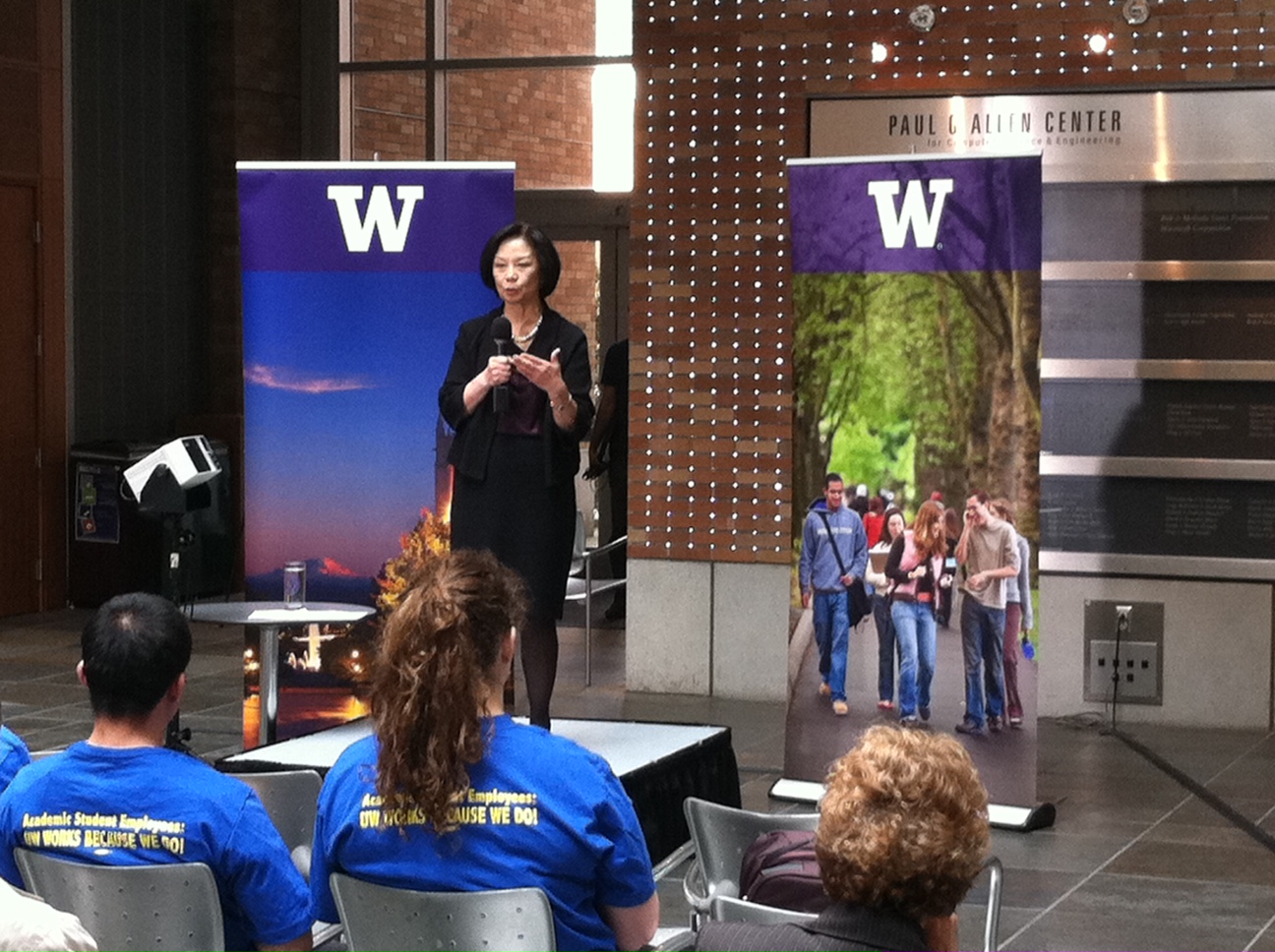
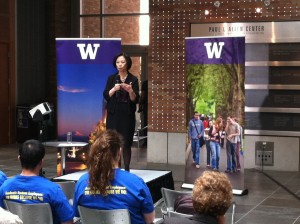 UW Interim President Phyllis Wise today hosted a “Community Conversation” on the future of the University of Washington in the Microsoft Atrium of the Paul G. Allen Center for Computer Science & Engineering. There was a strong turnout.
We’re delighted that the Allen Center continues to be a prime venue for campus events such as this, and the recent inaugural press conference of incoming UW President Michael Young. Read more →
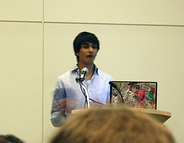 Akash Badshah has scored a triple-first: Akash is the first high school student in the nearly 30-year history of the CHI conference (human factors in computing) to serve as lead author, present a paper, or win a “Best of CHI” award.
Akash presented his paper on a self-powered haptic feedback device to a huge crowd at CHI 2011 in Vancouver BC last week. The session was standing-room-only, and the organizers even had to set up an overflow room and pipe video to it. The talk was fantastic. Akash, a high school junior from Bellevue, worked with CSE professor Shwetak Patel last summer as a part of Shwetak’s summer high school research program, where high school students carry out intense 10-week long research projects. Akash is now completing his senior year at Phillips Exeter Academy in New Hampshire.
Learn more about Akash’s research here. Learn more about research in the UW CSE UbiComp lab here. A related article from the Exonian (Philips Exeter Academy’s newspaper) here.
Read more →