UW CSE’s Tim Blakely: A Google “Intern Making an Impact”

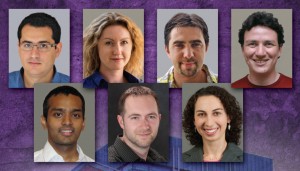
Google’s corporate-wide “Interns Making an Impact” feature today highlights UW CSE Ph.D. student Tim Blakely, working at Google Seattle.  Tim is the lead developer on BigBrain, a large-scale computational neuroscience tool built on the cloud. The project began as an exploratory venture between Google and the Allen Institute for Brain Science (AIBS) to investigate whether the cloud could provide a platform for doing massively parallel, large-scale neural simulations.

Read more here. Read more →

“The Human Face of Big Data”

A New York Times article describing Rick Smolan’s forthcoming book The Human Face of Big Data features two of our favorite computer scientists:  UW CSE professor Shwetak Patel, and MIT EECS professor John Guttag:

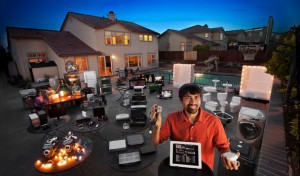
“Mr. Smolan visited recently to offer a glimpse of what will be in The Human Face of Big Data and the imaginative photo composition involved in bringing technical subjects to life. One photograph shows Shwetak Patel, an assistant professor at the University of Washington, who has developed technology that measures energy and water use in homes; with wireless sensors and clever software to determine what appliances and gadgets in a home use the most electricity and water, the software suggests ways to conserve — information delivered graphically on an iPad. The photo shows young Mr. Patel in the backyard of his cousin’s house in Hayward, Calif., with his cousin’s family, surrounded by what looks to be every single appliance, digital device, faucet and toilet in the household.

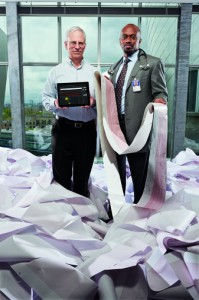
“Another photo illustrates software technology that captures previously discarded data from heart-monitoring electrocardiogram machines. The software program sifts the data, looking for subtle heart abnormalities that identify patients that are at high risk of suffering a second heart attack within a year. The photo shows two M.I.T. scientists, John Guttag and Collin Stultz, who developed the technology, standing in a small mountain of paper, which is 10 hours of printout data from an E.K.G. machine.”

Read the New York Times article here.  Visit the web page for the book here.

Additional related articles:  Enterprise here; Huffington Post here. Read more →

Facebook for the social-media-impaired …

Today is UW CSE Ph.D. alum Geoff Voelker‘s birthday.  His UCSD CSE colleague (and fellow UW CSE Ph.D. alum) Stefan Savage writes:

Dear all,

Untold years ago today, our own Geoff Voelker was born.  Unfortunately, those of us who seek to communicate birthday wishes in the contemporary vernacular – a wry combination of “Happy Birthday” posts on the recipient’s Facebook “wall” and the “liking” of other such posts – are unable to do so in this case.  You see, Geoff is a practicing neo-luddite.  In particular, he shamelessly refuses to use any technology popularized after 1996.  Thus, he does not text, he does not tweet, he does not blog, pin, digg or tumbl.  He carries no portable electronics, his only phone plugs into the wall, he watches television via a broadcast cable and buys pre-recorded audio physically encoded on quaint pressed discs of aluminum and poly-carbonate. Webmail?  No way, this guy still reads direct from /var/spool/mail/  And… germane to this particular conversation… Geoff Voelker has no Facebook page and hence no wall.   

How then to wish Geoff “Happy Birthday”?  My first thought was to just create a Facebook account in Geoff’s name, thereby simplifying life for all of us.  Unfortunately, Geoff knows me too well and long ago extracted a solemn promise from me that I would not create, cause to be created or “allow to be created through inaction,” any account or page on the Facebook online social network.  Sealed in blood under a full moon, this is one of the few oaths that I’ve felt obligated to keep.   I needed another way.

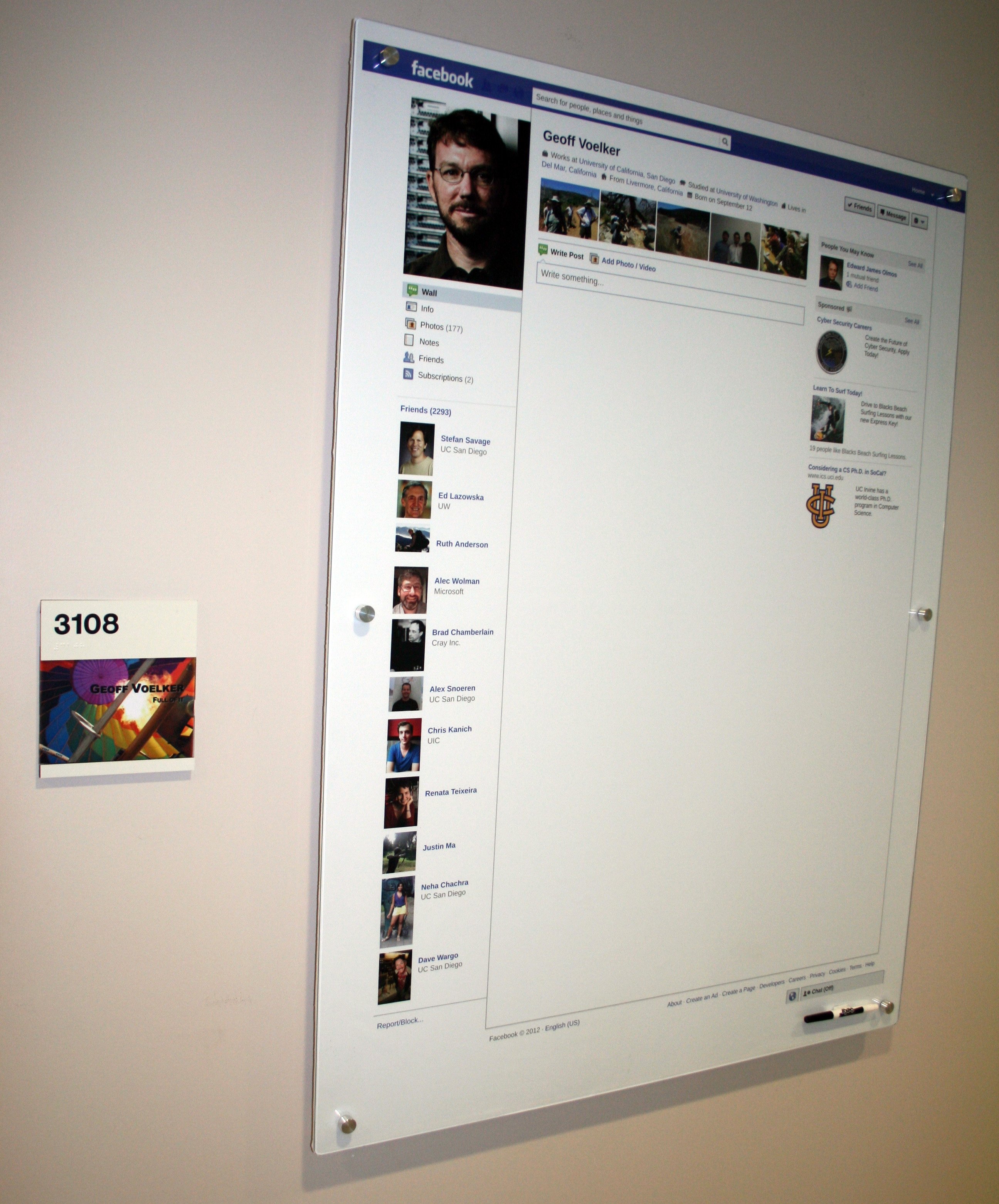
Working tirelessly with a crack team of specialists, entrepreneurs, astrologers, lawyers, academics, and wild-eyed dreamers, we eventually found the loophole we needed.  Using arcane quantum mechanisms we arranged to shift the raw potentiality of Geoff’s Facebook page from the virtual online world, into an _actual_ Facebook page located in our physical plane of existence.  Through this solipsistic sleight of hand, Geoff now has a Facebook wall, appropriately located… on his wall.

Particular thanks go to alumnus Chris Kanich in our Great Lakes office for creating the page to exacting specifications, Neha Chachra for printing it, Dave Wargo for mounting it under glass and Kirill “the most interesting computer scientist in the world” Levchenko for his inestimable management skills.  

With that, I’d like to invite all of you who know and care for Geoff, to write your birthday wishes on his new Facebook wall in its physical location outside room 3108. Read more →

dub cleans up at Ubicomp!

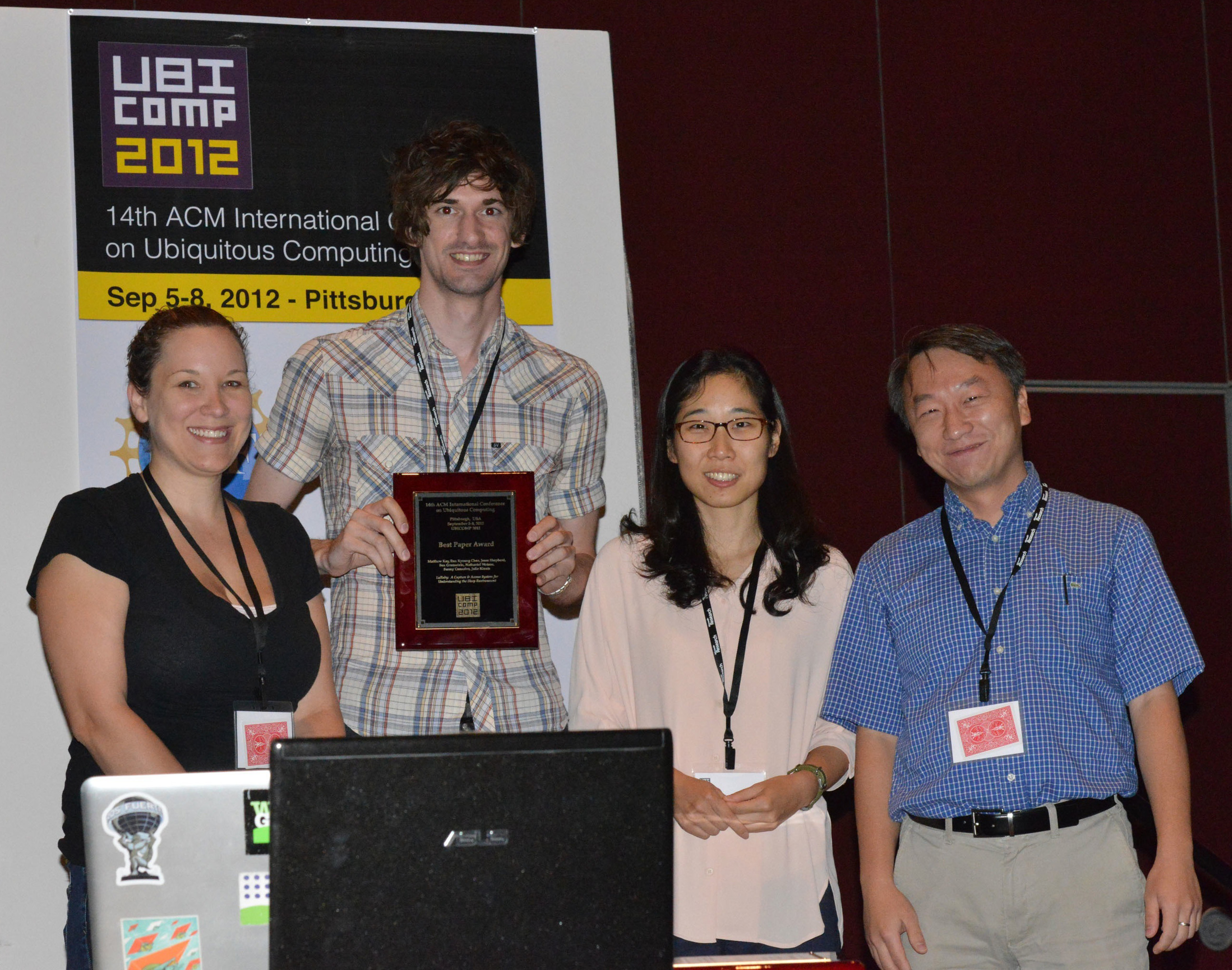
UW CSE Ph.D. student Matt Kay receives a Ubicomp 2012 Best Paper Award

dub is the University of Washington’s highly successful cross-campus (and beyond!) collaboration on human-computer interaction and design.

Earlier we reported on the receipt of a Best Paper Award at the 14th ACM International Conference on Ubiquitous Computing by the paper “An Ultra-Low-Power Human Body Motion Sensor Using Static Electric Field Sensing” by dub researchers Gabe Cohn (UW, and Microsoft Research consultant), Sidhant Gupta (UW, and MSR consultant), Tien-Jui Lee (UW), Dan Morris (MSR, and UW affiliate professor), Josh Smith (UW), Matt Reynolds (Duke), Desney S. Tan (MSR, and UW affiliate professor), and Shwetak Patel (UW).  (Lead author Gabe Cohn is a Ph.D. student advised by Shwetak Patel.)

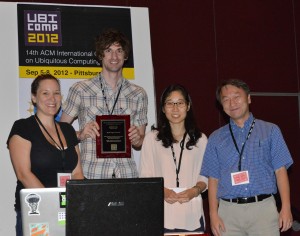
It turns out that this was just the tip of the iceberg.  Another dub paper was also recognized with a Ubicomp Best Paper Award:  “Lullaby: A Capture & Access System for Understanding the Sleep Environment” by Matt Kay (UW), Eun Kyoung Choe (UW), Jesse Shepherd (UW), Ben Greenstein (Google, and UW affiliate professor), Nathaniel Watson (UW), Sunny Consolvo (Google, and UW affiliate professor), and Julie Kientz (UW).  (Lead author Matt Kay is a Ph.D. student co-advised by Julie Kientz and Shwetak Patel.)

Two other dub papers were among the 9 papers in total that were nominated for Ubicomp Best Paper Awards:

SpiroSmart: Using a Microphone to Measure Lung Function on a Mobile Phone” by Eric Larson (UW), Mayank Goel (UW), Gaetano Borriello (UW),  Sonya Heltshe (UW), Margaret Rosenfeld (UW), and Shwetak Patel (UW).  (Lead author Eric Larson is a Ph.D. student advised by Shwetak Patel.)

Investigating Receptiveness to Sensing and Inference in the Home Using Sensor Proxies” by Eun Kyoung Choe (UW), Sunny Consolvo (Google, and UW affiliate professor), Jaeyeon Jung (MSR, and UW affiliate professor), Beverly Harrison (Lab126-Amazon, and UW affiliate professor), Shwetak Patel (UW), and Julie Kientz (UW).  (Lead author Eun Kyoung Choe is a Ph.D. student advised by Julie Kientz.)

And two additional Microsoft Research papers with UW-affiliated authors also were nominated:

“Some Help On the Way: Opportunistic Routing Under Uncertainty” by Eric Horvitz (MSR, and UW affiliate professor) and John Krumm (MSR).

Automatically Characterizing Places with Opportunistic CrowdSensing using Smartphones” by Yohan Chon (Yonsei University, Seoul Korea), Nicholas D. Lane (MSR Asia), Fan Li (MSR Asia), Hojung Cha (Yonsei University), and Feng Zhao (MSR Asia and UW affiliate profess0r).

That’s six out of nine Ubicomp Best Paper Award nominees, including two of the three winners! Read more →

“Tech’s New Wave, Driven by Data”

Steve Lohr in the New York Times:

“Technology tends to cascade into the marketplace in waves. Think of personal computers in the 1980s, the Internet in the 1990s and smartphones in the last five years.

“Computing may be on the cusp of another such wave. This one, many researchers and entrepreneurs say, will be based on smarter machines and software that will automate more tasks and help people make better decisions in business, science and government. And the technological building blocks, both hardware and software, are falling into place, stirring optimism.”

The article quotes UW CSE’s Ed Lazowska.  Read more here. Read more →

UW+MSR win Ubicomp 2012 Best Paper Award

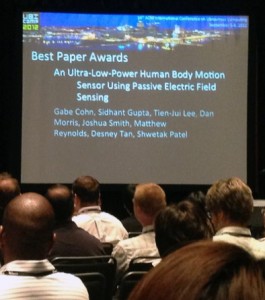
The paper “An Ultra-Low-Power Human Body Motion Sensor Using Static Electric Field Sensing” by Gabe Cohn (UW, and Microsoft Research consultant), Sidhant Gupta (UW, and MSR consultant), Tien-Jui Lee (UW), Dan Morris (MSR, and UW affiliate professor), Josh Smith (UW), Matt Reynolds (Duke), Desney S. Tan (MSR, and UW affiliate professor), and Shwetak Patel (UW) has just received a Best Paper Award at the 14th ACM International Conference on Ubiquitous Computing.  (Lead author Gabe Cohn is a Ph.D. student advised by Shwetak Patel.)

Congratulations, team! Read more →

UW CSE alum Anne Condon elected Fellow of the Royal Society of Canada

The Royal Society of Canada, founded in 1882, celebrates the nation’s leading scholars in the Arts, Humanities and Sciences through election as Fellows.

This week, the Class of 2012 was announced – 69 new Fellows:  15 in the Arts and Humanities, 15 in the Social Sciences, and 39 in the Sciences.

Among them – one of only two computer scientists – is 1987 UW CSE Ph.D. alum Anne Condon, Head of the Department of Computer Science at the University of British Columbia and a leading figure in computational biology.  Anne’s citation reads:

Anne Condon, a researcher in computational complexity theory and algorithms, has advanced understanding of the computing time and memory needed to solve classical computational problems. She has also developed creative means for programming at the nanometer scale with DNA molecules. Her algorithms for predicting and designing nucleic acid secondary structures have had significant practical impact.

Warm congratulations to Anne Condon, FRSC! Read more →

UW CSE’s game-changing hires in machine learning, “big data,” computer vision, and computer systems

A new booklet describes UW CSE’s  bumper crop of faculty hires:

  • Carlos Guestrin, Amazon Professor of Machine Learning in Computer Science & Engineering (machine learning)
  • Ben Taskar, Boeing Professor of Computer Science & Engineering (machine learning)
  • Jeffrey Heer, Associate Professor of Computer Science & Engineering (data visualization)
  • Emily Fox, Amazon Professor of Machine Learning in the Department of Statistics (machine learning)
  • Ira Kemelmacher-Shlizerman, Assistant Professor of Computer Science & Engineering (computer vision)
  • Ali Farhadi, Assistant Professor of Computer Science & Engineering (computer vision)
  • Shyam Gollakota, Assistant Professor of Computer Science & Engineering (computer systems)

Quoting the New York Times, “Although Stanford is considered the Hogwarts of techdom, UW has quietly established itself as the other West Coast nexus of the information economy.”

Read more here. Read more →

UW CSE’s “Control-Alt-Hack” game among “25 of today’s coolest network and computing research projects”

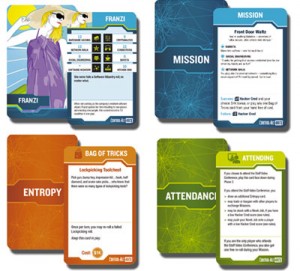
NetworkWorld has identified and profiled “25 of today’s coolest network and computing research projects.”  Among them is Control-Alt-Hack, a card game created by UW CSE researchers to introduce computer security topics.

Read the article here.  Learn more about Control-Alt-Hack here. Read more →

GigaOm features UW CSE alumni startup LearnSprout

“Last fall, when LearnSprout cofounder and one-time Facebooker Frank Chien called up his college buddies Joe Woo, previously with Microsoft, and Anthony Wu, a former Googler, he didn’t necessarily have an education startup in mind.

“The trio could have tackled healthcare or energy instead, he said. What mattered was that they go for something big — dent-the-universe, shake-up-the-system significant.

“‘I [told them], let’s do something crazy,’ he said. ‘We can stay at our jobs forever or we can swing for the fences.’

“Not too much later, the three engineers, who met at the University of Washington, quit their jobs. Over the past ten months, they’ve built a startup taking on a major obstacle facing innovators interested in K-12 education: the siloed way in which student data is stored.”

Congratulations to UW alums Frank Chien (Business), Joe Woo (CSE), and Anthony Wu (CSE)!

Read the GigaOm article here.  Learn more about LearnSprout here and here. Read more →

« Newer PostsOlder Posts »