UW CSE Ph.D. alum and Google Fellow Jeff Dean is profiled in the current issue of Wired:
“Inside Google, Jeff Dean is regarded with awe. Outside the company, few even know his name. But they should. Dean is part of a small group of Google engineers who designed the fundamental software and hardware that underpinned the company’s rise to the web’s most dominant force, and these creations are now mimicked by the rest of the net’s biggest names — not to mention countless others looking to bring the Google way to businesses beyond the web.”
It’s a terrific profile – read it here. Read more →
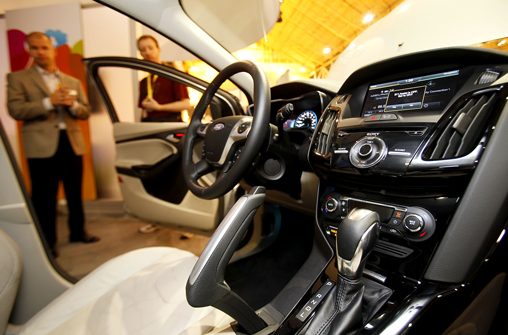
 UW CSE Ph.D. student Franzi Roesner and UW CSE Ph.D. alum Stefan Savage (now on the faculty at UCSD) are extensively quoted in this ComputerWorld article:
“It’s not time for full-on panic, but researchers have already successfully applied brakes remotely, listened into conversations and more.”
Read more here. Read more →
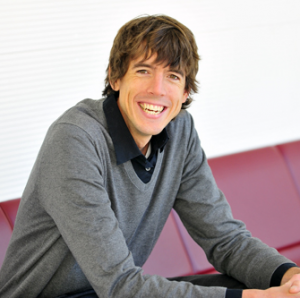 Jon Froehlich – a 2011 UW CSE Ph.D. alum now on the Computer Science faculty at the University of Maryland – has been named the recipient of the 2012 University of Washington Distinguished Dissertation Award.
Froehlich’s dissertation, Sensing and Feedback of Everyday Activities to Promote Environmental Behaviors, was advised by James Landay and Shwetak Patel. It focuses on creating new types of sensors to monitor and infer everyday human activity such as driving to work or taking a shower and then taking this sensed information and feeding it back to the user in novel, engaging, and informative ways with the goal of increasing awareness and promoting environmentally responsible behavior. UbiGreen and HydroSense were two key contributions.
Congratulations Jon! Read more →
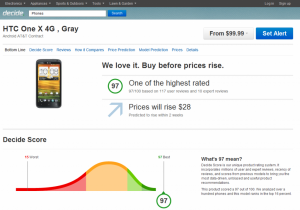 “Decide.com already tells consumers when they should buy cameras, phones, refrigerators and other gadgets and appliances, analyzing price drops and increases. Now, the Seattle startup and brainchild of University of Washington computer scientist Oren Etzioni and others is getting into the recommendation business, assigning a score of 1 to 100 on more than 22,000 products that it tracks.”
Read more here. Read more →
 2005 UW CSE alum Brett Newlin stroked the USA men’s eight into the Olympic finals with a convincing victory over Australia, Poland, and the Ukraine in a tough qualifying heat on Saturday.
Read about it, and watch a video of the heat, here.
The final will be Wednesday at 12:30 p.m. BST, 4:30 a.m. PDT. Read more →
 The IEEE Presidents’ Change the World Competition recognizes students who develop unique solutions to real-world problems using engineering, science, computing, and leadership skills to benefit their community, the world at large, or both.
UW CSE’s FoneAstra has been recognized with third place in the 2012 competition.
FoneAstra is an ARM7-based board that plugs into the data port of low-tier mobile phones. With attached sensors, custom applications can be run through FoneAstra. As a prototype, the per-unit cost of the board is $15. FoneAstra, enhanced with temperature probes, is being used for vaccine cold chain monitoring – in developing countries, this cost effective method can make vaccine implementation efficient and cut possible losses from temperatures of vaccines that are not extensively monitored. In addition, FoneAstra is being used for accurately monitoring milk temperatures by providing three levels of safety.
The FoneAstra team includes Rohit Chaudhri, William Thomas Pitts, Darivanh Vlachos, Troy Martin, Jillyn Johnson, Eleanor O’Rourke, Jaylen Scott Vanorden, Michael Falcone, Waylon Brunette, Mayank Goel, and Rita Sodt.
Congratulations! Read about the competition here. Learn more about FoneAstra here. Learn about UW’s ICTD activities – Change – here. Read more →
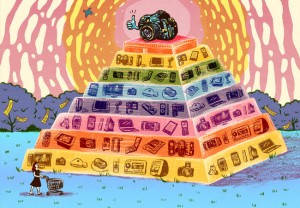 In an article titled “Clearing Away the Clutter From Tech Shopping,” the New York Times recommends the use of UW CSE startup Decide.com:
“A couple of years ago, some exceedingly bright minds from the worlds of computer science and business created Farecast, a site that takes reams of data about airline ticket pricing and analyzes it to let consumers know if the fares for trips they want to take at a given moment are going to go up or down soon. The price-prediction engine was later bought by Microsoft and incorporated into that company’s Bing Travel site.
“The founders of Farecast then turned their attention to consumer technology. This was much more challenging because new products are being replaced by even newer products at an alarming rate. Decide.com is the result.
“On the Decide site, you can search for tech products and find out whether one is about to be supplanted by a newer, better model, as well as whether the price is likely to rise or fall. Decide uses all kinds of algorithms, machine learning and artificial intelligence to comb not only pricing data, but also articles and blog posts to predict a product’s price and life span.
“Armed with that data, you can either move ahead and buy with confidence, or lie low for a little while and feel extra knowledgeable.”
Read the New York Times article here. Try Decide.com here. Learn about the UW CSE research of Oren Etzioni, Decide.com co-founder, here. Read more →
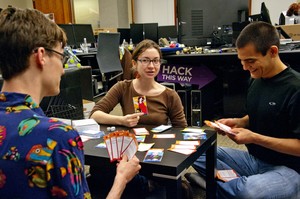 Do you have what it takes to be an ethical hacker? Can you step into the shoes of a professional paid to outsmart supposedly locked-down systems?
Now you can at least try, no matter what your background, with a new card game developed by members of the UW CSE Security and Privacy Lab.
“Control-Alt-Hack” gives teenage and young-adult players a taste of what it means to be a computer-security professional defending against an ever-expanding range of digital threats. The game’s creators will present it this week in Las Vegas at Black Hat 2012, an annual information security meeting.
Read a UW News story here. Learn about Control-Alt-Hack here. Learn about UW CSE computer security and privacy research here.
Wall Street Journal article here. GeekWire post here. Read more →
 This week, the nation’s computer science, information science, and computer engineering department heads are gathered in Snowbird, Utah for the every-other-year Computing Research Association Conference at Snowbird.
In his keynote address on Monday morning, Farnam Jahanian, the National Science Foundation’s Assistant Director for Computer and Information Science and Engineering, highlighted two UW CSE research breakthroughs.
Jahanian showed the NSF “Science Nation” video describing UW CSE’s “Rome in a Day” project – synthesizing tens of thousands of photographs into 3D models of cities that can be navigated. Watch the great video here. Learn more about the project here.
Jahanian also highlighted Foldit, UW CSE’s web-based videogame for protein folding and protein structure calculation. Last year, gamers using Foldit cracked an AIDS-related protein structure problem that had eluded the scientific community for more than a decade. Learn about UW CSE’s Center for Game Science here. Play Foldit here.
Both of these breakthroughs came from UW CSE’s extraordinary GRaphics and Imaging Laboratory – GRAIL. Learn more about GRAIL here. Read more →
 47 top researchers from across the nation gathered last week for the 17th Summer Research Institute in Computer Science, co-organized each summer by University of Washington Computer Science & Engineering and Microsoft Research.
The goal of these Summer Research Institutes is to catalyze research in emerging areas. This year’s topic was “Crowdsourcing Personalized Online Education.” The organizers were Dan Weld (UW CSE), Mausam (UW CSE), Eric Horvitz (MSR), and Meredith Ringel Morris (MSR). Quoting from the overview:
“Strong recent enthusiasm for leveraging online platforms for education has highlighted opportunities to leverage ‘the crowd’ in novel ways. We seek to explore challenges and opportunities at the intersection of online education and crowdsourcing – at a time when ideas and methods in both areas are accelerating.”
Learn more about this year’s Summer Research Institute here. Learn about previous Institutes here. Read more →