“A Few Useful Things to Know about Machine Learning”

pedroOne year ago, CSE professor Pedro Domingos published the paper “A Few Useful Things to Know about Machine Learning” in Communications of the ACM.  Since it was published, the free version linked from Pedro’s Web page has been downloaded over 100,000 times.  Not bad for a technical paper!

Haven’t read it yet?  Check it out here. Read more →

Raj Rao: “Brain-Computer Interfacing: An Introduction”

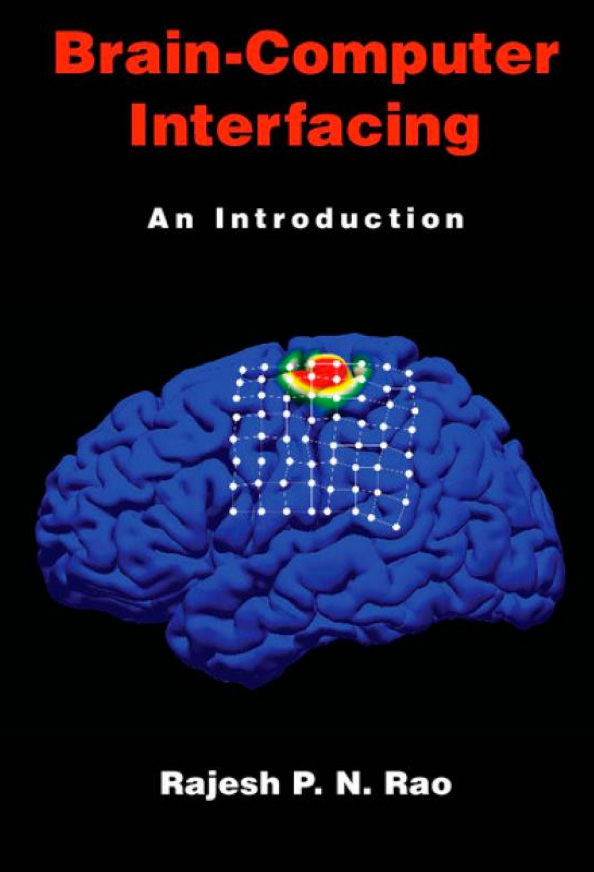
UntitledAfter a labor of love lasting 5 years, UW CSE professor Rajesh Rao’s book “Brain-Computer Interfacing: An Introduction” is finally out!

The idea of interfacing minds with machines has long captured the human imagination. Recent advances in neuroscience and engineering are making this a reality, opening the door to restoring and potentially augmenting human physical and mental capabilities.

Buy it here! Read more →

NBC News: “The next big ideas from ‘Idea Man’ Paul Allen: A.I. and cell biology”

8C9194575-130928-coslog-ideaman-1130a.blocks_desktop_smallNBC News reports on the new Allen Institute for Artificial Intelligence, led by UW CSE professor Oren Etzioni:

“Allen, the 60-year-old co-founder of Microsoft, laid out his plans during an interview on the sidelines of the Allen Institute for Brain Science’s annual symposium …

“[AIBS] serves as the model for Allen’s ventures to expand the frontiers of artificial intelligence and cell biology. Just this month, he laid out his plan for the Allen Institute for Artificial Intelligence (AI2, or “A.I. squared”) with University of Washington computer scientist Oren Etzioni at the helm.

“Allen said some of the inspiration came from his years-long project to create next-generation interactive textbooks. Some came from the Watson computer’s triumph on the “Jeopardy” quiz show in 2011. And some came from the issues that have been raised at the brain institute.

“How will research into artificial intelligence mesh with Allen’s interest in human intelligence? ‘It’s a strange kind of race … Can you create an artificial object or entity or something that can perform language before you understand how it’s done in the brain?’ he said during Thursday’s symposium. ;It’s a kind of crazy race, and I don’t know which horse to bet on. I’m betting on both. Both are fascinating.'”

Read more here. Read more →

UW CSE welcomes new graduate students at the “Pit Party”

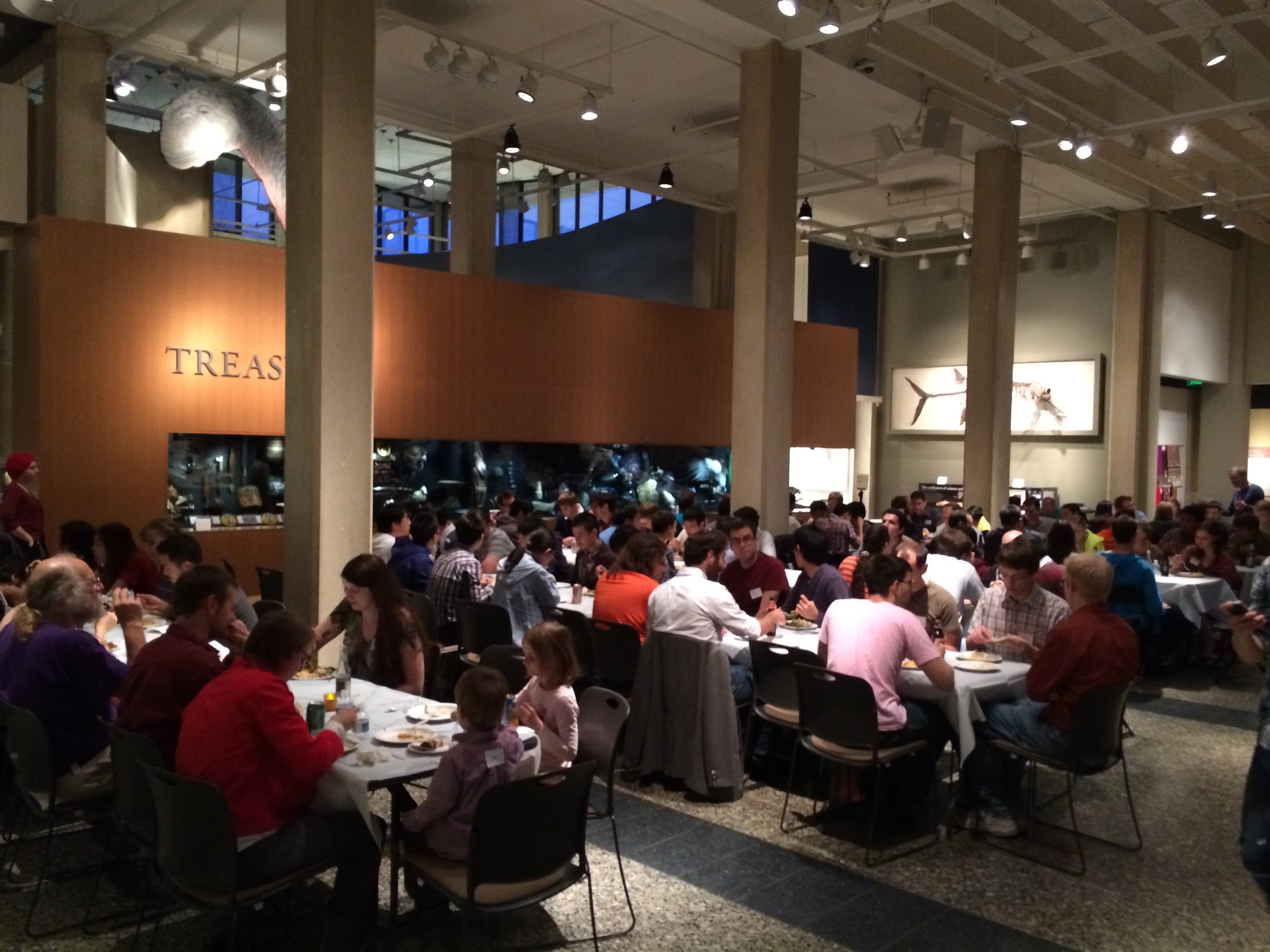
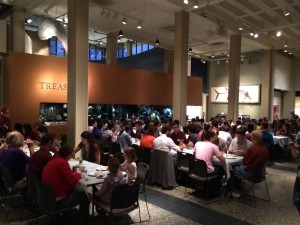
IMG_1861This evening, UW CSE faculty, staff, and graduate students welcomed the incoming class of graduate students at our annual “Pit Party” potluck dinner, held this year at the Burke Museum on the UW campus.

The name “Pit Party” is … a bit obscure. Of our currently active faculty, only Richard Ladner ever spent time in the actual “pit.”

In the 1960’s, CSE (then called “the Computer Science Group”) was partially housed in the basement of Roberts Hall – once the home of UW’s College of Mines.  You guessed it – there was a facsimile mine in the basement, where our annual welcoming party was held!

Here’s a 1970 letter from CSE professor Jean-Loup Baer to the Dean of the Graduate School describing housing conditions for junior faculty. Makes Sieg Hall look like heaven!

A bit more history:

A School of Mining Engineering was established at UW in 1898. Milnor Roberts, after whom Roberts Hall is named, became Dean in 1901.  The School began its life in Denny Hall, then moved to Parrington Hall (at that time called Science Hall), and in 1910 moved to a brick powerhouse which had been constructed for 1909’s Alaska-Yukon-Pacific Exposition (held on the UW campus), which was re-named Mines Hall. The School was re-named the College of Mines, and moved to the new Mines Laboratory (the south half of the current Roberts Hall) in 1921. In 1947, reflecting decreased interest in mining engineering, the College was re-named the School of Mineral Engineering and given departmental status in UW’s College of Engineering. In 1968, reflecting decreased interest in mineral engineering and increased prominence of ceramic engineering, the School became the Department of Mining, Metallurgical, and Ceramic Engineering, and in 1983 it became the Department of Materials Science and Engineering.

A working model of the Cripple Creek Gold Mine in Colorado was constructed as an exhibit for 1909’s Alaska-Yukon-Pacific Exposition. It later went to the World’s Fair in Belgium, and then to the basement of Roberts Hall – the pit! It ultimately was donated to Seattle’s Museum of History and Industry.

The Department of Computer Science & Engineering was established as an inter-college graduate program – the Computer Science Group – in 1967, and was housed in Roberts Hall. Jerre Noe was hired from SRI as CSE’s first chair in 1968; was succeeded by Hellmut Golde (1976), Bob Ritchie (1977), Paul Young (1983), Jean-Loup Baer (1988), Ed Lazowska (1993), David Notkin (2001), and Hank Levy (2006). In 1975 an undergraduate program in Computer Science was added, departmental status was conferred within the College of Arts & Sciences, and Sieg Hall became our home. A second undergraduate program, in Computer Engineering, was added in 1989 when the department moved to the College of Engineering and was re-named the Department of Computer Science & Engineering. The Paul G. Allen Center for Computer Science & Engineering was dedicated in 2003.

The University of Washington was established as the Territorial University of Washington in 1861, only 10 years after Seattle was settled and 18 years before Washington became a state. UW’s founder and first president, Asa Shinn Mercer, blazed the trail for a proud record of UW entrepreneurship and public service: he left his post after only two years, heading east to Massachusetts in 1863 and again in 1865 to recruit more than 100 young women – “The Mercer Girls” – to move to Seattle, funded by donations from eager men. In recognition of this contribution to civic life, he was elected to the Territorial Legislature. (Former UW President Bill Gerberding often remarked on the fact that one of his predecessors quit to run a brothel …)

Read more →

NPR: “Competition For Tech Talent Heats Up In Seattle Area”

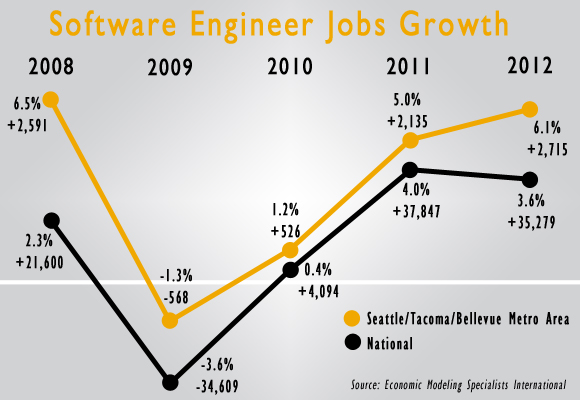
EngineerGrowthDraft3“From 2010 to 2013, the number of people working as software engineers in the Seattle metro area rose 14 percent … As of last year, a total of 48,725 software engineers were employed in the region …

“And there are still thousands more engineering jobs that have yet to be filled. Microsoft and Amazon alone are advertising close to 2,500 open engineering positions …

“And it’s not just the big local companies, like Amazon, Microsoft and Expedia that are hiring. In the past few years, a whole host of new companies — including Facebook, Google, LinkedIn, Twitter and eBay — have moved into the Seattle area to compete for talent …

“Rich Williams, senior vice president of marketing for Groupon … says outside companies are now discovering what locals have long known: the Seattle area is a great place to find talent.

“‘You have deep technology roots here. You have an increasingly vibrant start-up and entrepreneurial community, you have a great university system, and a lot of great companies operating here,’ Williams said.”

Read or listen here. Read more →

UW CSE’s OneBusAway continues to expand

OneBusAwayUW CSE’s OneBusAway continues to expand.  A transit rider in any of the OneBusAway regions (currently Atlanta, Puget Sound, and Tampa – and growing) can download the OneBusAway app for iPhone, Android, or Windows Mobile, which will then automatically detect which region it’s in, connect to the server for that region, and seamlessly start serving transit data.  Read the blog post here.
Read more →

UW CSE @ Seattle Business Magazine’s 2013 Tech Impact Awards

Jeremy-Jaech-CEO-of-SNUPI-TechnologiesAt a downtown gala on Thursday night, Seattle Business magazine presented its 2013 Tech Impact Awards – celebrating the accomplishments of the region’s technology companies and their leaders.

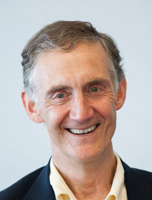
UW CSE alumnus Jeremy Jaech received the premier award of the night – the Lifetime Achievement Award.  Jeremy co-founded Aldus (invented desktop publishing – sold to Adobe), Visio (constraint-based drawing – sold to Microsoft), and Trumba (calendar integration), served for several years as CEO of Verdiem (building energy management), and now is co-founder and CEO of the UW CSE startup SNUPI Technologies – the result of spending a year in UW CSE after his exit from Verdiem.  UW President Michael Young, his wife Marti Young, and many UW Regents and friends were present to honor Jeremy.skytap_logo_tag

UW CSE spinoff Skytap received the Gold Award in the “Cloud” category.

UW CSE professor Ed Lazowska delivered the (blessedly brief) keynote address for the evening.T4A1

Read the Seattle Business awards article here.  Read Lazowska’s keynote here. Read more →

CSE’s Ed Lazowska on “The Future of Advanced Cyberinfrastructure”

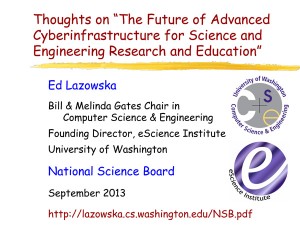
Pages from NSBCSE’s Ed Lazowska addressed the National Science Board (the oversight board for the National Science Foundation) on “The Future of Advanced Cyberinfrastructure.”  Other participants in the 3-hour briefing were Peter Lee (Microsoft Research), David Baker (UW Biochemistry), and Thom Dunning (NCSA, but soon to be the Northwest Institute for Advanced Computing, the joint initiative of UW and the Pacific Northwest National Laboratory).

The topics that Ed addressed:

  • Why must America remain the world leader in computer science?
  • How did we gain the lead, and how can we retain it?
  • How should our competitiveness be defined?
  • The coming decade: Dramatic improvements in technology and algorithms enable “smart everything”
  • Cyberinfrastructure to support 21st century “smart discovery”
    • Implications for academia
    • Implications for research policy
    • Implications for K-12 education

Ed’s slides are here. Read more →

$1.5M for UW brain-computer-spinal interface research from Paul G. Allen Family Foundation

CSNE-logo-300x261To help develop a fascinating new prosthetic device, Microsoft co-founder Paul G. Allen is providing $1.5 million to a team of University of Washington researchers including specialists in neuroengineering and computer science. The team is developing a brain-computer-spine interface that’s intended to restore hand and arm function in people who have suffered spinal cord injuries. It’s basically an implantable computer, the size of a pacemaker, that will relay signals from the brain into the spinal cord.

The project is led by Chet Moritz, professor of Rehabilitation Medicine. Other faculty participants are Adrienne Fairhall, professor of Physiology & Biophysics, and Josh Smith, professor of Computer Science & Engineering and of Electrical Engineering.  All three are associated with UW’s National Science Foundation Engineering Research Center for Sensorimotor Neural Engineering.

Announcement from the Paul G. Allen Family Foundation hereSeattle Times article here. Read more →

Josh Blumenstock, Joe Devietti, Peter Henry honored by Intel

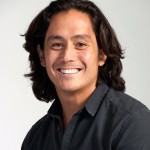
Josh Blumenstock

Josh Blumenstock

Nine faculty members from across the nation have been recognized by Intel in its 2013 U.S. Early Career Faculty Honor Program.  Among the nine:  UW CSE adjunct professor (and iSchool professor) Josh Blumenstock, and UW CSE Ph.D. alum (and University of Pennsylvania professor) Joe Devietti.

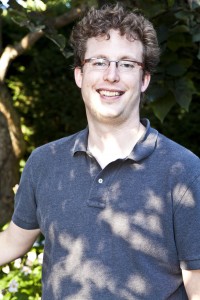
Fifteen top Ph.D. students from across the nation have been recognized by Intel in its 2013 U.S. PhD Fellowship Program, including UW CSE Ph.D. student Peter Henry.

Josh studies the social and economic impacts of technology.

Joe Devietti

Joe Devietti

Joe – advised by CSE’s Luis Ceze and Dan Grossman – studies programmability challenges raised by multicore architectures.

Peter – advised by CSE’s Dieter Fox – studies the use of depth cameras for dense 3D modeling of environments and objects.

Congratulations to Josh, Joe, and Peter!  Read more here!

Peter Henry

Peter Henry

Read more →
« Newer PostsOlder Posts »