The 2003 research paper “Inferring High-Level Behavior from Low-Level Sensors” by UW CSE’s Don Patterson, Lin Liao, Dieter Fox, and Henry Kautz has been recognized with the “10 Year Impact Award” from Ubicomp 2013, the 2013 ACM International Joint Conference on Pervasive and Ubiquitous Computing.
The award committee concluded that “The paper … is an excellent example of how one can learn very useful context information from simple GPS traces and it formed the basis for today’s thriving smart cities/smart transportation work. It is a nice example of how higher order information can be gleaned from everyday sensing – which is an important thread of work at Ubicomp and one of the enduring methods.”
The award will be presented at the Ubicomp 2013 conference in Zurich, Switzerland during the opening session on September 10th.
Read more →
 “UW CSE researchers have created a new wireless communication system that allows devices to interact with each other without relying on batteries or wires for power.
“The new communication technique, which the researchers call “ambient backscatter,” takes advantage of the TV and cellular transmissions that already surround us around the clock. Two devices communicate with each other by reflecting the existing signals to exchange information. The researchers built small, battery-free devices with antennas that can detect, harness and reflect a TV signal, which then is picked up by other similar devices.”
Today this work received the SIGCOMM 2013 Best Paper Award.
Read more here. Read more →
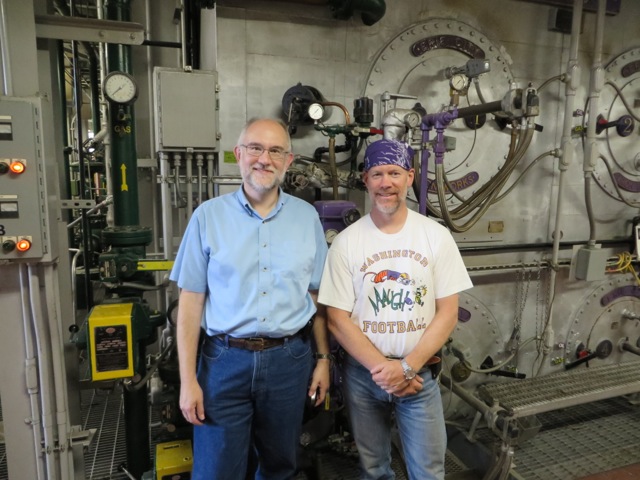
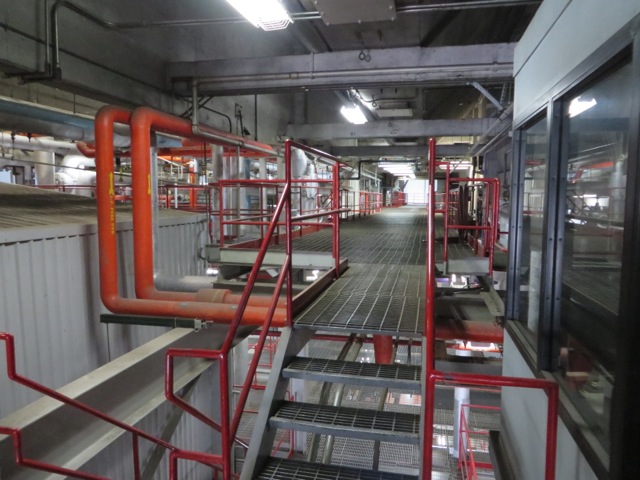
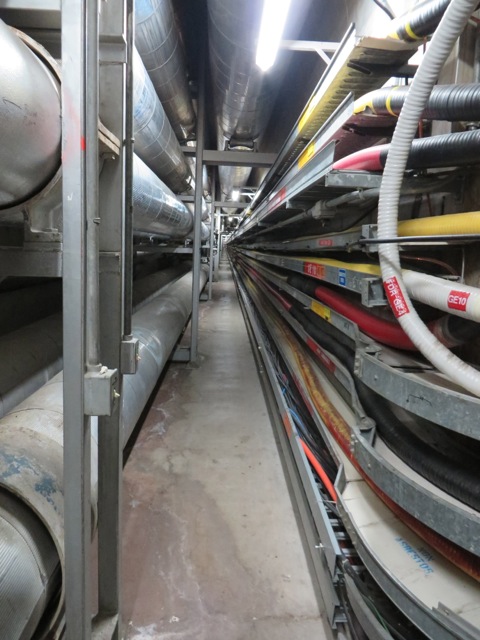
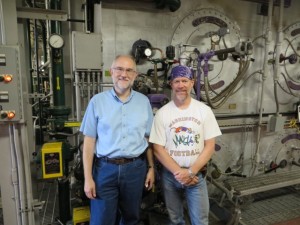 Somehow UW CSE’s advancement officer Karen Howard Leikin managed to wangle a 2-hour tour of UW’s power plant and steam tunnels for CSE alums Kirk Glerum and Don Hacherl. Karen accompanied, along with UW CSE’s Ed Lazowska.
There’s no way to describe how cool this was! (Well, truth be told, it was actually pretty hot …)
The central power plant supplies steam heat, chilled water air conditioning, compressed air, and emergency power to 174 buildings on the the 643-acre UW main campus and medical center through 8 miles of tunnels.
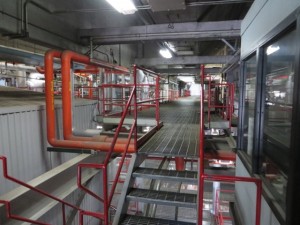 Five natural gas boilers (with fuel oil backup) provide steam. UW consumes about 55 megawatts of electrical power; 10% of this is provided by a steam turbine generator (the main goal of which is to provide uninterruptible power for the power plant itself), the rest is purchased from utilities. There are 5 2-megawatt diesel backup generators to provide emergency power to other critical parts of campus.
Mark Kirschenbaum, Assistant Director of Campus Utilities, was a wonderful tour guide; Mark is a graduate of the U.S. Merchant Marine Academy and spent a number of years dealing with shipboard boilers before joining UW 18 years ago.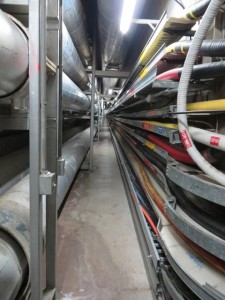
Additional photos here. Read more →
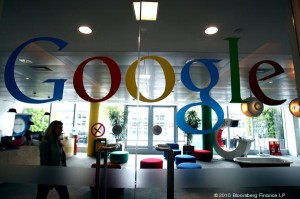 “If you’ve ever been mystified by how Google knows what you’re looking for before you even finish typing your query into the search box, or had voice search on Android recognize exactly what you said even though you’re in a noisy subway, chances are you have Jeff Dean and the Systems Infrastructure Group to thank for it.
“As a Google Research Fellow, Dean has been working on ways to use machine learning and deep neural networks to solve some of the toughest problems Google has, such as natural language processing, speech recognition, and computer vision. In this exclusive Q&A, he talks about his work and how it’s making Google more powerful and easy to use.”
Read the article here. Read more →
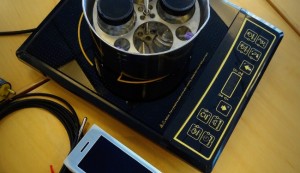 An article in The Atlantic includes work done with our collaborator PATH. The “Mobile-phone milk pasteurization” section is the work of Rohit Chaudhri and the “Digital video” section is a collaboration between PATH, UW, and Digital Green. Richard Anderson provides the UW-PATH linkages that make these projects possible. We also acknowledge our principal collaborators at PATH, Noah Perin and Kiersten Israel-Ballard (among others).
Read the article here. Read more →
 “The notion of a strict cortical hierarchy, especially a feedforward hierarchy of processing layers, is losing ground to a more nuanced view of the cortex as an interconnected and distributed network.” Read more here. Read more →
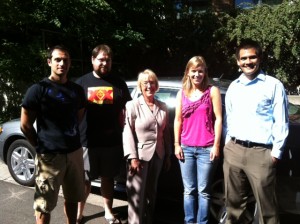
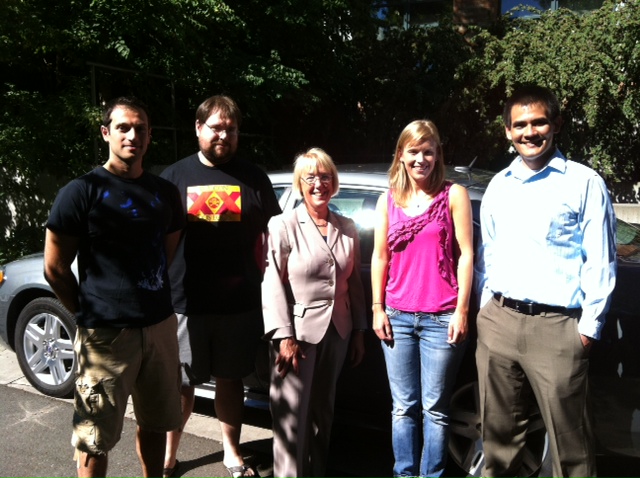
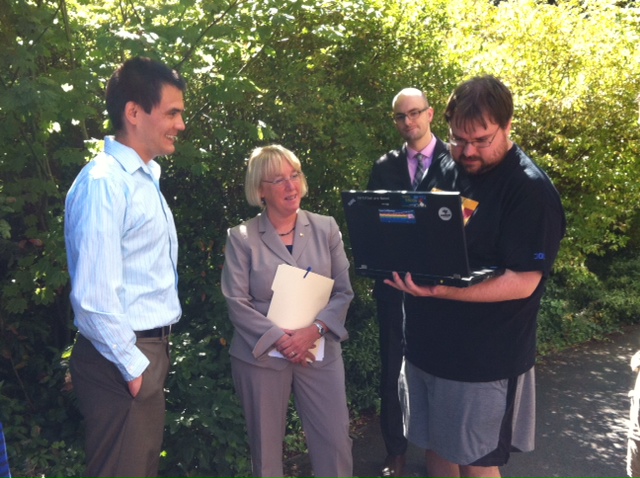
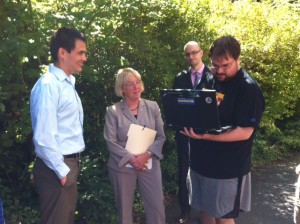 U.S. Senator Patty Murray visited UW CSE today for a discussion of cybersecurity issues with professors Yoshi Kohno and Ed Lazowska. Following the briefing, graduate students Karl Koscher, Franzi Roesner, and Alexei Czeskis demonstrated the security vulnerabilities of modern automobiles by controlling all aspects of a recent-model sedan from an Internet-connected laptop by exploiting vulnerabilities in the car’s telematics unit. Read more →
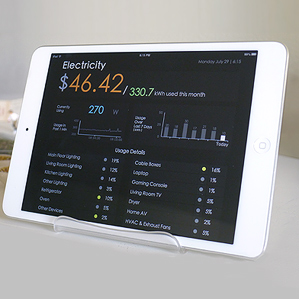 “If you use a credit card or a cell phone, chances are you get a monthly statement detailing each purchase or call. This may soon expand to your utility bills, too: a project in the works at electronics company Belkin makes it possible to see how much electricity you’re spending on everything from the TV in your living room to the washing machine in your basement.
“Called Belkin Echo Electricity, it’s a small device that connects to your utility meter and pays attention to the electromagnetic interference, or ‘noise,’ emitted by electrical appliances plugged in to wall outlets …
“Echo Electricity builds on technology acquired in 2010 from an energy-monitoring startup called Zensi together with the doctoral work of University of Washington PhD candidate Sidhant Gupta, whose advisor, Shwetak Patel, was a Zensi founder.”
Read the Technology Review article here. Read Belkin’s description of Echo Electricity here. Read more →
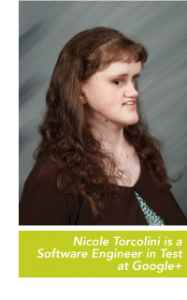 Nicole Torcolini has faced more obstacles than most: she lost most of her sight at age four due to cancer in the optic chiasm, and the cancer treatment she received caused her to become slightly hard-of-hearing in both ears.
While a student at Central Kitsap High School in Silverdale, Washington, Nicole attended a University of Washington summer workshop hosted by CSE professor Richard Ladner’s Alliance for Access to Computing Careers (AccessComputing). This experience inspired Nicole to invent the Nemetex Nemeth Back-Translator, a computer-based assistive technology device that translates visually incomprehensible braille math (Nemeth), produced on an electronic braille notetaker, into easily-readable print. Nicole became a high school entrepreneur, launching a small business to market the device to other blind students like her. This was just the beginning of Nicole’s journey to help build tools for vetting and enabling accessibility in technology.
Nicole was recognized with a 2007 NCWIT Seattle-area Award for Aspirations in Computing. She attended Stanford University and graduated in 2012, earning a B.S. in Computer Science with a focus in Human-Computer Interaction. She is now an engineer with Google.
Nicole is profiled in the current issue of NCWIT’s Award for Aspirations in Computing Newsletter, here.
Congratulations to Nicole for all that she has achieved, and to Richard for his long-standing national leadership in making computing and computer science accessible to students like Nicole! Read more →
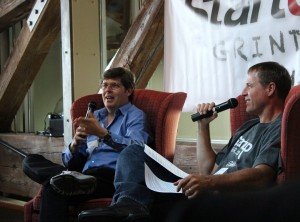 UW CSE’s Oren Etzioni, GeekWire‘s 2012 GeekWire Awards Geek of the Year, was the speaker at Seattle’s monthly Startup Grind meetup on Wednesday evening. During a fireside chat at Pier 70 — which was actually once home to one of Etzioni’s past startups, Go2Net — Etzioni shared some great advice for anyone in the startup world.
“Life is short,” he said. “Don’t do the same thing everyone else is doing … And don’t do something that’s two percent better than the other person. Do something that changes the world.”
Read the interview here. Read a previous GeekWire profile of Etzioni here. Read more →