 Nanocrafter , a synthetic biology game from UW CSE’s Center for Game Science, has been selected as a finalist in the 2014 Serious Games Showcase & Challenge (SGS&C). Qualifying as a finalist allows Nanocrafter to be placed at pavilion booth (#2663) at December’s Interservice/Industry Training Simulation and Education Conference (I/ITSEC) in Orlando, Florida.
At the conference, Nanocrafter is now eligible to win distinction as “2014 Best Serious Game” in the Business category as judged by the SGS&C evaluators, the “2014 Students’ Choice Award” which is determined by middle and high school students, the “2014 Best Game Special Emphasis Topic Social Media Crowdsourcing for Peer Learning Award” which is determined by a special panel, and the coveted “2014 People’s Choice Award” which is determined by conference attendees (so if you happen to be going, be sure to vote for Nanocrafter).
Read more here. Read more →
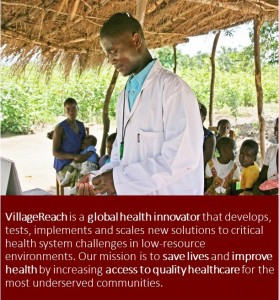 VillageReach, a Seattle-based non-profit that develops, tests, implements and scales global health innovations, has received a $470,000 grant from the Bill and Melinda Gates Foundation to further develop and enhance ODK scan, part of the Open Data Kit suite of data tools, in partnership with the University of Washington’s Department of Computer Science & Engineering. ODK Scan is an Android application that digitizes data on paper forms, using a device’s built-in camera and image-processing technology.
Read more here. Read more →
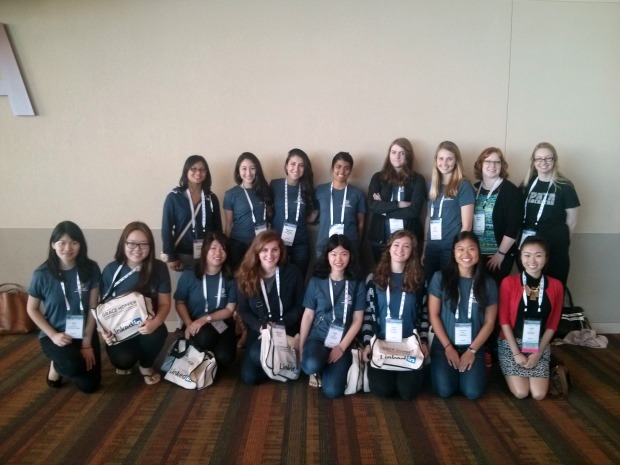
UW undergraduate and graduate students at last week’s Grace Hopper Conference
GeekWire writes:
“Satya Nadella set off a firestorm last week after advising women to not explicitly ask for a raise, but rather rely on “good karma” …
“We caught up with some University of Washington computer science students who were representing their school at the conference (read how the UW is trying to increase women representation in computing here). Read on to hear what they had to say about Nadella’s comments and women in technology as a whole.”
UW CSE undergraduates Jennifer Kang and Karolina Pyszkiewicz,and UW CSE graduate student Amrita Mazumdar are interviewed. Topics include:
- On Nadella’s comments and what it says about the tech industry
- On why it is important to get more females interested in computer science
Read it here!
Read a related Crosscut article by UW CSE professor Ed Lazowska here. Read more →
 An article in Crosscut by CSE’s Ed Lazowska:
“Let’s use Satya Nadella’s remarks at the Grace Hopper Celebration of Women in Computing as a learning experience – for all of us.
“When Larry Summers made the comments about women in academia that led to the termination of his presidency at Harvard, the issue was not “inarticulateness” – it was that his comments betrayed a lack of familiarity with a rich scholarly literature regarding discrimination against women in academia: literature that should be deeply familiar to any person in an academic administrative role, from department chair to dean to provost to president.
“Similarly, the issue with Satya Nadella’s remarks was not “inarticulateness” (as his first Twitter apology stated). It was that his remarks betrayed a lack of familiarity with a rich scholarly literature regarding discrimination against women in the tech workplace, and suggested a degree of faith in the personnel systems at Microsoft and other tech companies that is contradicted by data and experience …
“Diversity matters. The playing field is not level. Today’s biases are sometimes more subtle than yesterday’s biases. This makes them more difficult to identify and tackle. Leaders – at every level – must be held accountable for recognizing and tackling these biases.”
Read the entire article here.
Previous post on Nadella’s comments, with links to worthwhile background reading, here. Read more →
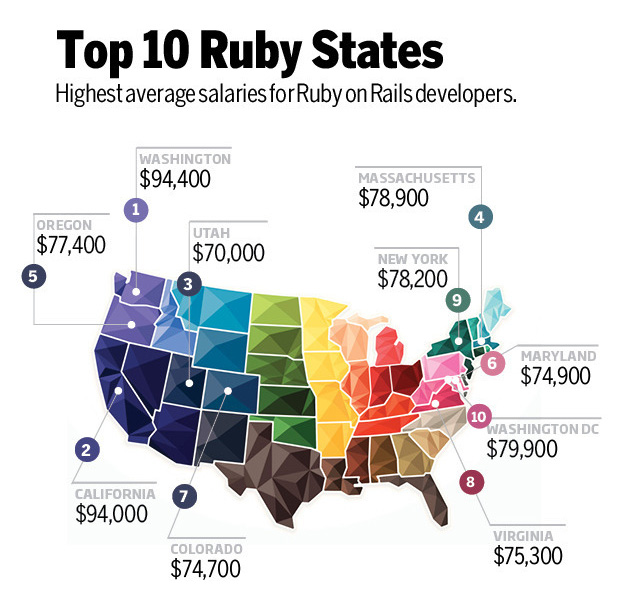 We’re #1!
An article in CIO Magazine, citing data from PayScale, reports that Washington leads the nation when it comes to average salaries for Ruby on Rails developers.
Check it out here. Read more →
 To demonstrate that we display no gender bias in our photo-inversion (see previous post here), we note today’s news concerning former UW Provost (and current University of Illinois at Urbana-Champaign Chancellor) Phyllis Wise, who, if reports are to be believed, on more than one occasion has published the same results multiple times, deleting co-authors.
From Retraction Watch:
“Phyllis Wise, the chancellor of the University of Illinois and an obstetrics researcher, has called for a massive correction of a 2006 paper in Neuroscience for work she appears to have tried to pass off as having been previously unpublished – but which wasn’t.”
Read more here.
From PubPeer, regarding a different paper:
“This paper appears to be a duplicate …
“The text is 99% the same, as are Figures 2 and 3 …
“Neither paper cites the other and they have different coauthors, although they share the same first author …
“Upon further examination, both papers are taken almost verbatim from an earlier publication …
“Again, this paper has different coauthors and the same first author. 99% of the text of both later papers appeared previously in this paper, which is cited in neither. The same figures also appear here …”
Read more here.
Ooopsie … Read more →
 Wired writes:
“If you’ve noticed your Facebook mobile messages zipping around a little more quickly over the past few months, you can thank a little-known open-source project called Apache Thrift.
“Facebook designed Thrift and has long used the tool to send data between computer servers inside the sprawling data centers that underpin its online empire. But in the summer, the company also began using it to connect user smartphones running the Facebook Messenger app to machines inside these data centers. ‘This is the first time we’ve sent it down to the phone,’ says [2002 UW CSE alum] Jason Jenks, a Facebook engineer who worked on the project.”
Read more here. Read more →
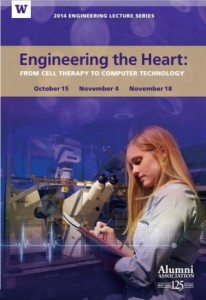 This year’s UW Engineering Lecture Series – “Engineering the Heart” – takes place on the evenings of October 15, November 4, and November 18.
The final talk – November 18 – will be by CSE and EE professor Josh Smith, explaining his team’s work on “Cutting the Cord: Wireless Power for Implantable Devices.” Read more →
Update: Here is Satya Nadella’s email to employees following the Hopper Conference interview:
“Toward the end of the interview, Maria asked me what advice I would offer women who are not comfortable asking for pay raises. I answered that question completely wrong. Without a doubt I wholeheartedly support programs at Microsoft and in the industry that bring more women into technology and close the pay gap. I believe men and women should get equal pay for equal work. And when it comes to career advice on getting a raise when you think it’s deserved, Maria’s advice was the right advice. If you think you deserve a raise, you should just ask.
“I said I was looking forward to the Grace Hopper Conference to learn, and I certainly learned a valuable lesson.”
Original post below:
 UNBELIEVABLE. Except that it’s not unbelievable. It’s classic.
The 2014 Larry Summers Award for failure to grasp the reality of the world that we aging males have created goes to …
Read more here … and everywhere. (Excellent Crosscut article here.)
Nancy Hopkins’s MIT report is required reading. Every generation of women believes that previous generations have faced obstacles, but her generation has a level playing field. Every generation of women is wrong about the latter clause.
The #1 thing tech companies can do to improve the diversity of the field is to create a welcoming and supportive environment within the company for female engineers. All of the outreach programs in the world for K-12 and college students, all of the advertising campaigns, all of the articles in the press, all of these together will not make nearly as big a difference as a visibly supportive corporate culture would make.
Excellent New York Times piece by Claire Cain Miller here. Read more →
 In the article “Engineering improvements for the world,” the Washington Post notes:
“It may be true that engineers are producing sometimes-myopic inventions. But something else is happening that is getting little attention.
“In labs around the world, a new generation of engineers is emerging. They are men and women concerned by the gulf between rich and poor and by environmental changes and resource depletion. They are what we call ‘development engineers’ – engineers (and often economics, business and social science majors, as well) who are dedicated to using engineering and technology to improve the lot of the world’s poorest people …
“The Open Data Kit, designed by engineers at the University of Washington [in collaboration with Google, by a team of students led by UW CSE faculty member Gaetano Borriello] is allowing hundreds of international development organizations to use mobile devices to collect critical data.
“This year, six of the 35 technology innovators recognized by the Massachusetts Institute of Technology’s prestigious 35 under 35 list were development engineers [including UW CSE Bachelors alums Kuang Chen and Kurtis Heimerl, who were advised in their UC Berkeley Ph.D. studies by UW CSE Ph.D. alum Tapan Parikh, a previous TR35 winner for his groundbreaking UW Ph.D. work on development engineering].”
Read more here. Read more →