
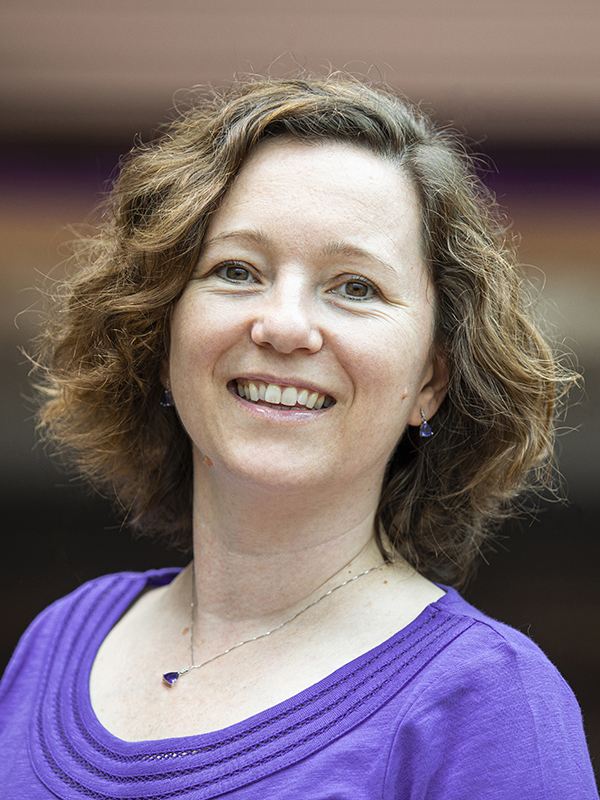
Magdalena Balazinska, professor and director of the Allen School, has been elected a member of the Washington State Academy of Sciences (WSAS) in recognition of her “contributions in data management for data science, big data systems, cloud computing, and image/video analytics and leadership in data science education.” The WSAS was established in 2015 as a source of independent, evidence-based scientific and technical advice for state policy makers, modeled after the National Academies of Science, Engineering and Medicine. Balazinska, who was directly elected by her WSAS peers, is one of 36 members in the 2025 class.
“We are pleased to recognize the achievements of these world-renowned scientists, engineers, and innovators,” said WSAS President Allison Campbell. “And we are grateful for their willingness to contribute expertise from a wide range of fields and institutions to support the state in making informed choices in a time of growing complexity.”
One of Balazinska’s most influential achievements has been her foundational work on Borealis, a distributed stream processing engine that made large-scale, low-latency data processing more dynamic, flexible and fault tolerant for a variety of applications, from financial services and industrial processing, to network monitoring and wireless sensing. Borealis introduced the ability to quickly and easily modify queries at runtime in response to current conditions, correct query results to account for newly available data, and allocate resources and optimize performance across a variety of networks and devices. Earlier this year, Balazinska and her collaborators earned a Test of Time Award at the Conference on Innovations Data Systems Research (CIDR 2025) for their work on Borealis. They received a Test of Time Award in 2017 from the Association for Computing Machinery Special Interest Group on the Management of Data (ACM SIGMOD) for a related paper expanding the system’s fault tolerant stream processing capabilities.
Balazinska also advanced the then-burgeoning field of “big data,” particularly for scientific applications. She co-led the design and development of Myria, a fast, flexible, open-source cloud-based service that enabled domain experts across various scientific fields to perform big data management and analytics. Myria was designed for efficiency and ease of use; it also functioned as a test-bed for Balazinska and her colleagues to explore new directions in data management research in response to real users’ needs. Her work on Myria and related projects earned Balazinska the inaugural VLDB Women in Database Research Award at the International Conference on Very Large Databases in 2016.
More recently, Balazinska has focused on data management for visually intensive applications such as video and augmented, virtual and mixed reality. For example, she and her collaborators developed VOCAL, or Video Organization and Compositional AnaLytics, to make it easier for users to organize and extract information from any video dataset. In the absence of a pretrained model, the system combines active learning with a clustering technique to reduce the manual effort involved in identifying and labeling features. It also supports compositional queries for analyzing the interaction of multiple objects over time, and it can self-enhance its own capabilities by using large language models (LLMs) to identify and generate missing functionality in response to user workloads.
Balazinska, who has served as director of the Allen School since 2020, holds the Bill & Melinda Gates Chair in Computer Science & Engineering at the University of Washington and is a senior data science fellow in the eScience Institute. She previously served as director of the eScience Institute and associate vice provost for data science at the UW, in addition to co-chairing the National Science Foundation’s Advisory Committee for Computer and Information Science and Engineering (CISE). Last year, Balazinska was appointed to Washington state’s Artificial Intelligence Task Force charged with developing recommendations on potential guidelines or legislation governing the use of AI systems. She currently co-chairs two task-force subcommittees focused on AI in education and workforce development and in health care and accessibility, respectively.
A total of 12 UW faculty members were elected as part of the incoming WSAS class, which also includes Allen School adjunct professor Julie Kientz, chair of the Department of Human-Centered Design & Engineering. Kientz was recognized for her research and leadership in human-computer interaction that “has advanced health and education technology, influenced policy, and shaped the HCI field through impactful scholarship, interdisciplinary collaboration, and inclusive, real-world technology design.” Balazinska, Kientz and their colleagues will be formally inducted at an event marking the Academy’s 20th anniversary in October.
Balazinska is the fourth Allen School faculty member to be elected to the WSAS; professors Anna Karlin and Ed Lazowska and professor emeritus Hank Levy previously joined following their elections to the National Academies of Science and/or Engineering.
Read the WSAS announcement and a related UW News story.