
MythBusters, computer science edition: Why an Allen School degree continues to be a great choice for students

Magnifying glass resting on the keys of a laptop computer
“The industry will continue to need smart, creative software engineers who understand how to build and harness the latest tools — including AI.” Allen School leaders Magdalena Balazinska and Dan Grossman examine some of the myths surrounding computer science careers in the era of artificial intelligence. Photo by Yevhen Smyk, Vecteezy

There has been a lot of chatter lately, online and in various media outlets, about the supposed dwindling prospects for new computer science graduates in the artificial intelligence era. Recent layoffs in the technology sector have students, parents and educators worried that a degree in computing, once seen as a sure path to a fulfilling career, is no longer a reliable bet.

“The alarmist doom and gloom prevalent in the news is not consistent with the experiences of the vast majority of our graduates,” said Magdalena Balazinska, professor and director of the Allen School. “The industry will continue to need smart, creative software engineers who understand how to build and harness the latest tools — including AI. And the fact remains that a computer science degree is great preparation for a broad range of fields within and beyond technology, including the natural sciences, finance, medicine and law.”

In our own version of MythBusters, we asked Balazinska and professor Dan Grossman, vice director of the Allen School, to examine the myths and realities surrounding AI and the prospects for current and future Allen School majors. Their answers indicate that the rumored demise of software engineering as a career path has been greatly exaggerated — and that no matter what path computer science majors choose after graduation, they can use their education to change the world.

Also be sure to check out our fact sheet, Computer Science Careers and AI: Myth vs. Reality.

Let’s start with the question on everyone’s mind: What’s the job market like for computer science graduates these days?

Dan Grossman: Individuals’ mileage may vary depending on a range of factors, but what’s being reported in some media outlets doesn’t reflect what we’re seeing here at the University of Washington. More than 120 different companies hired this year’s Allen School graduates into software engineering roles. Amazon alone hired more than 100 graduates from the Allen School’s 2024-25 class. Google and Meta didn’t hire at that scale, but still more than last year — they each hired 20 graduates this year. Microsoft hired more than two dozen graduates from this latest class. I expect these numbers to grow as we hear from more graduates. 

So, while the job market is tighter now than it was a few years ago, the sky is not falling. It’s important to remember that the Allen School is one of the top computer science programs in the nation, with a cutting-edge curriculum that evolves alongside the industry while remaining grounded in the fundamentals of our field. Our graduates are highly sought after, so their experience in the job market doesn’t necessarily reflect the experience of others. That has always been the case, even before this latest handwringing over AI. A B.S. in CS is not a uniform credential. The Allen School has always produced highly competitive graduates.

Magdalena Balazinska: In addition to those who found employment after graduation, more than 100 of our recent graduates opted to continue their education by enrolling in a master’s or Ph.D. program, which, of course, also makes us immensely proud!

How is AI impacting software engineering jobs?
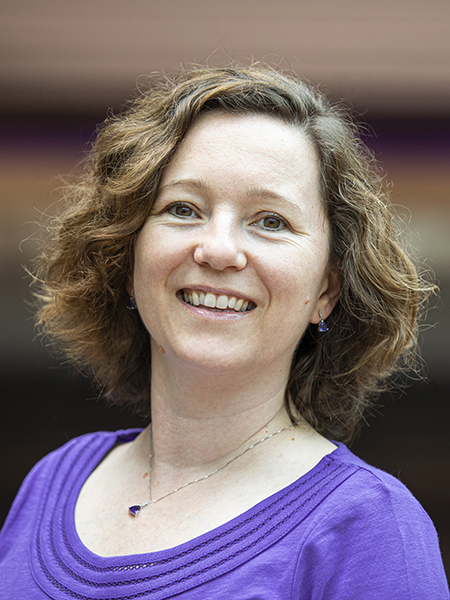
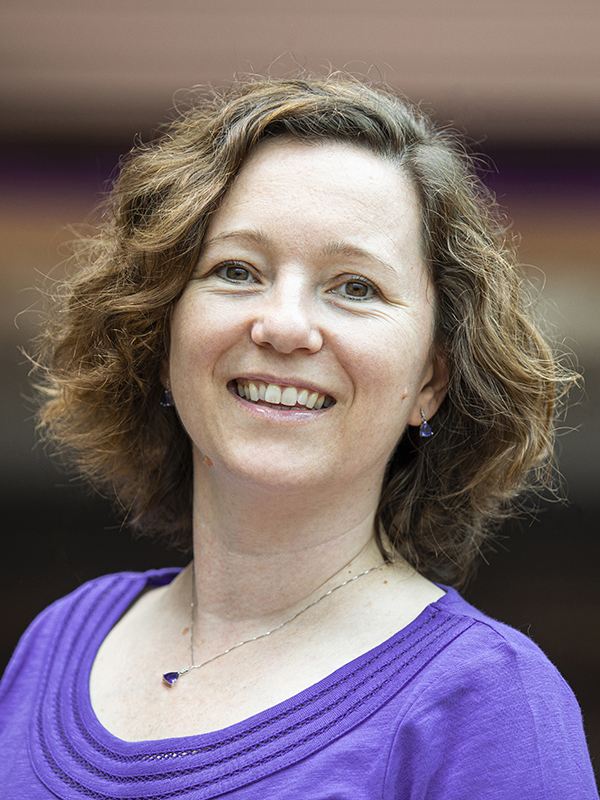
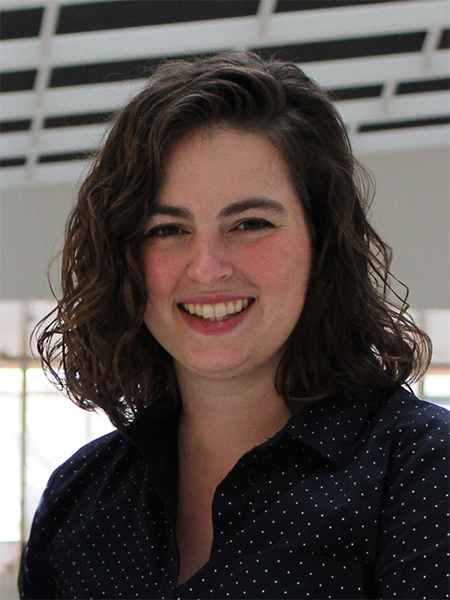
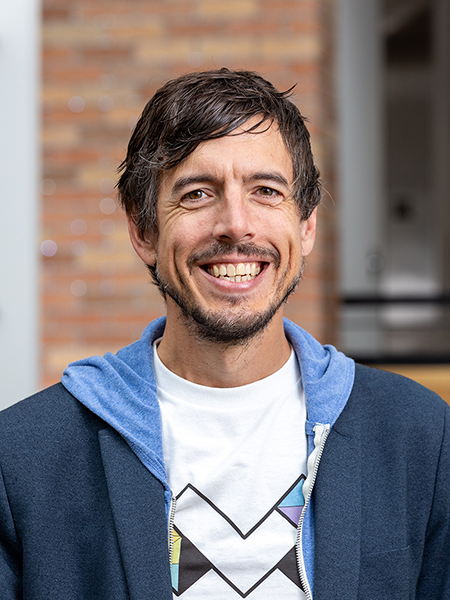
Portrait of Magdalena Balazinska
Magdalena Balazinska: “The industry will continue to need smart, creative software engineers who understand how to build and harness the latest tools — including AI.”

MB: There are two factors: (1) AI’s impact on the work of a software engineer, and (2) AI’s impact on the job market for software engineers. Regarding the latter, it’s not so much that AI is taking the jobs, but that companies are having to devote tremendous resources to the infrastructure behind AI, which is very expensive. Also, many companies over-hired during COVID, and now they’re doing a course-correction for the AI era. I look at this as more of a reset. There’s no question that AI is affecting many areas of computing, just as it’s affecting just about every other sector of the economy. Companies will continue to invest in the people who know how to build and leverage these and other tools.

To my first point: With AI, we should expect the work of a software engineer to change, but to change in a really exciting way! The task of coding, or the translation of a very precise design into software instructions, can largely be handled by AI. But that’s not the most exciting or challenging part of software engineering. Understanding the requirements, figuring out an appropriate design, and articulating it as a precise specification are the hard parts. Going forward, software engineers will spend more time imagining what systems to build and how to organize the implementation of those systems, and then let AI handle many of the details of converting those ideas into code.

DG: One of our former faculty colleagues, Oren Etzioni, said, “You won’t be replaced by an AI system, but you might be replaced by a person who uses AI better than you.” I think that’s the direction we’re headed. Not AI as a replacement for people, but as a differentiator. Here at the Allen School, one of our goals is to enable students to differentiate themselves in this rapidly evolving landscape. For example, we are introducing a course on AI-aided software development, which will teach students how to effectively harness these tools. 

How has AI affected student interest in the Allen School?

DG: Student interest remains strong — we received roughly 7,000 applications for Fall 2025 first-year admission.

MB: That may sound like a daunting number. However, we were able to offer admission to 37% of the Washington high school students who applied. That’s not as high as we would like it to be, but it’s far higher than public perception. We achieve this by heavily favoring applicants from Washington. For Fall 2025, we offered admission to only 4% of applicants from outside Washington.

If AI can write code, why should students major in computer science?

MB: Because computer science is so much more than coding! Creating a new system or application, perhaps a system to help the elderly take care of their daily tasks and manage their paperwork or a new approach for doctors to perform long-distance tele-operations, isn’t just a matter of “writing code.” A software engineer begins by clearly understanding the requirements — what the system needs to provide. Then the software engineer will decompose the problem into pieces, understand how those pieces will fit together, and anticipate failures. What happens if there is a power or network failure, or someone tries to hack the system? This gets progressively more challenging with the complexity and scale of systems that software engineers build, typically on teams with many people working together. Coding is the relatively easier part.

DG: In that spirit, here in the Allen School, we do teach students how to code, but as a component of how to envision, design and build systems and applications that solve complex problems and touch people’s lives. The principles, precision, and reasoning gained from reading and writing code is a necessary foundation that serves our students very well — including graduates who now use AI in industry. It is the software engineers with the deepest knowledge who will be most effective at using AI to write their code, because they will know how and where AI can go wrong and how to steer it toward producing a correct output.

MB: Engineers have always used tools, and their tools have always advanced with time and opened the door to innovation. Thanks to developments like modern coding libraries and languages, online repositories like StackOverflow, GitHub, automated testing, cloud computing, and more, software engineers today are far more efficient and can develop applications more quickly than ever before. And this was before AI for coding had really taken off. And yet, there are more software engineers doing more interesting and important things than ever before!

How does the Allen School prepare students for a workplace — and a world — being transformed by AI?
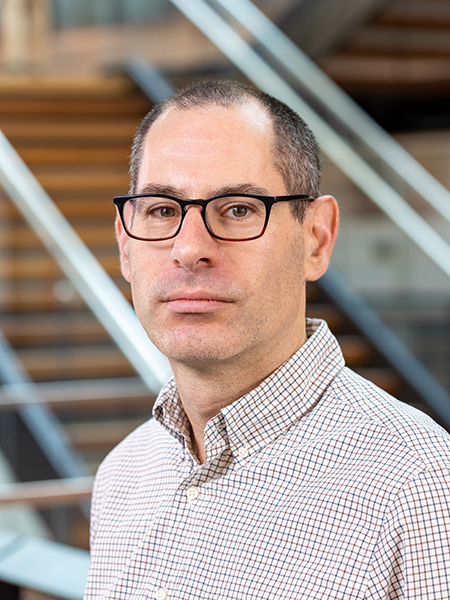
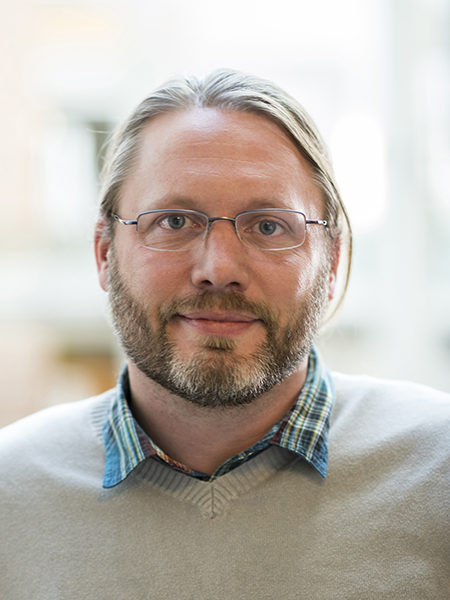
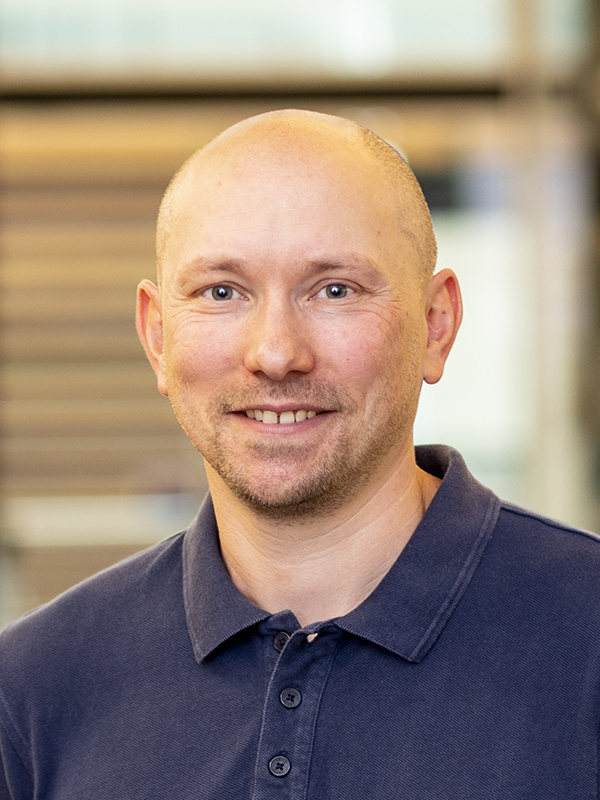
Portrait of Dan Grossman
Dan Grossman: “One of our goals is to enable students to differentiate themselves in this rapidly evolving landscape.”

MB: As a leader in AI research, the Allen School is ideally positioned to help students learn how to use AI, how to build AI, and how to move the field of AI forward to benefit humanity. We give students multiple opportunities to explore AI topics and tools as part of our curriculum. Dan mentioned our AI-assisted software development course, and many of our other courses allow for using AI assistance in well-prescribed ways. This enables students to focus on core course concepts, generate more complex projects, and so on. Gaining experience with any AI tool can give a sense of what the technology can help with — along with its limitations. That said, we will continue in some courses to expect students to build, design, test, and document software without AI assistance.

DG: Our courses sometimes use the same cutting-edge tools used in industry, and other times will provide a simpler setting for pedagogical purposes. Software engineering tools change rapidly, so we tend not to get into the weeds on any one particular tool but give students the confidence to pick up future tools. Importantly, we don’t just teach students how to build and use AI. We also help them to think critically about the ethics and societal impacts of these technologies, such as their potential to reinforce bias or be used as a surveillance tool, and ways to mitigate those impacts.

MB: Another advantage we have at the Allen School is that we are a leading research institution, and our faculty are among the foremost experts in the field. This gives us the ability to incorporate new concepts and techniques into our coursework quickly. We also have a program devoted to supporting undergraduates in engaging in hands-on research in our labs alongside those very same faculty and our amazing graduate students and postdocs. Many students choose to get involved in research during their undergraduate studies.

What if a student is interested in computing, but not AI?

DG: Great! There are many open challenges across computing, from systems development, to human-facing interactive software design, to hardware design, to data management, and many others. Even if you are not using or developing AI itself, building systems that can run AI efficiently is driving a lot of exciting work in the field these days. While the big breakthroughs that have been driving rapid change over the last few years are AI-centered, computing remains a broad field.

MB: A student can major in computer science and follow their passion wherever it takes them. A subset of students will choose to study AI and build the next AI technologies, but the vast majority will use AI as a tool while building systems for medicine, education, transportation, the environment, and other important purposes. Or they will build back-end infrastructure at global companies like Google, Amazon, or Microsoft, or tackle other challenges like those that Dan mentioned. The more we advance computing, the more we open new opportunities. I think that’s why the number of software engineers just keeps growing. There is always more to do. The job is never done.

What is your advice to current and aspiring computer science majors who worry about their career prospects with the rise of AI?

MB: First, if you think you want to be a computer scientist or a computer engineer, pursue that! If you choose a major that you are excited about, you will not mind spending hours deepening your knowledge and sharpening your skills, which will help you to become an expert and to enjoy your chosen profession even more. My advice to every student is to take a broad range of challenging courses. Learn how to use the current tools, with the understanding that the tools you use today will not be the ones you use tomorrow. This field moves fast, which is what makes it exciting.

When it’s time to start your job search, whether for an internship or a full-time job, apply broadly. Apply to large companies, small companies, companies in various sectors, non-profits, and so on. Many organizations need software engineers! And not all interesting technical jobs that use a computing degree have the title of software engineer. Pick the position where you will learn the most. It’s important to optimize for learning and for growth, especially early on in one’s career.

DG: I would also remind students that a UW education is not about vocational training; our goal is that students graduate with the knowledge and skills to succeed in their chosen career, yes, but also to be engaged citizens of the world. While you’re here, make the most of your education — take a range of challenging courses and put in the time to learn the material. After all, it is a multi-year investment on your part, and the faculty have invested a lot of time and effort into creating a challenging, coherent curriculum for you. Take the hardest classes that you think are also the most exciting ones, and then focus on learning as much as you can.

Any final thoughts?

DG: Don’t choose a major solely because it’s popular. Choose a major that you’re passionate about. If that’s computer science or computer engineering, we’d love to see you at the Allen School. If it’s something else, we’d still love to see you in some of our classes.

MB: Everyone can benefit from learning at least a little computer science, especially now in the AI era!

Download the fact sheet: Computer Science Careers and AI: Myth vs. Reality
Read more →

Allen School partners with Ai2 to advance open AI and breakthrough science, with support from NSF and NVIDIA

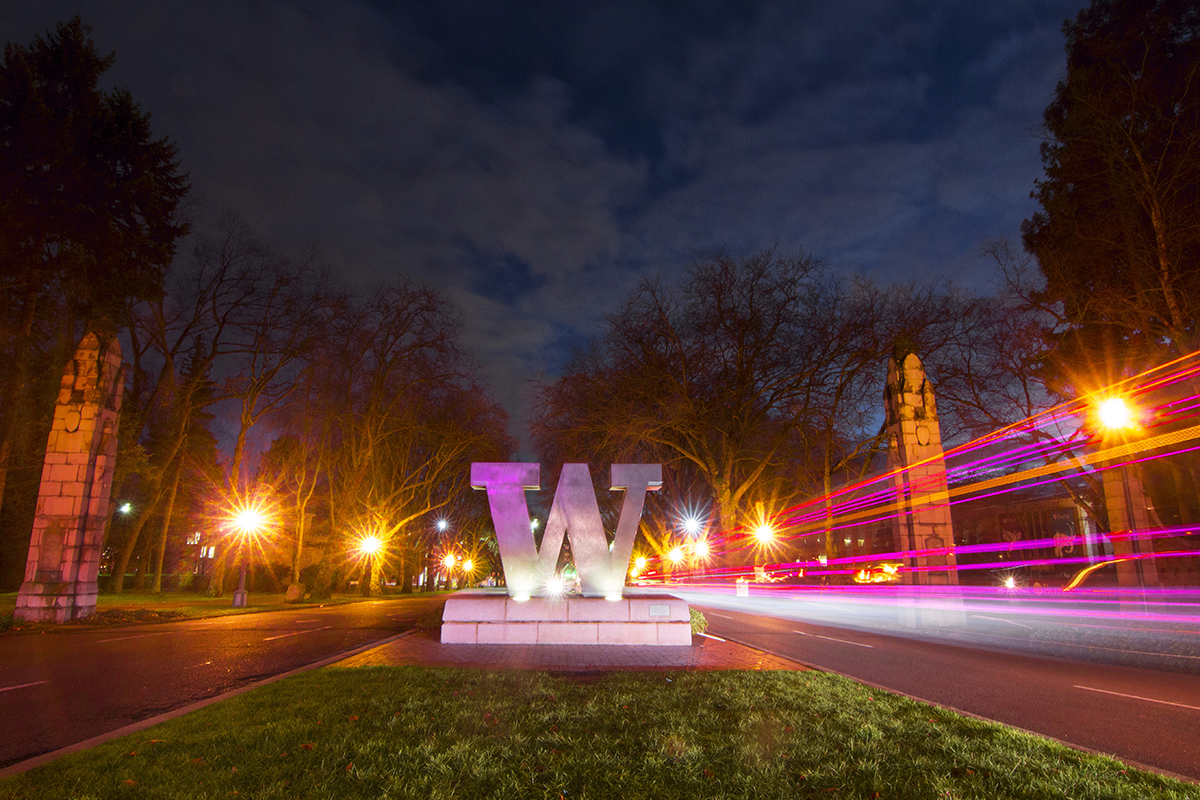
A bronze W statue at the entrance to the University of Washington campus at night, flanked by pink and orange tinged light trails from passing vehicles
The Allen School at the University of Washington is working with Ai2 and other partners on a new initiative to advance open AI for science and the science of AI, with support from the U.S. National Science Foundation and NVIDIA.

The University of Washington’s Paul G. Allen School of Computer Science & Engineering has teamed up with the Allen Institute for AI (Ai2) on a new project aimed at developing the first fully open set of artificial intelligence tools to accelerate scientific discovery and enhance the United States’ leadership in AI innovation. Today the U.S. National Science Foundation (NSF) and NVIDIA announced a combined investment of $152 million in this effort, including $75 million awarded through the NSF’s Mid-Scale Research Infrastructure program.

Ai2 will lead the Open Multimodal AI Infrastructure to Accelerate Science (OMAI) project. The principal investigator is Ai2 Senior Director of NLP Research Noah A. Smith, who is also Amazon Professor of Machine Learning at the Allen School. Smith’s faculty colleague Hanna Hajishirzi, Torode Family Professor at the Allen School, is co-principal investigator on behalf of UW and also Ai2’s senior director of AI. 

“OMAI is a terrific opportunity to leverage the longstanding partnership between Ai2 and the Allen School, which has yielded some of the most exciting developments in building truly open AI models and trained some of the most promising young scientists working in AI today,” said Hajishirzi. “This is a pivotal moment for us to form the foundation for scientific discovery and innovation across a variety of domains — and also, importantly, advance the science of AI itself.”

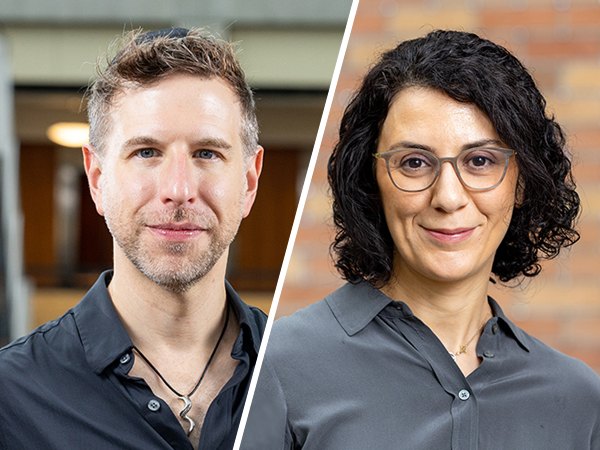
Side by side portraits of Noah A. Smith and Hanna Hajishirzi
Noah A. Smith (left) and Hanna Hajishirzi aim to leverage the partnership between Ai2 and the Allen School to benefit science and society.

The cost of building and maintaining today’s AI models is too prohibitive for all but the most well-resourced companies, leaving researchers in academic and not-for-profit labs without ready access to these powerful tools and stifling scientific progress. The goal of the OMAI project is to build out this foundational infrastructure through the creation and evaluation of models trained on open-access scientific literature and informed by the needs of scientists across a range of disciplines. By openly releasing the model weights, training data, code and documentation, the team will provide researchers using its tools with an unprecedented level of transparency, reproducibility and accountability, instilling confidence in both the underlying models and their results.

The concept for OMAI was incubated in an ecosystem of open research and collaboration that the Allen School and Ai2 have built since the latter’s founding in 2014. That ecosystem has enabled dozens of UW students to collaborate with Ai2 on research projects, produced leading-edge open AI artifacts like the Open Language Model (OLMo) and Tulu, and developed tools like OLMoTrace to give anyone full visibility into models’ training data — all of which have helped fuel Seattle’s emergence as a hub of AI innovation. 

Smith looks forward to leveraging that longstanding synergy to push technologies that will have a transformational impact on the American scientific enterprise — and even transform the conversation around AI itself.

“There’s been a reaction that seems to be widespread that AI is a thing that is happening to us, as if we are passively subject to this technology and don’t have agency,” Smith said. “But we do have agency. We get to define what the priorities should be for AI and to build tools that scientists will actually be able to use and trust. With OMAI, the UW will be a leader in this new paradigm and push AI in a more responsible direction that will benefit society in a multitude of ways.”

In addition to the UW, academic partners in the OMAI project include the University of Hawai’i at Hilo, the University of New Hampshire and the University of New Mexico.

OMAI represents a landmark NSF investment in the technology infrastructure needed to power AI-driven science — a development that Brian Stone, performing the duties of the agency’s director, described as a “game changer.” 

“These investments are not just about enabling innovation; they are about securing U.S. global leadership in science and technology and tackling challenges once thought impossible,” Stone said.

To learn more, read the award announcement, the Ai2 blog post and related coverage GeekWire and SiliconANGLE.

Read more →

Professor Magdalena Balazinska elected to Washington State Academy of Sciences for contributions in data management and data science research and education

Portrait of Magdalena Balazinska
Photo by Mark Stone/University of Washington

Magdalena Balazinska, professor and director of the Allen School, has been elected a member of the Washington State Academy of Sciences (WSAS) in recognition of her “contributions in data management for data science, big data systems, cloud computing, and image/video analytics and leadership in data science education.” The WSAS was established in 2015 as a source of independent, evidence-based scientific and technical advice for state policy makers, modeled after the National Academies of Science, Engineering and Medicine. Balazinska, who was directly elected by her WSAS peers, is one of 36 members in the 2025 class.

“We are pleased to recognize the achievements of these world-renowned scientists, engineers, and innovators,” said WSAS President Allison Campbell. “And we are grateful for their willingness to contribute expertise from a wide range of fields and institutions to support the state in making informed choices in a time of growing complexity.”

One of Balazinska’s most influential achievements has been her foundational work on Borealis, a distributed stream processing engine that made large-scale, low-latency data processing more dynamic, flexible and fault tolerant for a variety of applications, from financial services and industrial processing, to network monitoring and wireless sensing. Borealis introduced the ability to quickly and easily modify queries at runtime in response to current conditions, correct query results to account for newly available data, and allocate resources and optimize performance across a variety of networks and devices. Earlier this year, Balazinska and her collaborators earned a Test of Time Award at the Conference on Innovations Data Systems Research (CIDR 2025) for their work on Borealis. They received a Test of Time Award in 2017 from the Association for Computing Machinery Special Interest Group on the Management of Data (ACM SIGMOD) for a related paper expanding the system’s fault tolerant stream processing capabilities.

Balazinska also advanced the then-burgeoning field of “big data,” particularly for scientific applications. She co-led the design and development of Myria, a fast, flexible, open-source cloud-based service that enabled domain experts across various scientific fields to perform big data management and analytics. Myria was designed for efficiency and ease of use; it also functioned as a test-bed for Balazinska and her colleagues to explore new directions in data management research in response to real users’ needs. Her work on Myria and related projects earned Balazinska the inaugural VLDB Women in Database Research Award at the International Conference on Very Large Databases in 2016.

More recently, Balazinska has focused on data management for visually intensive applications such as video and augmented, virtual and mixed reality. For example, she and her collaborators developed VOCAL, or Video Organization and Compositional AnaLytics, to make it easier for users to organize and extract information from any video dataset. In the absence of a pretrained model, the system combines active learning with a clustering technique to reduce the manual effort involved in identifying and labeling features. It also supports compositional queries for analyzing the interaction of multiple objects over time, and it can self-enhance its own capabilities by using large language models (LLMs) to identify and generate missing functionality in response to user workloads.

Balazinska, who has served as director of the Allen School since 2020, holds the Bill & Melinda Gates Chair in Computer Science & Engineering at the University of Washington and is a senior data science fellow in the eScience Institute. She previously served as director of the eScience Institute and associate vice provost for data science at the UW, in addition to co-chairing the National Science Foundation’s Advisory Committee for Computer and Information Science and Engineering (CISE). Last year, Balazinska was appointed to Washington state’s Artificial Intelligence Task Force charged with developing recommendations on potential guidelines or legislation governing the use of AI systems. She currently co-chairs two task-force subcommittees focused on AI in education and workforce development and in health care and accessibility, respectively.

A total of 12 UW faculty members were elected as part of the incoming WSAS class, which also includes Allen School adjunct professor Julie Kientz, chair of the Department of Human-Centered Design & Engineering. Kientz was recognized for her research and leadership in human-computer interaction that “has advanced health and education technology, influenced policy, and shaped the HCI field through impactful scholarship, interdisciplinary collaboration, and inclusive, real-world technology design.” Balazinska, Kientz and their colleagues will be formally inducted at an event marking the Academy’s 20th anniversary in October.

Balazinska is the fourth Allen School faculty member to be elected to the WSAS; professors Anna Karlin and Ed Lazowska and professor emeritus Hank Levy previously joined following their elections to the National Academies of Science and/or Engineering.

Read the WSAS announcement and a related UW News story. Read more →

‘Go out and build a life that matters’: Celebrating the Allen School’s Class of 2025

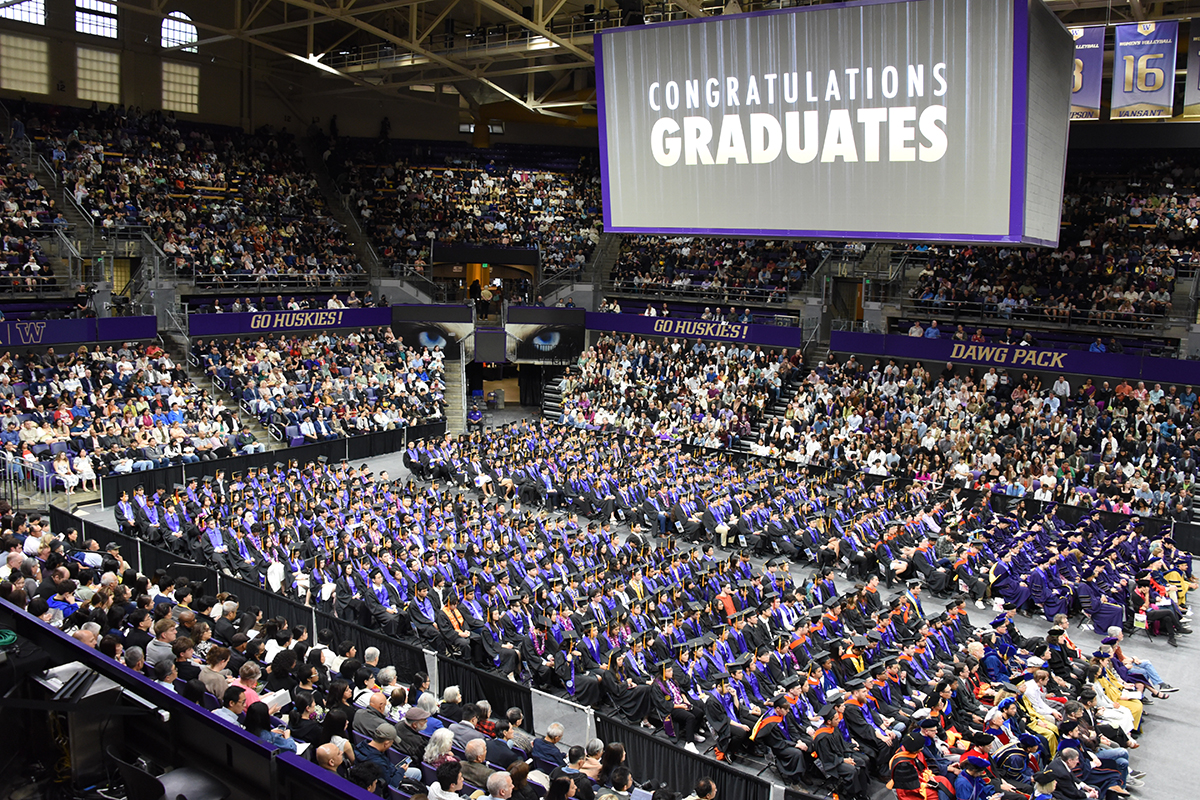
A college basketball arena decorated for graduation, with people wearing graduation regalia seated in rows of chairs on the carpeted floor, and people filling the stands to cheer them on. The jumbotron above the floor displays the message Congratulations, Graduates.
A packed Alaska Airlines Arena celebrates the Allen School’s graduating class of 2025. (Photo by Kerry Dahlen)

On Friday, June 13, an estimated 5,000 friends, family, faculty and staff packed the Alaska Airlines Arena in the University of Washington’s Hec Edmundson Pavilion to celebrate the Allen School’s graduating class of 2025. While the date invited superstition, the evening was full of jubilation as roughly 800 graduates collected their commemorative diplomas, flipped their tassels and made the transition from Allen School students to Allen School alumni.

“It feels like yesterday that we were welcoming you to the Allen School. And tonight we celebrate all you have accomplished here,” said Magdalena Balazinska, professor and director of the Allen School. “We are extremely proud of you. We are proud of all you have accomplished and can’t wait to see what you accomplish next!”

‘True impact doesn’t come from what you accumulate, but what you contribute.’

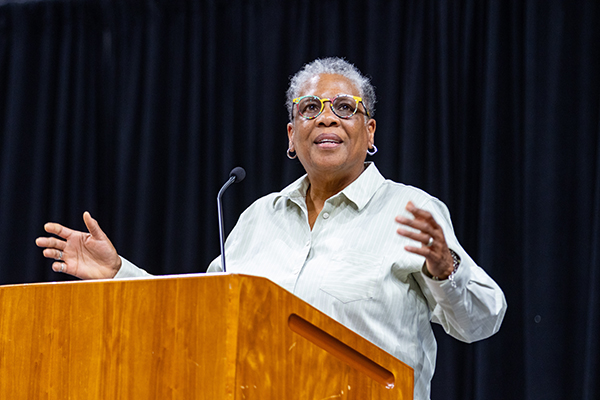
A woman stands at a podium with microphone and gestures with her hands while speaking
Trish Millines Dziko: “Changing the world isn’t about being remembered — it’s about doing things worth remembering.” (Photo by Matt Hagen)

That was the message graduation speaker Trish Millines Dziko — co-founder and executive director of the Technology Access Foundation (TAF), computer scientist and proud Husky mom — delivered to the graduates as they contemplate the next stage of their journey. She was welcomed to the stage by professor Ed Lazowska, who exercised one of his last official acts in his 48th and final year as an Allen School faculty member by introducing Millines Dziko, calling her “a friend of mine and a hero of mine.”

“TAF uses STEM as a tool for social change,” Lazowska said during his introductory remarks. “And in its nearly 30 years, TAF has changed the lives of tens of thousands of students in our area.”

Technology as a tool for social change was a recurring theme in Millines Dziko’s speech — but, she noted, not always for the better. With more than 60% of the nation’s wealth concentrated in the top 10% of households, while the bottom 50% hold just 5%, Millines Dziko suggested that the world needs “more people who care enough to fix what’s broken.”

“You can use your critical thinking, problem solving, ideation, creation and leadership skills to build solutions to some of the most pressing problems like homelessness, generational poverty, public education, the environment and health care,” she said.

Whatever path they decide to pursue, the graduates will not be able to rely on their technical skills alone. Saying hard work and good grades were “just the beginning,” Millines Dziko advised the graduates to prioritize building relationships by showing themselves to be capable, reliable, truthful, empathetic and accountable. Developing these qualities would enable them to build social capital that, she noted, they could use along with technology and engineering “as the vehicle to creating a better future for everyone.”

“I hope you pursue purpose over profit, and let your values lead your vision. Please create solutions that lift people up and improve communities,” Millines Dziko urged. “Because in the end, changing the world isn’t about being remembered — it’s about doing things worth remembering.”

Alumni Impact Award: Nicki Dell (Ph.D., ‘15)

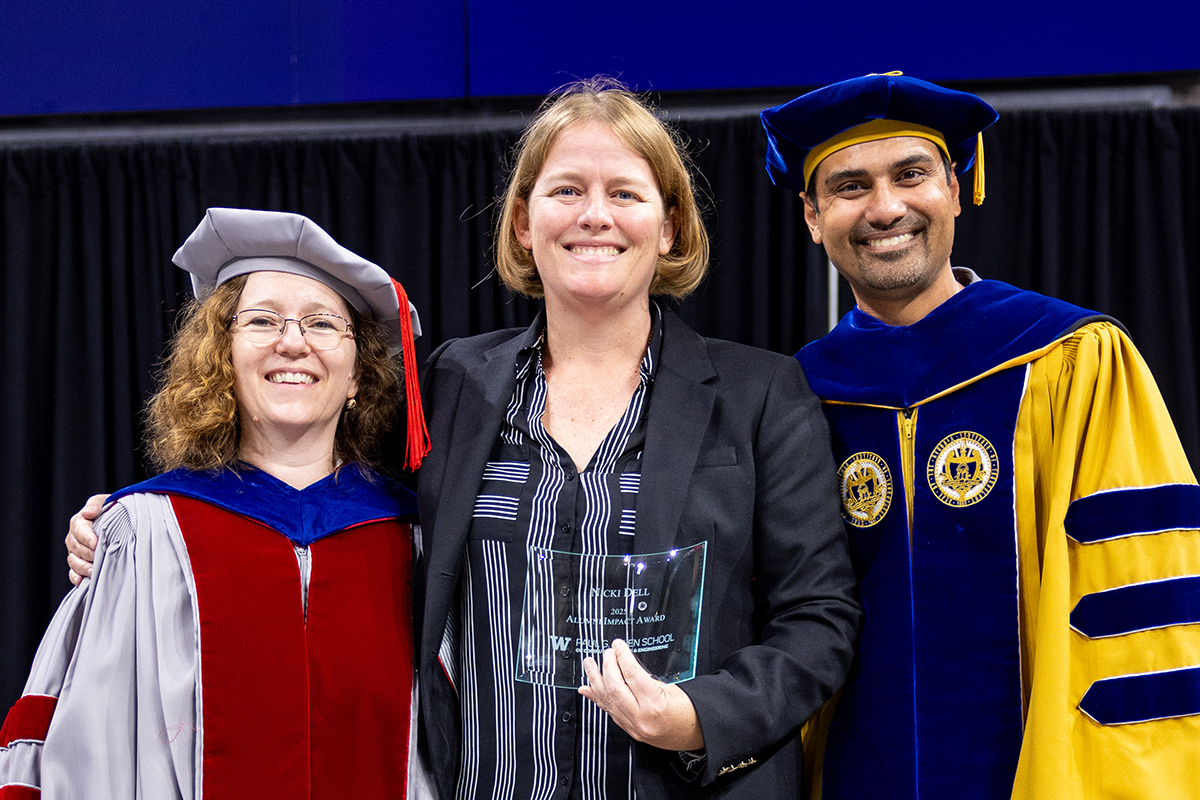
Three people pose onstage, with the woman in the center holding a glass plaque flanked by two people in Ph.D. regalia
Making our computer-mediated world safer and and more equitable: Nicki Dell with Magda Balazinska (left) and Shwetak Patel (Photo by Matt Hagen)

Nicki Dell is a shining example of what Millines Dziko talked about. Each year, the Allen School recognizes one or more alumni who have used their Allen School education to change the world. Since her own graduation a decade ago, the 2025 Alumni Impact honoree has been “doing things worth remembering” in the form of technologies that serve the needs of overlooked communities such as home health care workers and people experiencing intimate partner violence. Dell worked with professors Linda Shapiro and the late Gaetano Borriello on her way to earning the 500th doctoral degree awarded by the Allen School before taking up a faculty position at Cornell Tech.

In his remarks, presenter Shwetak Patel, professor and associate director of development and entrepreneurship, highlighted Dell’s leadership of the Clinic to End Tech Abuse (CETA) among her many contributions — contributions that had already earned her a SIGCHI Societal Impact Award as well as a MacArthur Foundation “genius grant.”

“She deeply partners with affected communities, and then builds systems and interventions that make our computer-mediated world safer and more equitable for everyone,” Patel said.

Recognizing student leadership and service

So many members of the Allen School’s undergraduate student body — which now numbers more than 2,200 — contribute to activities and events that enrich the student experience, it is difficult for the Undergraduate Student Services Team (USST) to choose the recipients of this and the Outstanding Senior awards. But choose, they did; after USST Director Crystal Eney invited all graduating students who were involved in outreach, community building and mentorship to stand and be recognized, the following individuals were singled out for their contributions to the Allen School community and the field of computing.

Undergraduate Service Awards

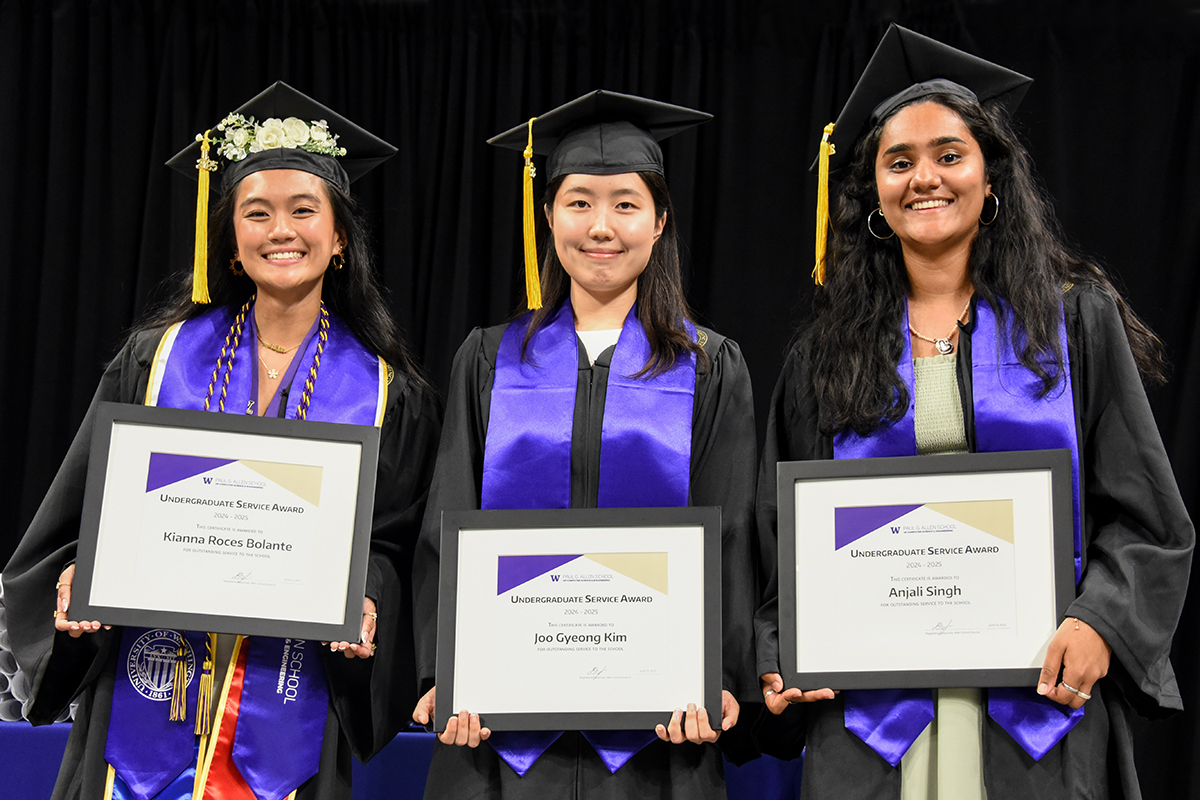
Three women dress in graduation caps and gowns smile while posing with framed award plaques
Inspirational, compassionate and mission-driven: (left to right) Kianna Roces Bolante, Joo Gyeong Kim and Anjali Singh (Photo by Kerry Dahlen)

Honoree Kianna Roces Bolante was described as the “epitome of service” in her role as chair of the student group Computing Community, or COM^2, overseeing school-wide events and activities that build community among the undergraduate majors in the Allen School. In her two years at the helm, she earned a reputation — and universal appreciation — for interacting with the community she serves with empathy, intention and a commitment to inclusion. “Her leadership is a labor of love, and she is an inspiration to so many students on campus,” said Chloe Dolese Mandeville, senior assistant director for student engagement and access at the Allen School.

Joo Gyeong Kim was recognized for her foundational leadership in shaping the Allen School’s Changemakers in Computing (CIC) program that engages rising juniors and seniors in high school in learning about technology, society and justice. “As one of the founding mentors, she brought a thoughtful, mission-driven approach that helped define the program’s values and direction,” Dolese Mandeville said. She leaned heavily on that approach when she took on temporary leadership of the entire program one summer while both directors were out sick. Known as a steady and compassionate leader, Kim’s impact extends to the entire CIC community.

Anjali Singh was honored for her dedicated service in multiple roles with the Student Engagement & Access team. Starting with the Allen School Ambassadors — a team of current majors who engage middle and high school students in learning about computer science via school visits and field trips — Singh used her warmth and knack for storytelling to inspire students. She quickly rose to the position of lead ambassador before going on to help launch a new team of Student Recruitment Representatives. Having served hundreds of prospective students along the way, “her dedication, advocacy for accessible pathways into computing and long-standing service have left a lasting legacy,” Dolese Mandeville said.

Zhengyu Zhang was recognized for his service to the robotics research community in the Allen School. His contributions include the mastery of complex simulation tools, one-on-one mentorship and the development of an open-source repository that is used by researchers in multiple labs. Known for being generous with his time and willing to support others regardless of their skill level, Zhang’s collaboration, service and mentorship has, noted Dolese Mandeville, “enabled the success of countless students and researchers, from undergraduates to postdocs.”

Outstanding CSE Senior Awards

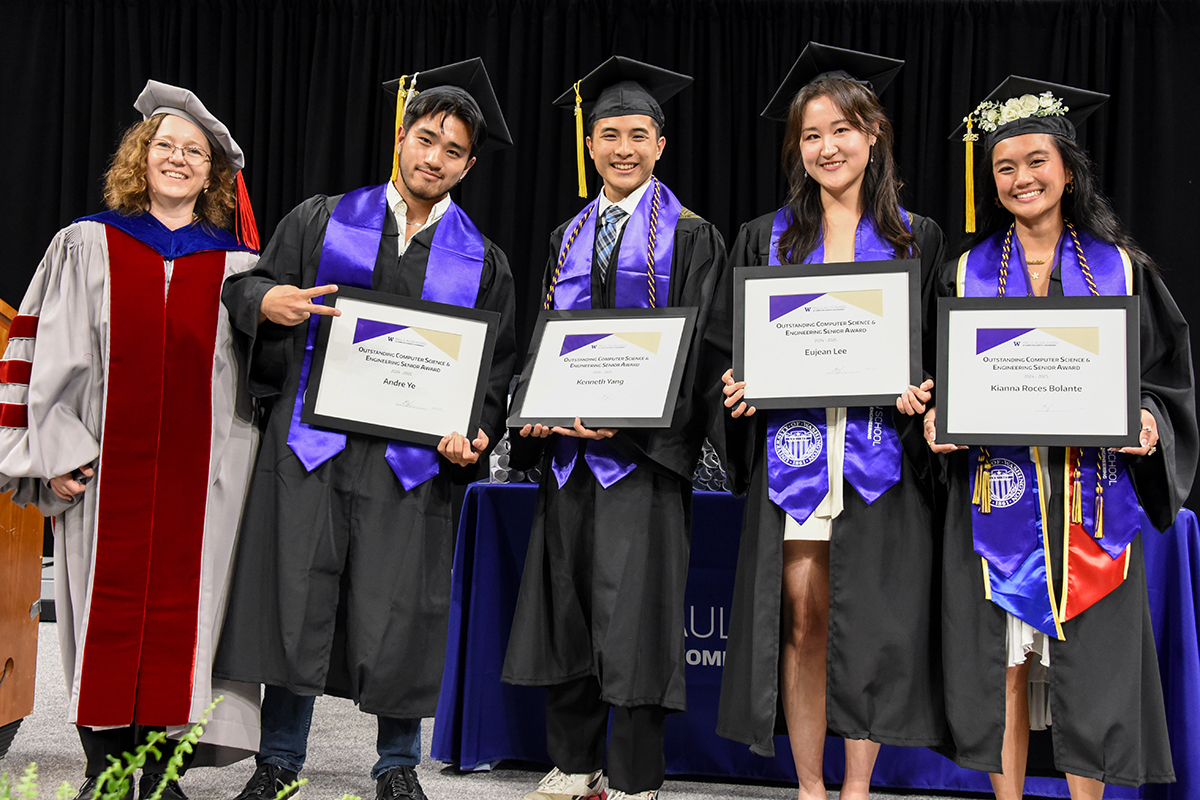
A smiling woman in Ph.D. regalia poses with four smiling people dressed in graduation caps and gowns and holding framed award plaques
The epitome of scholarship and leadership: Balazinska with (left to right) Andre Ye, Kenneth Yang, Eujean Lee and Kianna Roces Bolante (Photo by Kerry Dahlen)

Balazinska called Bolante back to the stage to collect one of four awards designed to recognize students who demonstrate superior scholarship and leadership potential — qualities that Bolante has epitomized during her time at the Allen School. In addition to her aforementioned service contributions, she has also contributed to research supporting people with Parkinson’s disease, language preferences in disability communities and computer science education. For the latter, she developed a suite of six social computing modules which she piloted with more than 1,400 local high school students. Last year, she received a CRA Outstanding Undergraduate Researcher Award from the Computing Research Association — one of four in the nation — for her work.

Eujean Lee was recognized for her outstanding academic achievements and research contributions, for which she was also nominated for a College of Engineering Dean’s Medal for Academic Excellence. As an undergraduate researcher in the Makeability Lab, Lee co-authored two papers on the use of augmented reality and computer vision to make sports more accessible to people with low vision — one of which earned a Best Paper Award at the Workshop on Inclusion, Diversity, Equity, Accessibility, Transparency and Ethics in Extended Reality (IDEATExR). Lee also served as vice president of the Korean Job Search Association, helping to connect students with career opportunities and resources.

Honoree Kenneth Yang’s research spans software engineering, neuroscience and computer graphics. He contributed to a paper presenting a suite of new, more reliable version control merge tools for shared repositories such as Git that was published at the IEEE/ACM International Conference Automated Software Engineering (ASE) — one of the top conferences in the field. He also developed new software tools for automating electrophysiology experiments to accelerate brain research and open up new avenues of experimentation. Yang previously received a CRA Outstanding Undergraduate Researcher Award honorable mention for his work.

Andre Ye was recognized for blending technical innovation with humanistic insight in research that spans computer vision, machine learning and human-AI interaction. In the Allen School’s Social Futures Lab, he developed a framework to account for human uncertainty in medical image segmentation models that earned an honorable mention at the Conference on Human Computation and Crowdsourcing (HCOMP). He has also investigated the influence of linguistic and cultural differences on image captioning models and the use of language models to support critical thinking. Ye has earned multiple accolades, including a Paul & Daisy Soros Fellowship and a College of Arts & Sciences Dean’s Medal. He will pursue his Ph.D. at MIT in the fall.

Celebrating scholarly achievement

The path to a doctorate involves years of intensive, original research — as the 52 newly-hooded Ph.D. graduates seated on the floor of the arena could attest. But they are not the only Allen School students who make original contributions to the field on their way to earning a degree; a significant number of bachelor’s and fifth-year master’s students know their way around a lab, as well. Professors Leilani Battle and Maya Cakmak, co-chairs of the Allen School’s Undergraduate Research Committee, had the pleasure of highlighting several of them with Best Senior Thesis or Outstanding Master’s Thesis awards.

Two smiling women, one dressed in Ph.D. regalia and one in a blazer and dress, flank four smiling students holding framed award plaques. The two students on the left are dressed in casual attire, while the two on the right are dressed in graduation caps and gowns.
They know their way around a lab: Maya Cakmak (left) and Leilani Battle (right) with Sela Navot, Haoquan Fang, Andrew Shaw and Hayoung Jung (Photo by Matt Hagen)

Best Senior Thesis (Winner)

Winner Andrew Shaw was recognized for his thesis titled “Agonistic Image Generation: Unsettling the Hegemony of Intention,” which was the result of a collaboration with Outstanding Senior honoree Andre Ye. Under the guidance of Allen School professors Ranjay Krishna and Amy Zhang, Shaw combined computer science and philosophy to develop a novel image generation interface that actively engages users with competing visual interpretations of their prompts, in consideration of the sociopolitical context, to facilitate user reflection. The paper was accepted to the ACM Conference on Fairness, Accountability, and Transparency (FAccT).

Best Senior Thesis (Honorable Mention)

In his thesis titled “SAM2Act: Integrating A Visual Foundation Model with A Memory Architecture for Robotic Manipulation,” honorable mention recipient Haoquan Fang introduced new models that achieved state-of-the-art performance on existing benchmarks for robotic manipulation, plus a new benchmark for testing robots’ ability to act based on past information. Fung completed this work under the supervision of Allen School professor Dieter Fox and presented his results at the International Conference on Machine Learning (ICML) and the Conference on Computer Vision and Pattern Recognition (CVPR).

Outstanding Master’s Thesis (Winner)

Winner Hayoung Jung’s thesis, “Towards Inclusive Technologies: Examining Social Values and Harms in Large-Scale Sociotechnical Systems,” introduced technical approaches grounded in the social sciences to measure and mitigate human biases and social harms perpetuated by generative large language models and algorithmically driven platforms such as YouTube. Jung completed this work, which was published in multiple top-tier conferences, under the guidance of Tanu Mitra, a professor in the UW Information School and adjunct faculty member in the Allen School. Jung will begin his Ph.D. in computer science at Princeton University in the fall.

Outstanding Master’s Thesis (Honorable Mention)

In his thesis titled  “On the Existential and Strong Unforgeability of Multi-Signatures in the Discrete Log Setting,” honorable mention recipient Sela Navot advanced new theories and protocols for generating secure digital signatures in distributed, multi-party scenarios such as blockchain systems. Navot completed this work, which was published at the International Conference on the Theory and Application of Cryptology and Information Security (Asiacrypt), under the guidance of Allen School professor Stefano Tessaro.

Honoring excellence in teaching

Two smiling women, the one on the left in Ph.D. regalia and the one on the right dressed in a blouse and trousers, flank a group of four students holding award plaques. Two of the students are dressed in graduation caps and gowns, while the student in the center is dressed in a suit and tie.
Game recognizes game: Undergraduate Teaching Award recipients Lauren Bricker (left) and Ruth Anderson (right) with Bandes Award winners Amal Jacob, Antonio Ballesteros and Naama Amiel (Photo by Matt Hagen)

Bob Bandes Memorial Awards

The Bob Bandes Memorial Award for Outstanding Teaching, which is named in honor of a graduate student who died in a skydiving accident in 1983, recognizes exceptional teaching assistants (TAs) who go above and beyond in service to the thousands of students who take Allen School courses each year. Over the past year, roughly 650 undergraduate or graduate students served as TAs; among those, nearly 250 individuals were nominated for Bandes Award recognition via over 600 nominations submitted by Allen School faculty and students.

Winner Naama Amiel served as a TA for CSE 351: The Hardware/Software Interface, no fewer than six times before her latest TA assignment with CSE 451: Introduction to Operating Systems. According to one nominator, “Anyone that talks to her can explain and help others struggling with the same things, so she creates a chain of learning that has impacts far beyond her conversations and office hours.”

Fellow winner Antonio Ballesteros was honored for his kindness and patience in meeting students where they are in his role as TA for two courses — once for CSE 391: System and Software Tools, and three times for CSE 331: Software Design and Implementation. “In every interaction with Antonio as a student, it is clear that he deeply cares about every student’s learning and experience in the course,” one nominator said.

The third and final winner, Amal Jacob, served as a TA for CSE 344: Introduction to Data Management a total of six times, for five different instructors. Known as patient, friendly, professional and dedicated, Jacob earned the appreciation of instructors for routinely picking up extra responsibilities — often before they even realized there were gaps that needed filling — and was heralded by at least one student nominator as “one of the best TA’s I have had in the Allen School.”

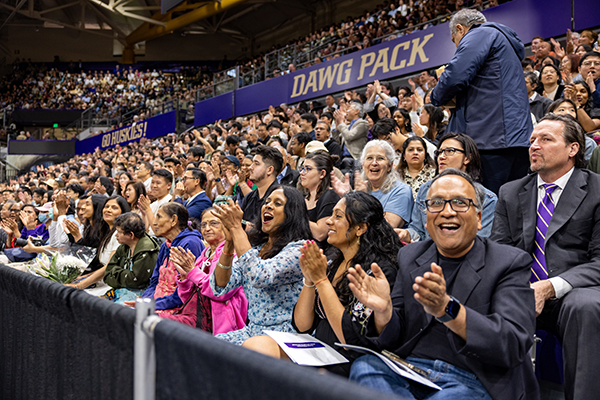
A crowd of people seated in the stands of a college basketball arena clap and cheer
Friends and loved ones cheer for the graduates (Photo by Matt Hagen)

The Allen School also recognized three TAs with honorable mentions. Elizabeth Shirakian was a TA nine times for the Allen School’s revamped introductory programming course series, specifically CSE 121 and CSE 122, and will be the instructor for the summer offering of CSE 122. Megan Wangsawijaya was a TA multiple times for CSE 390T: Transfer Admit Seminar that helps newly arrived transfer students acclimate to the Allen School, as well as CSE 390Z: Mathematics for Computation Workshop, a companion to the Allen School’s Foundations of Computing course. Last but not least, Ph.D. student Zhihan Zhang earned “rave reviews” for his support of student teams enrolled in the CSE 475: Embedded Systems Capstone course.

Undergraduate Teaching Awards

Bolante presented the 2025 Undergraduate Teaching Awards in her capacity as chair of COM^2, the largest Allen School student organization that represents all undergraduate majors. 

“As we celebrate the class of 2025, it’s worth remembering that none of us reached this stage alone,” Bolante said. “Educators do more than teach; they support us, inspire us and help shape the paths we take.”

Bolante described the first honoree, Ruth Anderson, as a “powerhouse” within the Allen School who has made a lasting impact on students as well as TAs. “In every class she teaches, Ruth creates a clear and supportive environment where students feel empowered to engage with complex material and build lasting understanding,” observed Bolante, noting that her work with TA’s elevates the quality of teaching across the school. 

Anderson’s fellow honoree, Lauren Bricker, was Bolante’s first professor by way of the Allen School Scholars Program — making the presentation of this award especially meaningful. “Lauren brings warmth, enthusiasm and genuine care to absolutely everything she does…She creates inclusive spaces where students feel supported and encouraged to grow,” Bolante said. “Through her tireless support and advocacy, Lauren continues to inspire and uplift our community.”

Watch the Allen School graduation video on YouTube, and read GeekWire’s coverage of Millines Dziko’s graduation speech.

Congratulations to the Allen School Class of 2025! In the words of Trish Millines Dziko, “Go out and build a life that matters!”

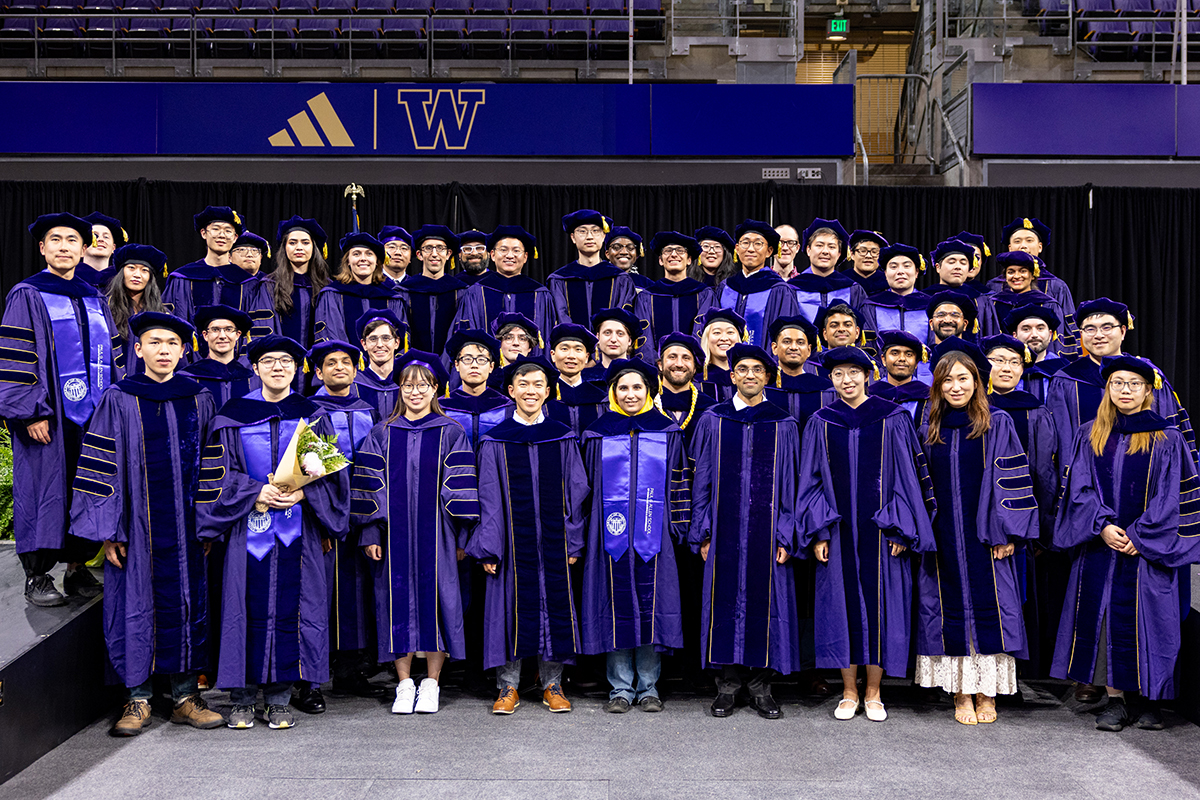
The Allen School’s Ph.D. class of 2025 (Photo by Matt Hagen)

Read more →

Allen School launches new stackable Graduate Certificate in Modern AI Methods 

Artificial intelligence existed as both a subfield of computing and a cultural phenomenon long before ChatGPT entered the lexicon in November of 2022. While AI may be decades old, its impact on the way we work, the way we learn and, indeed, the way we live clearly has been accelerating in recent years. What isn’t clear is what comes next; regardless, a growing number of professionals across a range of industries will need the ability to understand, leverage and integrate AI and machine learning as part of their work.

Starting this fall, one option for gaining the necessary knowledge and skills will be the Allen School’s stackable Graduate Certificate in Modern AI Methods, a new part-time evening program designed with the needs of working professionals in mind.

Portrait of Taylor Kessler Faulkner
Taylor Kessler Faulkner

“This new curriculum provides students with the opportunity to gain hands-on experience and build their knowledge of best practices when it comes to widely-used AI and machine learning methods,” said instructor Taylor Kessler Faulkner. “Professionals in a wide range of fields who are interested in applying AI and ML techniques in their work will benefit from this certificate.”

That curriculum comprises four courses taught by Allen School instructors with deep expertise in the field, addressing topics such as deep learning, computer vision and natural language processing and their applications. The series culminates in a final, project-based course that invites students to put what they’ve learned into practice. 

Although the certificate is geared toward working professionals, the Allen School also welcomes applications from recent graduates who want to develop their knowledge and skills in AI. Unlike many other programs of this type, the Graduate Certificate in Modern AI Methods will be delivered in person on the University of Washington’s main campus — which will provide students with multiple benefits beyond the course content.

“Students in the certificate program will have access to UW facilities and face time with faculty and the other students in their cohort,” noted Allen School professor Luke Zettlemoyer, who is also senior research director at Meta FAIR. “It’s a great opportunity for local professionals and recent graduates without a formal education background in computer science to take graduate-level courses in the Allen School.”

Luke Zettlemoyer

Course content will be available only to students enrolled in the program. The courses are designed to be taken sequentially over twelve months, starting in September. 

For those with ambitions of earning a master’s degree, the stackable certificate in Modern AI Methods can be applied towards either of two stacked master’s degree programs currently offered at the UW: the Master of Science in Artificial Intelligence and Machine Learning for Engineering, and the Master’s of Engineering in Multidisciplinary Engineering. More stackable degree options may be added in future.

“AI is having an impact on many professions, both inside and outside of the technology industry, and that impact will continue to grow as new techniques and tools come online,” said Magdalena Balazinska, professor and director of the Allen School and holder of the Bill & Melinda Gates Chair in Computer Science & Engineering. “With the Allen School’s long history of leadership in AI, we embrace our responsibility to help students to acquire the fundamental knowledge and skills that will enable them to leverage the latest advances in their current profession or any new career path they might want to explore.”

While the program is likely to be a good match for individuals with a background in science, technology, engineering or mathematics (STEM) or mathematically-focused business degrees, holders of a bachelor’s in any field with the requisite math and programming skills are welcome to apply. However, for those with a degree in computer science or computer engineering, Kessler Faulkner says, the Allen School’s Professional Master’s Program is likely to be a better fit. Applicants can complete an online self-assessment prior to submitting their application to gauge how well their skills are a match for the certificate program.

The inaugural cohort will start in autumn 2025. The deadline to apply to be part of that cohort is August 1st. Learn more about the stackable Graduate Certificate in Modern AI Methods by visiting the Allen School website and also check out a related story in GeekWire. Read more →

‘An incredible driver of economic mobility’: $3M gift from alum Armon Dadgar and Joshua Kalla will support systems research and student success

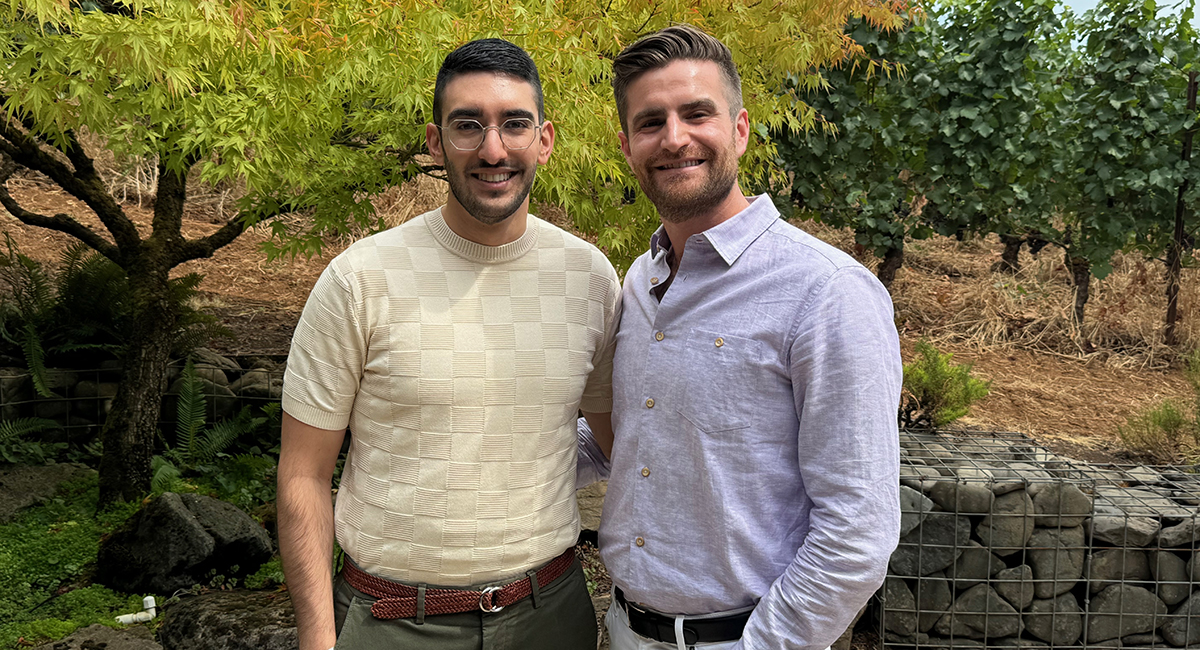
Armon Dadgar and Joshua Kalla smiling together in front of leafy trees of varying shades of yellow and green
Allen School alum Armon Dadgar (left) and Joshua Kalla have committed $3 million to Dadgar’s alma mater to create a new professorship and fund programs that support student success.

Ever since he was a student at the University of Washington, Armon Dadgar (B.S., ‘11) has had his head in the cloud. And despite co-founding the high-flying company HashiCorp after graduation, he has kept his feet firmly on the ground by finding ways to parlay his success into support for future innovators and entrepreneurs.

That success grew out of an experience Dadgar and his friend and co-founder, Mitchell Hashimoto (B.S., ‘11), had as undergraduate researchers in the Allen School’s systems research group. It was there that the two gained their first hands-on exposure to cloud computing and the challenges it posed for practitioners. At the time, cloud computing was on the rise, and of today’s three big players — Amazon, Google and Microsoft — only Amazon had officially launched its platform. But Dadgar and Hashimoto had access to all three for the aptly named Seattle Project, which aimed to leverage these emerging platforms for large-scale, peer-to-peer scientific applications. As part of the project, the duo attempted to build a software solution that would span the “multi-cloud” environment they had to work with.

They were unsuccessful on that first attempt, but according to Dadgar, the experience sparked their entrepreneurial spirit. After graduation, they moved to San Francisco and eventually decided to revisit the old research problems that had since emerged on an enterprise scale. They started HashiCorp, which became a leading provider of software for companies and organizations seeking to automate their infrastructure and security management in multi-cloud and hybrid environments. As co-founder and Chief Technology Officer, Dadgar helped grow HashiCorp to over 2,500 employees. The company counted such household names as Expedia and Starbucks among its roughly 5,000 commercial customers prior to its acquisition by IBM for $6.4 billion earlier this year, after going public in 2021.

“Major revolutions in computing, such as the public cloud, have depended on crucial research innovation in computer systems. As an undergrad in the Allen School, I was fortunate to have been exposed to research in operating systems, virtualization, networking, and more which underpins the public cloud,” said Dadgar. “Those experiences ultimately led to me founding HashiCorp. By supporting systems research, I hope for the Allen School to continue to be at the forefront of innovation in AI and beyond to inspire the next generation of students, researchers and entrepreneurs.”

A large group of students pose with Armon Dadgar in a high-ceilinged room
Inspiring the next generation: Dadgar with UW students at a DubHacks event.

Dadgar may have traded the city by the sound for the city by the bay years ago, but his affection for the UW is evergreen. Now, he and his partner, Joshua Kalla, are living in Seattle and hoping to sow the seeds of the next HashiCorp through a $3 million gift to the Allen School to support research and student success — and drive the next wave of systems innovation for the artificial intelligence era. The couple’s commitment includes $1 million to establish the Armon Dadgar & Joshua Kalla Endowed Professorship in Computer Science & Engineering, with the intent to help propel Seattle and Dadgar’s alma mater from the epicenter of cloud computing to the leading edge at the intersection of systems and AI.

“We are incredibly grateful to Armon and Josh for their generosity,” said Magdalena Balazinska, director of the Allen School and Bill & Melinda Gates Chair in Computer Science & Engineering. “The Allen School is one of the top computer science programs in the country, and an academic leader in cloud computing, systems, and AI research. But to maintain that leadership and continue to make transformational advances while educating the next generation of innovators, we need support to attract and retain the most talented faculty and students. Armon’s and Josh’s gift will greatly help us with that.”

While Dadgar is eager to give next-generation systems research a lift, he is even more enthusiastic about elevating the next generation of students entering the field. To that end, he and Kalla have committed $2 million to the Allen School Student Success Fund to support a variety of initiatives aimed at prospective and current Allen School students, with a focus on first-generation college students and K-12 students in Washington with limited access to computing education resources.

A group of seven college students stand, arms interlinked, alongside Armon Dadgar and Joshua Kalla in a conference room
“Education has always been an incredible driver of economic mobility”: Dadgar and Kalla with scholars in the UW’s Educational Opportunity Program.

“Education has always been an incredible driver of economic mobility,” said Dadgar. “Our goal is to broaden the pathways into computer science and technology, and particularly to focus on first-generation college students where we can have a multi-generational impact on both the individual and their families.”

Dadgar has repeatedly walked the talk, whether on campus or at company headquarters. At HashiCorp, he championed the creation of the Early Career Program in 2021 to enable college students of all majors and backgrounds to spend a summer at HashiCorp applying what they’ve learned in the classroom in a real-world corporate setting. More than 170 interns from across the country have benefited from the program’s mentorship and networking opportunities — over a third of whom accepted full-time positions with the company after graduation. In 2019, Dadgar and Kalla committed $3.6 million to the UW to provide scholarships to undergraduate students who participate in the university’s Educational Opportunity Program, which has supported 35 scholars to date.

As a professor at Yale University, Kalla is well aware of the impact such programs can have on students — and the institutions that provide them with that pathway to economic mobility.

“The University environment is a unique setting where students are exposed to new ideas, learn valuable skills, and through research advance the frontiers of knowledge,” said Kalla. “Creating opportunities for the next generation to participate and ultimately to lead us forward is incredibly important to us personally.”

Among the programs supported by the Student Success Fund are the Allen School Scholars Program, a one-year cohort-based program for incoming computer science and computer engineering majors focused on emerging leaders from first generation, low-income and underserved communities, and Changemakers in Computing, a summer program for rising juniors and seniors in high school to learn about computing and its societal impacts.

“We’re hugely appreciative of Armon and Josh’s extraordinary generosity, which will have a lasting impact on our program and our students,” said Ed Lazowska, professor and the Bill & Melinda Gates Chair Emeritus at the Allen School. “This gift is an opportunity to reflect on the inspirational story of HashiCorp: best friends pursuing a vision that began with some software that they built as part of an undergraduate project in the Allen School — and it will enable future generations of Allen School students to pursue their dreams.”

Read a related GeekWire story.
Read more →

One medical model to rule them all: AI takes center stage at Allen School’s 2024 Research Showcase

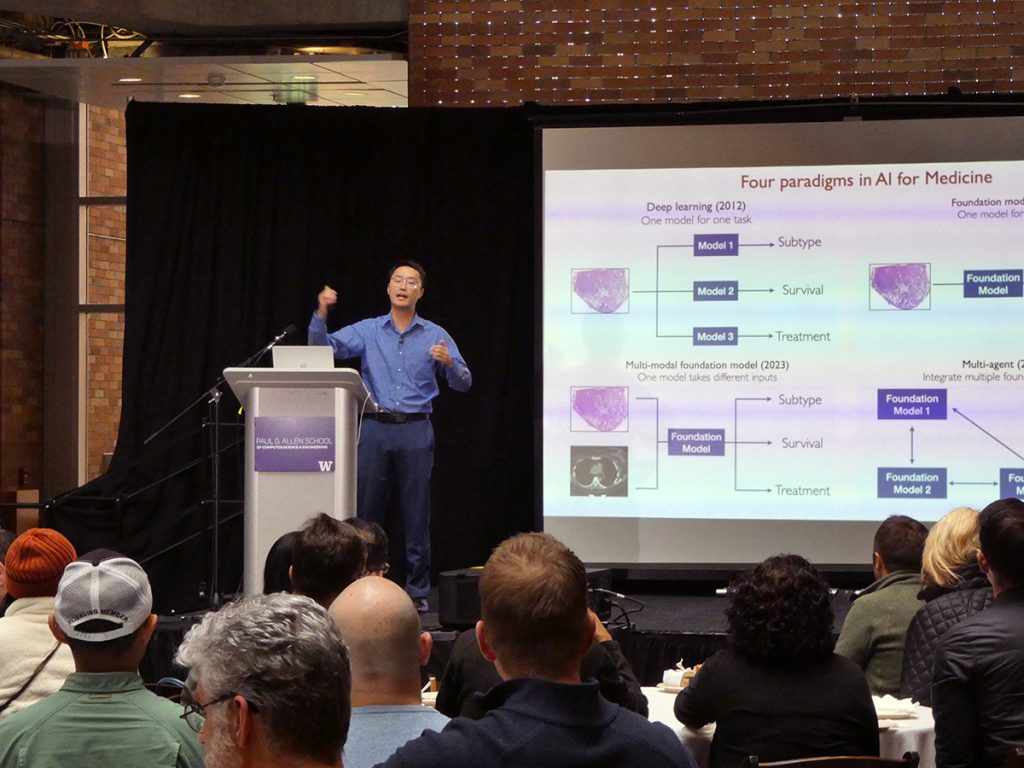
Sheng Wang onstage speaking to a crowd of people seated at round tables with a slide behind him titled Four Paradigms in AI for Medicine

While the Allen School’s annual Research Showcase and Open House highlights both the breadth and depth of computing innovation at the state’s flagship university, the 2024 event at the University of Washington last week had a decidedly AI flavor. From a presentation on advances in AI for medicine, to technical sessions devoted to topics such as safety and sustainability, to the over 100 student research projects featured at the evening poster session, the school’s work to advance the foundations of AI and its ever-expanding range of applications took center stage.

“Medicine is inherently multimodal”

In his luncheon keynote on generative AI for multimodal biomedicine, Allen School professor Sheng Wang shared his recent work towards building foundation models that bring together medical imaging data from multiple sources — such as pathology, X-ray and ultrasound — to assist doctors with diagnosing and treating disease. 

“Medicine is inherently multimodal,” noted Wang. “There are lots of complicated diseases, like diabetes, hypertension, cancer, Alzheimer’s or even Covid…and we will see signals all over the body.”

The ability to capture these signals using multiple imaging modalities requires overcoming a number of challenges. For example, pathology images are too large for existing AI models to analyze in sufficiently detailed resolution — 100,000 by 100,000 pixels, large enough to cover a tennis court. Typically, images encountered by AI models are closer to 256 by 256 pixels which, in keeping with Wang’s analogy, is akin to a single tennis ball.

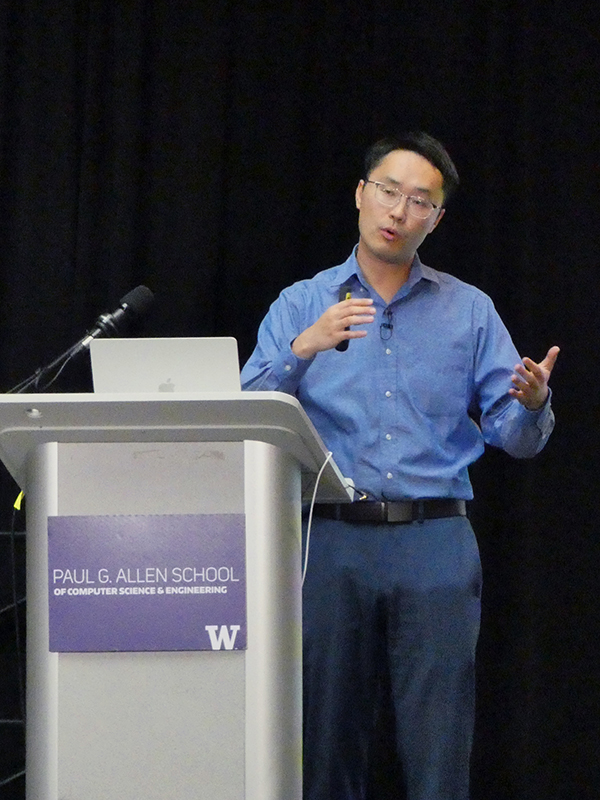
Sheng Wang gestures as he speaks at a podium displaying the Allen School logo
“In the future the AI model could be like a clinical lab test every doctor can order.” Allen School professor Sheng Wang shares his vision for using generative AI in medical imaging.

To make pathology images more manageable, Wang and his collaborators looked to generative AI. Despite the stark difference in domains, “the challenge or the solution here is very similar to the underlying problem behind ChatGPT,” Wang explained. ChatGPT can understand and summarize long documents; by converting large pathology slide images to a “long sentence” of smaller images, Wang and his colleagues determined AI could then summarize these image-sentences to obtain an overview of a patient’s status. Based on that idea, Wang and his team developed GigaPath, the first foundation model for whole-slide pathology. GigaPath, which achieved state-of-the-art performance on 25 out of 26 tasks, is “one model fits all,” meaning it can be applied to different types of cancer. Since its release, the tool is averaging 200,000 downloads per month.

One task for which AI models typically do not perform well is predicting which treatment to recommend for a particular patient. So Wang and his colleagues borrowed another concept drawn from generative AI, chain-of-thought, which calls for decomposing a complicated task into multiple, small subtasks. The model is then asked to solve those smaller tasks individually on the way to addressing the bigger, more challenging task.

“The question is, how can we apply chain-of-thought to medicine?” Wang asked. “This has never been done before.” The answer is to use clinical guidelines as the chain to instruct a large language model (LLM). By breaking the chain into subtasks such as predicting cancer subtype and patient biomarkers, the LLM then arrives at a prediction of the appropriate treatment.

Yet another challenge is how to apply AI to 3D medical imaging. Here again, Wang and his colleagues achieved a milestone by developing the first 3D OCT foundation model. OCT is short for optical coherence tomography, a type of imaging used to diagnose retinal diseases.

“Our model can comprehensively understand the entire 3D structure to make a diagnosis,” said Wang, who aims to extend this approach to other types of medical 3D imaging, like MRI and CT scans — and eventually, to create one model that can handle everything. This is challenging for even general domain machine learning; the state of the art, CLIP, is limited to two modalities, Wang noted; he wants to build a medical model that can integrate as many as nine.

To overcome the problem, Wang and his fellow researchers drew inspiration from Esperanto, a constructed language that provides a common means of communication among a group of people who speak different languages. They devised an approach, BiomedParse, in which they built one foundation model for each modality, and then projected everything into the medical imaging equivalent of Esperanto — in this case, human language in the form of text from the associated clinical reports — as the common space into which they can project the millions of images, both 2D and 3D, from the different modalities.

But Wang wants to go beyond multi-modal to multi-agent. Using the example of a molecular tumor board, in which multiple experts convene to discuss challenging cases to determine a course of treatment, he suggested that AI models developed for different imaging modalities could help doctors efficiently and accurately determine a treatment plan — analogous to a Microsoft 365 for cancer research. And while some doctors may worry about AI replacing them, Wang’s approach is focused on advancing human-AI collaboration: Medical experts still develop the high-level guidelines for the model, with the AI handling the individual steps.

“In the future the AI model could be like a clinical lab test every doctor can order,” Wang suggested. “The doctor can order an AI test to do a specific task, and then the doctor will make a decision based on the AI output.”

“It’s just really exciting to see all this great work”

The event culminated with the announcement of the recipients of the Madrona Prize, which is selected by local venture capital firm and longtime Allen School supporter Madrona Venture Group to recognize innovative research at the Allen School with commercial potential. Rounding out the evening was the presentation of the People’s Choice Award, which is given to the team with the favorite poster or demo as voted on by attendees during the event — or in this case, their top two.

Managing Director Tim Porter presented the Madrona Prize, which went to one winner and two runners up. Noting that previous honorees have gone on to raise hundreds of millions of dollars and get acquired by the likes of Google and Nvidia, he said, “It’s just really exciting to see all this great work turning into things that have long-term impact on the world through commercial businesses and beyond.”

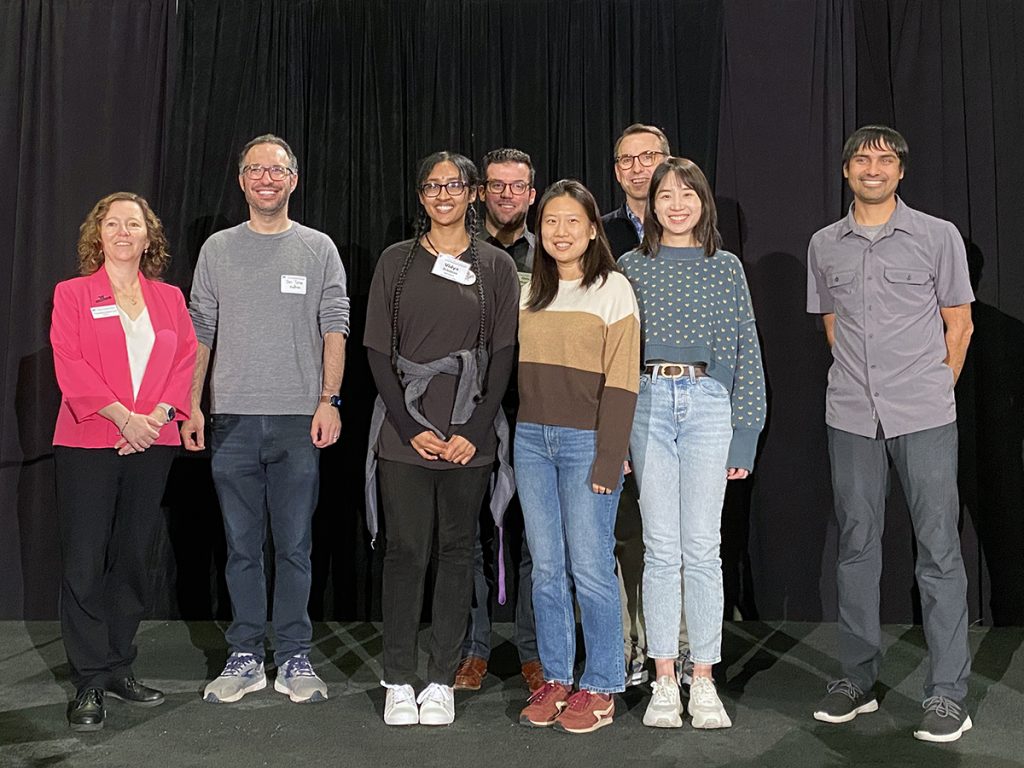
A group of eight people standing onstage smiling
Award winners and presenters, left to right: Magdalena Balazinska, professor and director of the Allen School; Jon Turow, partner at Madrona Venture Group; Madrona Prize runner-up Vidya Srinivas; Chris Picardo, partner at Madrona Venture Group; Madrona Prize winner Ruotong Wang; Tim Porter, managing director at Madrona Venture Group; People’s Choice winner Chu Li; and professor Shwetak Patel

Madrona Prize winner / Designing AI systems to support team communication in remote work

Allen School Ph.D. student Ruotong Wang accepted Madrona’s top prize for a pair of projects that aim to transform workplace communication  — Meeting Bridges and PaperPing

The Covid-19 pandemic has led to a rise in remote meetings, as well as complaints of “Zoom fatigue” and “collaboration overload.” To help alleviate this negative impact on worker productivity, Wang proposed meeting bridges, or information artifacts that support post-meeting collaboration and help shift work to periods before and after meetings. Based on surveys and interviews with study participants, the team devised a set of design principles for creating effective meeting bridges, such as the incorporation of multiple data types and media formats and the ability to put information into a broader context.

Meanwhile, PaperPing supports researcher productivity in the context of group chats by suggesting papers relevant to their discussion based on social signals from past exchanges, including previous paper citations, comments and emojis. The system is an implementation of Social-RAG, an AI agent workflow based on the concept of retrieval-augmented generation that feeds the context of prior interactions among the group’s members and with the agent itself into a large language model (LLM) to explain its current recommendations.

Additional authors on Meeting Bridges include Allen School alum Lin Qui (B.S. ‘23) and  professor Amy Zhang, as well as Maestro AI co-founder Justin Cranshaw. In addition to Zhang and Qui, Allen School postdoc Xinyi Zhou and Allen Institute for AI’s Joseph Chee Chang and Jonathan Bragg (Ph.D., ‘18) contributed to PaperPing.

Madrona Prize runner up / Interpreting nanopore signals to enable single-molecule protein sequencing

For one of two runners up, Madrona singled out a team of researchers in the Allen School’s Molecular Information Systems Laboratory (MISL) for developing a method for long-range, single-molecule protein sequencing using commercially available nanopore sensing devices from Oxford Nanopore Technologies. Determining protein sequences, or the order that amino acids are arranged within a protein molecule, is key to understanding their role in different biological processes. This technology could help researchers develop medications targeting specific proteins for the treatment of cancer and neurological diseases such as Alzheimer’s.

The research team includes Allen School Ph.D. students Daphne Kontogiorgos-Heintz and Melissa Queen, current Master’s student Sangbeom Yang (B.S., ‘24), former postdoc Keisuke Motone, now a faculty member at Osaka University, and research professor Jeff Nivala; MISL undergraduate researchers Jasmine Wee, Yishu Fang and Kyoko Kurihara, lab manager Gwendolin Roote and research scientist Oren E. Fox; UW Molecular Engineering and Science Institute Ph.D. student Mattias Tolhurst and alum Nicolas Cardozo; and Miten Jain, now a professor of bioengineering and physics at Northeastern University.

Madrona Prize runner up / Knowledge boosting during low-latency inference

Another team of researchers earned accolades for their work on knowledge boosting, a technique for bridging potential communication delays between small AI models running locally on edge devices and larger, remote models to support low-latency applications. This approach can be used to improve the performance of a small model operating on headphones, for example, with the help of a larger model running on a smartphone or in the cloud. Potential uses for the technology include noise cancellation features, augmented reality and virtual reality headsets, and other mobile devices that run AI software locally.

Lead author Vidya Srinivas accepted the award on behalf of the team, which includes fellow Allen School Ph.D. student Tuochao Chen and professor Shyam Gollakota; Malek Itani, a Ph.D. student in the UW Department of Electrical & Computer Engineering; Microsoft Principal Researcher Emre Sefik Eskimez and Director of Research at AssemblyAI Takuya Yoshioka.

People’s Choice Award (tie) / AHA: A vision-language-model for detecting and reasoning over failures in robotic manipulation

Jiafei Duan gestures as he explains the contents of an adjacent research poster to another person
An “AHA” moment: Ph.D. student Jiafei Duan (right) explains his vision-language-model for robotics

Attendees could not decide on a single favorite presentation of the night, leading to a tie for the People’s Choice Award.

While advances in LLMs and vision-language models may have expanded robots’ problem solving, object recognition and spatial reasoning capabilities, they’re lacking when it comes to recognizing and reasoning about failures — which hinders their deployment in dynamic, real-world settings. The research team behind People’s Choice honoree AHA: A Vision-Language-Model for Detecting and Reasoning over Failures in Robotic Manipulation designed an open-source VLM that identifies failures and provides detailed natural-language explanations for those failures. 

“Our work focuses on the reasoning aspect of robotics, often overlooked but essentially especially with the rise of multimodal large language models for robotics,” explained lead author and Allen School Ph.D. student Jiafei Duan. “We explore how robotics could benefit from these models, particularly by providing these models with the capabilities to reason about failures in the robotics execution and hence helped with improving the downstream robotic systems.”

Using a scalable simulation framework for demonstrating failures, the team developed AHA to effectively generalize to a variety of robotic systems, tasks and environments. Duan’s co-authors include Allen School Ph.D. student Yi Ru Wang, alum Wentao Yuan (Ph.D. ‘24) and professors Ranjay Krishna and Dieter Fox; Wilbert Pumacay, a Master’s student at the Universidad Católica San Pablo; Nishanth Kumar, Ph.D. student at the Massachusetts Institute of Technology; Shulin Tian, an undergraduate researcher at Nanyang Technological University; and research scientists Ajay Mandlekar and Yijie Guo of Nvidia.

People’s Choice Award (tie) / AltGeoViz: Facilitating accessible geovisualization

The other People’s Choice Award winner was AltGeoViz, a system that enables screen-reader users to explore geovisualizations by automatically generating alt-text descriptions based on the user’s current map view. While conventional alt-text is static, AltGeoViz dynamically communicates visual information such as viewport boundaries, zoom levels, spatial patterns and other statistics to the user in real time as they navigate the map — inviting them to interact with and learn from the data in ways they previously could not. 

“Coming from an urban planning background, my motivation for pursuing a Ph.D. in human-computer interaction originates from my passion for helping people design better cities,” lead author and Allen School Ph.D. student Chu Li said. “AltGeoViz represents a step towards this goal — by making spatial data visualization accessible to blind and low-vision users, we can enable broader participation in the urban planning process and shape more inclusive environments.”

Li’s co-authors include Allen School Ph.D. students Rock Yuren Pang, Ather Sharif and Arnavi Chheda-Kothary and professors Jeffrey Heer and Jon Froehlich

For more about the Allen School’s 2024 Research Showcase and Open House, read GeekWire’s coverage of the daytime sessions here and the award winners here, and Madrona Venture Group’s announcement here.

Kristine White contributed to this story.

Read more →

Pushing beyond the silos: Allen School’s Jon Froehlich aims to build a unified approach to urban science as part of new NSF-funded project

Urban street scene depicting hot pink streetcar entering an intersection, with a car on the opposite side of the road and painted pedestrian crossing visible against a backdrop of street trees and low-rise buildings, with high-rise buildings in distant background
Mark Stone/University of Washington

According to the United Nations, more than half of the world’s population — 55% — lives in urban areas, with that figure projected to rise to 70% by the year 2050. While urban communities are vibrant centers of economic, cultural and civic activity, this vibrancy tends to be accompanied by concerns about housing affordability, aging or inadequate infrastructure, environmental impacts and more.

Such vibrancy also yields a lot of data that could provide a window onto how our urban environments function, with a view to creating more sustainable and equitable communities as well as planning for future growth. But it’s difficult to extract usable insights, let alone turn those insights into practical actions, when the data is stored in different formats, spread across different systems and maintained by different agencies.

A team of researchers that includes professor Jon Froehlich, director of the Allen School’s Makeability Lab, is pursuing a more unified approach that will democratize data analysis and exploration at scale and empower urban communities. Froehlich is co-principal investigator on a new, five-year project dubbed OSCUR — short for Open-Source Cyberinfrastructure for Urban Computing — that recently earned a $5 million grant from the National Science Foundation. The project is spearheaded by the NYU Tandon School of Engineering’s Visualization Imaging and Data Analytics Research Center (VIDA) in partnership with the University of Washington and the University of Illinois Chicago.

Portrait of Jon Froehlich wearing a t-shirt branded with an M logo for the Makeability Lab
Jon Froehlich

“The true beauty and promise of OSCUR is in how it attempts to unify long-standing and deeply interconnected problems in urban science that often have disparate approaches spread across disciplines,” Froehlich said in the project announcement. “We are trying to develop standardized tools, datasets, and data standards to address problems related to climate change (e.g., urban heat island effects), walkability and bikeability, urban accessibility for people with disabilities, and more.”

To that end, Froehlich and his colleagues intend to cultivate a cohesive urban computing community spanning computer science, data science, urban planning, civil engineering, environmental sciences and other expertise. They will harness this combined wisdom to develop a set of scalable, open-source tools to enable interactive exploration and analysis of complex data, with an emphasis on findability, usability, interoperability, transparency and reproducibility. This would enable a variety of stakeholders, from researchers, to practitioners, to residents, to collaboratively address common challenges — without having to build something from scratch that may quickly become obsolete. 

Communities stand to benefit from this more integrated approach in multiple ways. For example, the team envisions a set of tools that would enable agencies to make more robust use of citywide sensor data to monitor and mitigate noise pollution and improve quality of life. In addition, they could combine data from different sources to gain a more comprehensive understanding of how their infrastructure might withstand disaster — and where they may need to shore up their resilience. Such an approach would also enable communities to glean new insights into how the built environment affects pedestrian mobility, with a view to making their communities more accessible for all residents.

Froehlich is no stranger to urban accessibility issues — or collaborating with residents and decision makers to extend the real-world impact of his research. He previously co-founded Project Sidewalk, an effort that combines advances in artificial intelligence with the power of citizen science to identify and map pedestrian accessibility issues such as missing curb ramps and uneven surfaces. The initiative has spread to 21 cities in the U.S. and around the world, including Seattle and Chicago in the U.S., Mexico City, Mexico, and Amsterdam in the Netherlands. To date, contributors to Project Sidewalk have mapped more than 11,400 miles of infrastructure and contributed over one million labels — data that has been leveraged to improve city planning, build new interactive tools and train AI to automatically log accessibility issues.

“I have worked in urban computing for more than a decade,” said Froehlich. “OSCUR is one of those rare opportunities to push beyond the silos of academia and develop tools for and with communities that will take them far into the 21st century.”

Read the project announcement here.

Read more →

Marvelous mutants: Allen School’s René Just and Michael Ernst receive FSE Most Influential Paper Award for showing the validity of mutants in software testing

A large bolt of lightning illuminates clouds in a bluish-purple sky
Photo by NOAA on Unsplash

In the Marvel Universe, mutants known as the X-Men wield superhuman abilities ranging from shape-shifting to storm-summoning. 

In the software universe, mutants may not bring the thunder, but they are no less marvelous. In 2014, Allen School professors René Just and Michael Ernst, along with their collaborators, demonstrated that mutants function as an effective substitute for real defects in software testing. Their work, which spawned a robust line of follow-on research over the ensuing decade, earned them the Most Influential Paper Award at the ACM International Conference on the Foundations of Software Engineering (FSE 2024) last month in Porto de Galinhas, Brazil.

Mutants are artificial defects (bugs) intentionally embedded throughout a program. If a test suite is good at detecting these artificial defects, it may be good at detecting real defects. Testing is an important element of the software development cycle; buggy code can be annoying, like when a video game glitches, or it can grind industries to a halt, like the world witnessed during the recent CrowdStrike incident. According to the Consortium for Information & Software Quality (CISQ), the costs associated with defective software surpassed $2 trillion in 2022 in the United States alone. 

Portrait of René Just
René Just

Among the solutions CISQ emphasized in its report were “tools for understanding, finding and fixing deficiencies.” Mutants play an integral role in the development and evaluation of such tools. While the software community historically had assumed such artificial defects were valid stand-ins for real ones, no one had empirically established that this was, indeed, the case.

“We can’t know what real errors might be in a program’s code, so researchers and practitioners relied on mutants as a proxy. But there was very little evidence to support that approach,” Ernst said. “So we decided to test the conventional wisdom and determine whether the practice held up under scrutiny.”

Ernst, Just and their colleagues applied this scrutiny through a series of experiments using 230,000 mutants and over 350 real defects contained in five open-source Java programs comprising 321,000 lines of code. To reassemble the real defects, which had already been identified and fixed by developers, the researchers examined the version history for bug-fixing commits. They then ran both developer-written and automatically generated test suites to ascertain how their ability to find known mutants in a program correlated with their ability to identify the real defects. During their testing, the researchers controlled for code coverage, or the proportion of each program’s code that was executed during the test, which otherwise could confound the results.

Those results revealed a statistically significant relationship between a test suite’s effectiveness at detecting mutants and its effectiveness at detecting real defects. But while the team’s findings confirmed the conventional wisdom in one respect, it upended it in another.

Portrait of Michael Ernst
Michael Ernst

“Our findings validated the use of mutants in software test development,” said Just, who was first author of the paper and a postdoctoral researcher in the Allen School at the time of publication. “It also yielded a number of other new and practical insights — one being that a test suite’s ability to detect mutants is a better predictor of its performance on real defects than code coverage.”

Another of the paper’s insights was confirmation that a coupling effect exists between mutants and real defects. This effect is observed between a complex defect and a set of simple defects when a test that detects the latter also succeeds in detecting the former. While prior work had shown that the same effect exists between simple and complex mutants, it was unclear whether a similar coupling effect applied between real defects and simple mutants. The researchers found that this was, indeed, the case, identifying 73% of real defects that were coupled to mutants. Based on an analysis of the 27% that did not exhibit this coupling effect, the team recommended a set of concrete approaches for improving mutation analysis — and by extension, the effectiveness of test suites. 

In addition to Just and Ernst, co-authors of the paper include Allen School alum Darioush Jalali (M.S., ‘14), now a software engineer at Ava Labs; then-Ph.D. student Laura Inozemtseva and professor Reid Holmes of the University of Waterloo, now a senior software engineer at Karius and a faculty member at the University of British Columbia, respectively; and University of Sheffield professor Gordon Fraser, now a faculty member at the University of Passau.

Read the full paper here. Read more →

NSF CAREER Award recipients Vikram Iyer and Adriana Schulz seek to expand capabilities in robotic sensing and computer-aided design with AI

Portraits of Vikram Iyer and Adriana Schulz side by side against an abstract image associated with the NSF CAREER program
Allen School professors Vikram Iyer, left, and Adriana Schulz received 2024 NSF CAREER Awards to advance their research in autonomous microrobotics and computer-aided design for manufacturing, respectively. Background image: National Science Foundation

When it comes to miniature robots, Allen School professor Vikram Iyer has big ideas.

“Imagine a fleet of tiny robotic sensors that automatically self-disperse to monitor crops on a farm,” Iyer said. “Others might routinely track inventory in a warehouse or inspect essential infrastructure.”

Before these so-called microrobots can autonomously cross that bridge, however, Iyer seeks to ditch the batteries — and add onboard perception and computation so they can navigate on their own — with the help of artificial intelligence. Meanwhile, his faculty colleague Adriana Schulz has designs on a different kind of power problem: how to use AI to supercharge a new era of creativity and eco-consciousness in computer-aided manufacturing.  

“AI has been transformative in so many domains, from health care and e-commerce, to music and the visual arts,” Schulz said. “We haven’t yet seen the same progress in manufacturing, despite the potential to dramatically improve the process for turning ideas into tangible products that shape our daily lives.”

Schulz and Iyer earned National Science Foundation (NSF) CAREER Awards through the agency’s Faculty Early Career Development Program for research that promises to fundamentally alter the way we create and interact with objects and our environment.

Beyond batteries: A powerful new approach to building truly autonomous robotic sensors

The problem of how to untether robots from the limitations of battery power weighs heavily on Iyer’s mind — not least because batteries would add too much payload to a device roughly the size of a bug. In addition, a short battery life can limit the distance they move and the applications they can enable. And then there is the environmental impact, which also can’t be taken lightly.

“Aside from the costs of repeated recharging and replacement, which would be prohibitive and impractical, battery manufacturing and disposal have significant environmental impacts and require critical minerals,” he noted. 

Iyer and his students have developed battery-less sensors that can run on solar energy or wireless power from radio signals; however, in real world conditions, the power available changes over time — making it challenging to fuel a moving robot. Using this NSF CAREER Award, his research group is exploring strategies like buffering small amounts of harvested energy in a capacitor allowing a robot to move in discrete steps.

“This motion is similar to how insects and birds perch between jumps or flights, which require bursts of energy,” Iyer explained. “This allows us to use power sources that provide small or variable amounts of energy.”

Iyer intends to design robots that incorporate this capability to travel on wheels, jump or do both. Whether via sun, signal or stop-and-go, battery-free power will only get microrobots so far; tasks such as measuring soil quality, detecting hazards or even taking readings in space will also require new kinds of onboard sensing, data processing and control that are optimized for intermittent power.

“We’re also exploring ways to use AI to help design and optimize both the software and hardware,” Iyer explained. “Beyond making single robots that can move on their own, we’re also interested in ways they can communicate with larger robots and AI systems that could coordinate a fleet of tiny robots to work together.”

Taking shape: A new era in AI-driven design and manufacturing grounded in geometry

Tiny robots are not the only objects that could see big gains with the help of AI. As Schulz sees it, we are on the cusp of an exciting new era of computer-aided design and manufacturing just about anything, from couches to cars. To unlock this potential, she aims to leverage advances in program synthesis, large language models and other innovations to assist makers in squaring the need for precision with the urge to experiment.

“Engineering design is a paradoxical process. On the one hand, it demands exactness and the ability to incorporate fine-grained information — which also makes it complex and time-consuming,” Schulz explained. “On the other hand, design tends to thrive on an iterative and exploratory spirit.”

Schulz will apply her NSF CAREER Award to solving that paradox through the development of a new, geometry-based system dubbed SmartCAD that combines formal reasoning techniques with neural abstractions. The new system will be based on ShapeScript, a new domain-specific language capable of interpreting the geometry of new designs — meaning users will no longer need to have their intended shapes in mind at the start of the design process, as they do with conventional CAD systems. She also plans to integrate foundational code generation models, such as GPT, that have been trained on geometric knowledge to support multi-modal user input through text, sketches or images, in addition to enabling users to make structural changes as they edit and optimize their designs.

“Formal methods offer verifiability and synthesis that adheres to constraints, which is crucial for the precision and analytical reasoning inherent in engineering,” Schulz noted. “By combining these methods with recent developments in AI, we can better facilitate and automate design generation and iteration.”

This iterative capability could save not only manufacturing costs but potentially the planet, by allowing users to optimize their designs to make maximum use of materials while minimizing waste. Such tools could also democratize the design and fabrication process by empowering both novice and experienced fabricators alike.

“Our approach has the potential to completely upend the traditional design process to empower a new generation of fabricators,” said Schulz. “And since virtually every object in the world originated as a CAD model, even small advancements can have a profound impact.”

Learn more about the NSF CAREER program here.

Read more →

Older Posts »