Stefan Savage turns 44

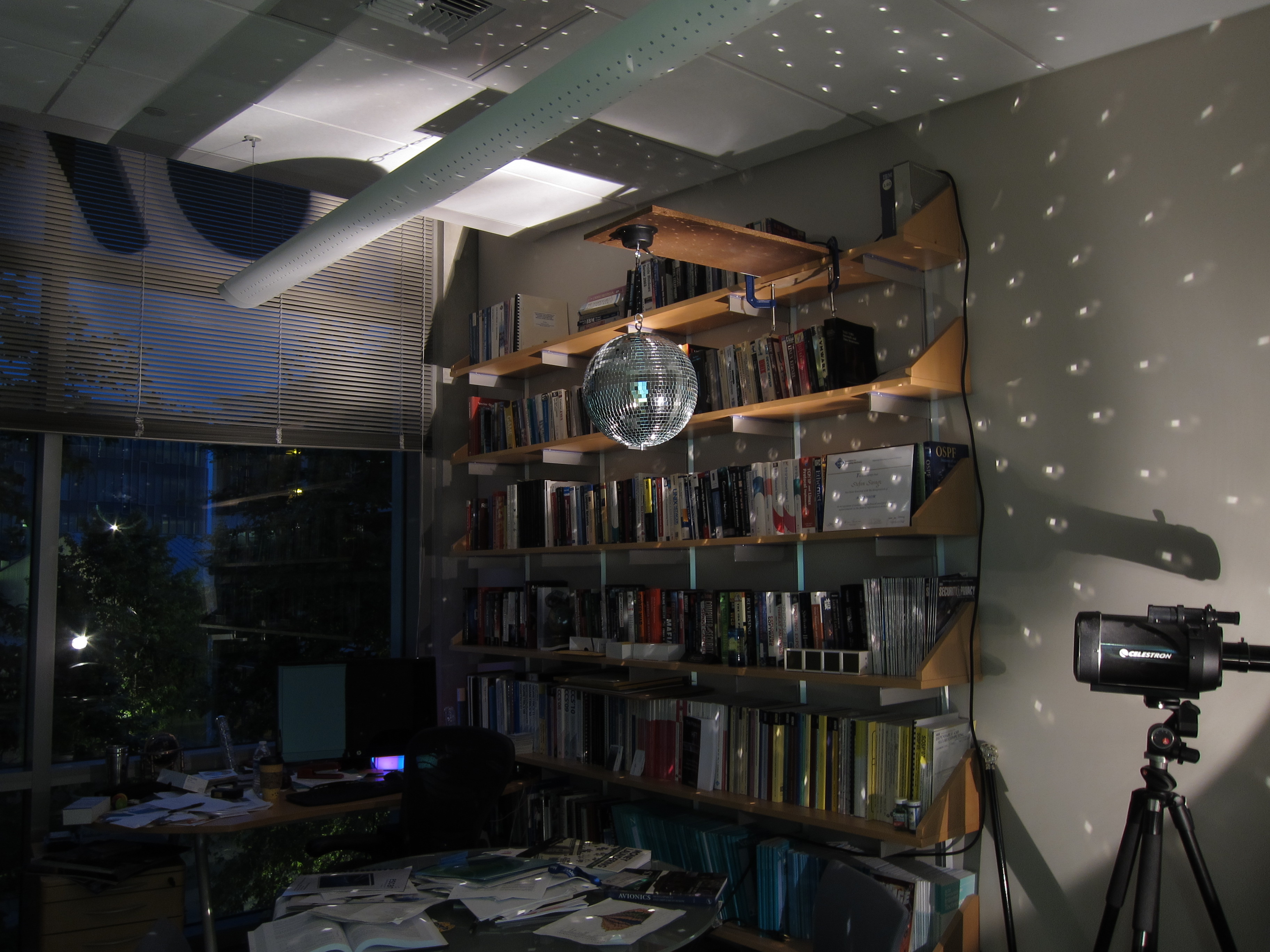
IMG_5156Even in binary it’s not a notable birthday, but if you put too many UW CSE Ph.D. alums in one place (UCSD CSE in this case), you get mayhem.  No faculty office is complete without a disco ball … Happy birthday Stefan!

(Also today:  CSE Ph.D. student Franzi Roesner turned 27, a perfect cube.  And CSE Ph.D. alum and postdoc Dan Halperin turned 29, a prime.  But no disco balls for them.  There’s no justice in this world.) Read more →

UW News: “New tasks become as simple as waving a hand with brain-computer interfaces”

BCI-brain-image-300x168“UW CSE’s Raj Rao and UW collaborators Jeff Ojemann, a professor of neurological surgery, and Jeremiah Wander, a doctoral student in bioengineering, published their results online June 10 in the Proceedings of the National Academy of Sciences.

“In this study, seven people with severe epilepsy were hospitalized for a monitoring procedure that tries to identify where in the brain seizures originate. Physicians cut through the scalp, drilled into the skull and placed a thin sheet of electrodes directly on top of the brain. While they were watching for seizure signals, the researchers also conducted this study.

“The patients were asked to move a mouse cursor on a computer screen by using only their thoughts to control the cursor’s movement. Electrodes on their brains picked up the signals directing the cursor to move, sending them to an amplifier and then a laptop to be analyzed. Within 40 milliseconds, the computer calculated the intentions transmitted through the signal and updated the movement of the cursor on the screen.

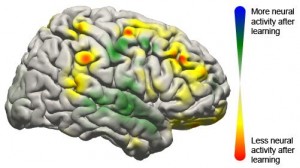
“Researchers found that when patients started the task, a lot of brain activity was centered in the prefrontal cortex, an area associated with learning a new skill. But after often as little as 10 minutes, frontal brain activity lessened, and the brain signals transitioned to patterns similar to those seen during more automatic actions.

“‘Now we have a brain marker that shows a patient has actually learned a task,’ Ojemann said. ‘Once the signal has turned off, you can assume the person has learned it.'”

Anyone who would like to have his or her skull drilled for science is invited to contact Rao via email.

Read more here. Read more →

Freshman demand for computer science – OFF THE CHARTS

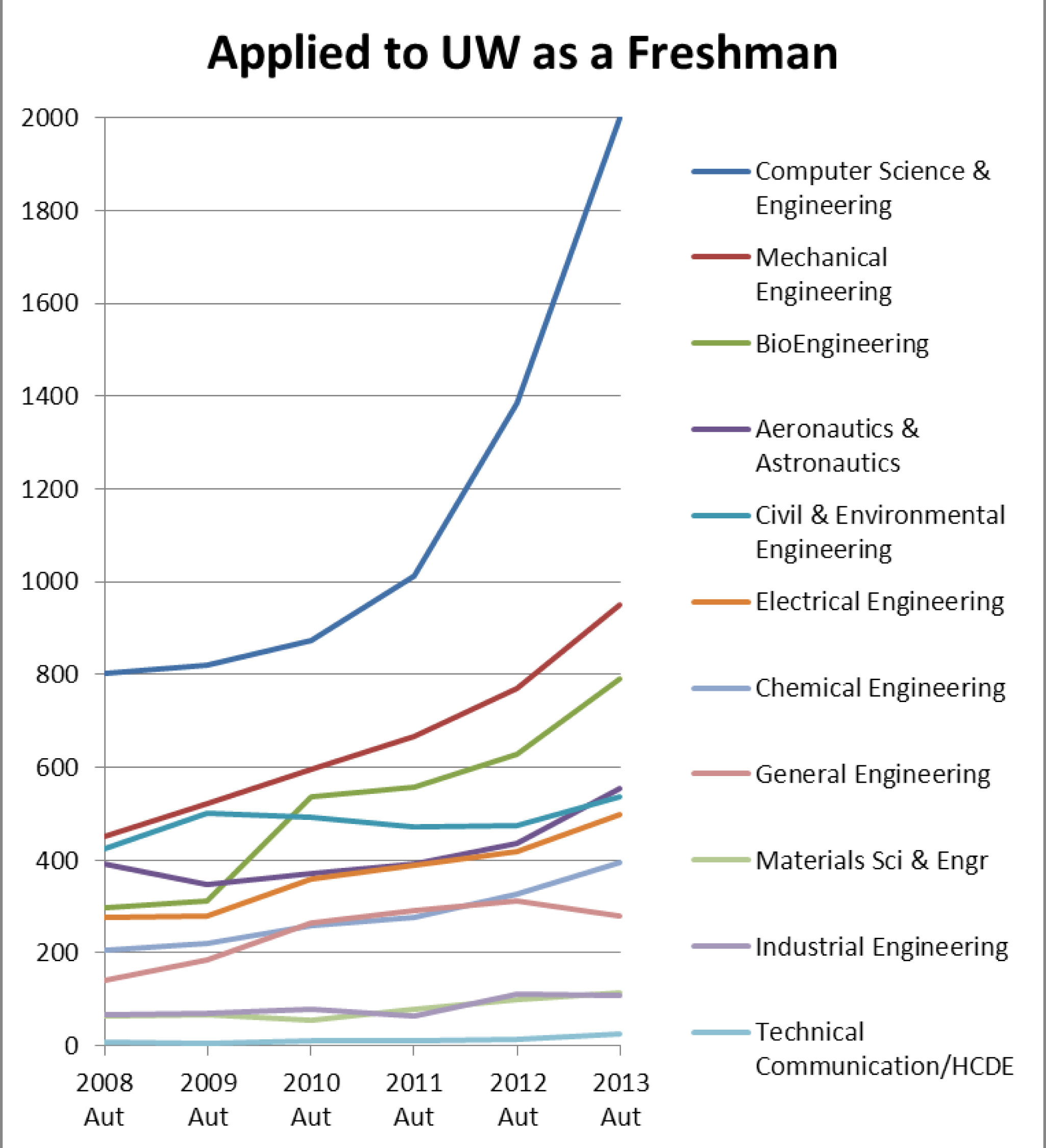
UW College of Engineering Freshman ApplicantsIt’s a national trend – demand for Computer Science is skyrocketing as students recognize that the field is chock full of intellectual challenges, has “change the world” potential like no other, and is central to pretty much any 21st century career.  Plus, there’s only so much creativity you can exercise with asphalt.

The graphic displayed here shows the desired major of freshman applicants to the various Engineering majors at the University of Washington for Fall 2013.  (We recognize that other premier Computer Science programs have even greater numbers of applicants, but still …)

Other graphics:  Intended major of freshman matriculants to the University of Washington College of Engineering for Fall 2013.  (Note that UW CSE’s capacity is only 200 new students per year – tragic.)  Annual enrollment in UW CSE’s two-quarter introductory sequence.

Our terribly constrained situation is not of our own design.  To UW and the citizens of the state, we say “Show me the money!”  Will UW CSE continue to be an engine of opportunity for Washington’s students? Read more →

“Hands down (and hands up), this is the coolest technology of the week”

screenshot-wiseeThe Washington Post praises UW CSE’s WiSee technology:

“Imagine standing in your kitchen preparing dinner, while the TV magically turns on in the living room, the dimmer lights flicker into action, a Netflix movie queues up for your viewing pleasure and the air conditioning adjusts just so. All of that, with just a wave of the hand, a swipe of your finger or a flick of the wrist.

“That’s the technological promise of new WiSee technology, a new gesture-recognition technology being developed at the University of Washington that is able to transform slight changes in the frequency of wireless signals into specific actions.

“What makes WiSee technology all the more extraordinary is that it essentially repurposes existing wireless signals within your home or business—there’s no need to purchase new cameras or sensors to make it work. Your wireless-enabled devices are already communicating with each other using a part of the wireless spectrum that’s unseen and unrecognized by humans. While we may take these wireless signals for granted, they are capable of penetrating through doors and walls (which is why your wireless router in the living room can power tablets or laptops elsewhere in your house or apartment). Any time you move a hand or arm or leg, you are ever-so-slightly changing the frequency of those wireless signals – a phenomenon that the University of Washington researchers refer to as a Doppler frequency shift.”

Read more here. Read more →

UC San Diego CSE lands game-changing $18.5 million alumni gift

ucsdThe largest gift ever made to UC San Diego by one of its alumni was received today by UCSD Computer Science & Engineering.  The gift – from an alum who wishes to remain anonymous – will fund new faculty endowed chairs, top-of-the-line teaching labs, support for graduate students, expanded mentoring and tutoring programs for the next generation of undergraduates, and a more diverse offering of project-based courses.

The UCSD CSE faculty is chock full of UW CSE Ph.D. alumni, including Bill Griswold, Sorin Lerner, Stefan Savage, Steve Swanson, Dean Tullsen, Amin Vahdat (we claim half-credit for Amin, with Berkeley), and Geoff Voelker.  They have returned the favor by sending to our faculty Yoshi Kohno and – soon to arrive – Zach Tatlock.  Undergraduates from both schools populate the graduate program at the other.

Congratulations to our friends in UCSD CSE!  Read more here. Read more →

Washington State Algebra Challenge – almost there with 2 days to go!

algebraCan Washington students solve 250,000 algebra equations in one school week?  That’s the Washington State Algebra Challenge, a partnership between UW’s Center for Game Science and the Technology Alliance.  And with three days down and two days to go, we’re almost there:   3,459 participating students have solved 246,033 equations – and counting!

Follow the action here. Read more →

Patent trolls on the march

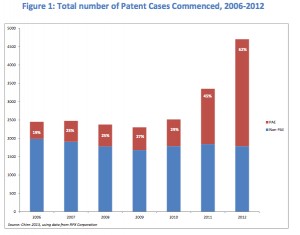
patentsuits0A scary graphic from our friends at GeekWire.  The blue segments are infringement lawsuits brought by companies actually practicing their patents.  The red segments are infringement lawsuits brought by non-practicing entities – patent trolls.  The National Economic Council and the Council of Economic Advisers released a detailed report accusing trolls of having “negative impact on innovation and economic growth.”

Read more here. Read more →

Why Computer Science? Why UW CSE?

Microsoft PowerPoint - For High School CounselorsPresentation materials from sessions for high school counselors conducted by UW CSE’s Ed Lazowska and Hélène Martin.  Includes information on the nature of the field, workforce demand, and UW CSE’s program.

Check it out here.  Learn more about UW CSE’s undergraduate program here.  Learn about DawgBytes, our K-12 outreach program, here. Read more →

SpiroSmart, SoundWave in The Economist

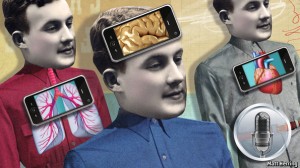
20130601_TQD005_0The Economist describes work by UW CSE researchers and collaborators that utilizes mobile phones and signal processing to create medical diagnostic instruments and other novel applications.

“Microphones exist in many shapes and sizes, and work in many different ways … These microphones all do the same thing: they convert sound waves into an electrical signal.

“It turns out, however, that with the addition of suitable software, microphones can detect more than mere audio signals. They can act as versatile sensors, capable of tuning into signals from inside the body, assessing the social environment and even tracking people’s posture and gestures. Researchers have reimagined microphones as multi-talented collectors of information. And because they are built into smartphones that can be taken anywhere, and can acquire new abilities simply by downloading an app, they are being put to a range of unusual and beneficial uses.”

Read the article here.  Learn more about SpiroSmart (mobile phone spirometry) here.  Learn more about SoundWave (gesture sensing) here. Read more →

WiSee: Whole-Home Gesture Recognition Using Wireless

wiseeThe work of UW CSE’s Qifan Pu, Sidhant Gupta, Shyam Gollakota, and Shwetak Patel is described in this UW News article:

“Forget to turn off the lights before leaving the apartment? No problem. Just raise your hand, finger-swipe the air, and your lights will power down. Want to change the song playing on your music system in the other room? Move your hand to the right and flip through the songs.

“University of Washington computer scientists have developed gesture-recognition technology that brings this a step closer to reality. Researchers have shown it’s possible to leverage Wi-Fi signals around us to detect specific movements without needing sensors on the human body or cameras.

“By using an adapted Wi-Fi router and a few wireless devices in the living room, users could control their electronics and household appliances from any room in the home with a simple gesture.”

Read more here.  Learn more about the WiSee research here.

Slashdot  noticed!  And NBC News!  And the LA Times!  Also The Verge, The Register, Wired, BBC, GeekWire. Read more →

« Newer PostsOlder Posts »