“We Are the World” – Science Career Q&A with Ed Lazowska

Science-AAAS-300x162But wait!  There’s more!  Today, Science has an extensive interview with UW CSE’s Ed Lazowska on careers in computer science.  An example:

Q: What’s new and emerging in computer science? If you were in training today, about to choose a thesis area, what subfields would you look at?

E.L.: Computer science is a field of limitless opportunity, and limitless impact. We are terrible at predicting the future: We overestimate what can be achieved in 10 years, and we underestimate what can be achieved in 50. Look back 10 or 12 years. Did we foresee the revolutions in search, Web-scale systems, digital media, mobility, e-commerce, the cloud, social networking, and crowdsourcing? No way! These were barely on the horizon in 2000, and they are part of our everyday lives today.

Here’s one thing that’s certain in the next 10 years: We will put “the smarts” in everything:  smart homes, smart cars, smart health, smart robots, smart science (confronting the data deluge), smart crowds and human-computer systems, smart interaction (virtual and augmented reality).

And here’s another thing that’s certain: Every field of discovery will become an “information” field. That’s the “big data” story: Data-driven discovery will become the norm, driven by advances in computer science. Think about biology. [James] Watson and [Francis] Crick discovered the biochemistry of DNA. But what they really discovered is that the human genome is a digital code, which can be read, deciphered, and rewritten. Over several decades, this transformed biology into an information science. Today, if you’re a biologist who is not deeply rooted in “computational thinking,” you’re collecting tadpoles in some swamp. The same is true of an increasing number of fields.

These advances draw upon all of computer science. Today, machine learning is hot. Tomorrow, it will be something else. The only thing for sure is that it will be computer science.

Read more here!  (Some of it is perhaps a bit too candid …) Read more →
Science: “Want a Great Scientific Career? Choose Computer Science”

Science-AAAS-300x162Science – flagship publication of the American Association for the Advancement of Science – extensively quotes UW CSE’s Ed Lazowska in this article about job opportunities in scientific fields:

“Lazowska notes that the President’s Council of Advisors on Science and Technology (PCAST) examined similar data from 2 years earlier and produced a report, signed by John P. Holdren, assistant to the president for science and technology and Director of the Office of Science and Technology Policy; Eric Lander, president and founding director of the Broad Institute; Shirley Ann Jackson, president of the Rensselaer Polytechnic Institute; and Eric Schmidt, executive chair (and former CEO) at Google, that reached the following conclusions:

“Finding: All indicators—all historical data, and all projections—argue that [computer science] is the dominant factor in America’s science and technology employment, and that the gap between the demand for [computer science] talent and the supply of that talent is and will remain large … While there will be inevitable variations in demand for every field, the long-term prospects for employment in [computer science] occupations in the United States are exceedingly strong. All other S&T fields pale by comparison.”

Ayup.  Read more here. Read more →

Washington Roundtable: “Increase computer science, engineering and health care capacity in Washington”

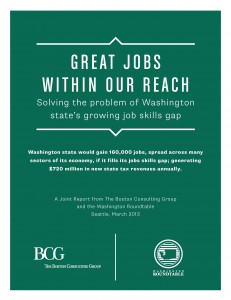
Pages from BCG_WRT_Great_Jobs_Within_Our_State_March_2013_reportA new report from the Washington Roundtable focuses on the need to increase educational capacity in computer science, other engineering fields, and health care (in that order!) in order to respond to student demand and employer demand in Washington State.

Duh … but it’s good to have another sane report that identifies the true “high impact” fields.

The new report is entirely consistent with a report 18 months ago from the state’s Higher Education Coordinating Board which placed computer science number one by a mile in the gap between degrees and jobs, with health professions second, and engineering third.  Other fields barely move the needle.

The new Washington Roundtable report is here.  Even more stark, see charts from the HECB report here. Read more →

UW wins Pacific Rim Collegiate Cyber Defense Competition for 6th consecutive year!

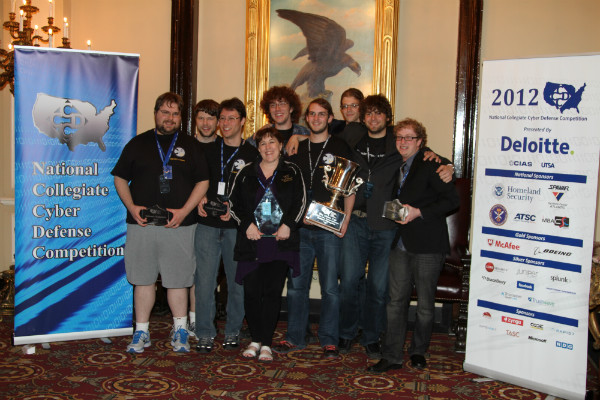
NCCDC_FTW_thumb

Last year’s Team Hillarious – winners of the National Collegiate Cyber Defense Competition

For the sixth year in a row, the University of Washington has won the Pacific Rim Collegiate Cyber Defense Competition.  Next month the team will head to San Antonio in an attempt to win their third consecutive National Collegiate Cyber Defense Competition crown.

Members of this year’s Team Hillarious (hey, that’s how they spell it …):

  • Alexei Czeskis, CSE
  • Morgan Hein, iSchool
  • Atanas Kirilov, CSE
  • Karl Koscher, CSE
  • David Mah, CSE
  • Michael McKerinan, pre-engineering
  • Jordyn Puryear, iSchool
  • Ed Samson, CSE
  • Omar Sandoval, CSE
  • Thomas Winegarden, iSchool
  • Tariq Yusuf, CSE
  • Lars Zornes, CSE
  • Melody Kadenko, CSE (advisor)

Congratulations – and good luck at nationals! Read more →

Jeff Dean, Sanjay Ghemawat win ACM – Infosys Foundation Award

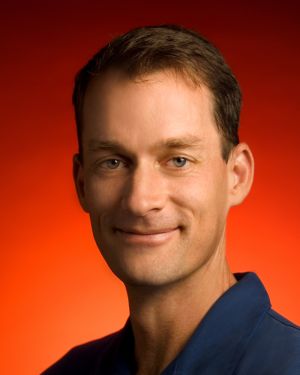
jeffdeanUW CSE Ph.D. alumnus and Google Fellow Jeff Dean, along with MIT CSAIL Ph.D. alumnus and Google Fellow Sanjay Ghemawat, have been honored with this year’s ACM – Infosys Foundation Award “For their leadership in the science and engineering of Internet-scale distributed systems.”  The citation goes on to say:

“Dean and Ghemawat led the conception, design, and implementation of much of Google’s revolutionary software infrastructure, which has transformed the practice and understanding of Internet-scale computing. Their efforts, along with those of their collaborators, created the first software designs for systems that harness the power of tens of thousands of computers. Their designs for systems such as MapReduce and BigTable are remarkable for scalability, the grace with which they tolerate faults, and the ease with which they support the construction of many new distributed services. We are in a new age of Internet-scale computing thanks in significant measure to the engineering innovations of Dean and Ghemawat.”

Congratulations Jeff and Sanjay!  Read the ACM announcement here. Read more →

CSE’s Lydia Chilton, Nicki Dell win Facebook Graduate Fellowships

Nicki-200x300lydiaUW CSE Ph.D. students Lydia Chilton and Nicki Dell have been named as winners of 2013-14  Facebook Graduate Fellowships.

Lydia works with James Landay and Dan Weld on crowdsourcing. She spent the 2010-11 academic year at MSR-Asia in Beijing observing Landay trying to speak Chinese.

Nicki works with Gaetano Borriello and Linda Shapiro on computer vision, machine-learning and human-computer interaction, with a focus on designing and evaluating applications that improve the lives of underserved populations in low-income regions.

Lydia and Nicki were among 12 top students from the nation’s top programs who received Facebook Graduate Fellowships.  UW CSE Ph.D. students Raymond Cheng and Paris Koutris were among 27 Finalists.

Congratulations to Lydia, Nicki, Raymond, and Paris!  Read the Facebook announcement here. Read more →

Mr. Smith Goes To Washington

bsmith-2_webBrad Smith, Microsoft’s General Counsel and Executive Vice President, addressed Washington’s Congressional delegation in Washington DC today on the dismal state of STEM education in our state.  The Seattle Times reports:

“By one measure, Washington has the nation’s highest concentration of STEM jobs. But the state ranks near the bottom in the proportion of students enrolled in graduate programs in engineering and science, and the gap between the growth in jobs requiring STEM skills and people qualified to fill them is estimated to be growing faster than in any state except Delaware.

“‘As a state, we are not nearly doing what we need to do,’ said Brad Smith, Microsoft’s general counsel …

“Smith reeled off statistics about the dearth of STEM learning, particularly among women and minorities. Of Washington’s 771 high schools, for instance, 35 offer advanced-placement computer science courses.

“And the University of Washington’s well-regarded computer-science department, Smith said, lacks capacity to expand enrollment despite being within 10 miles of thousands of computer-related jobs.

“Reversing that ‘is the single best and most important opportunity we have in Washington state to grow our economy,’ said Smith.”

Read the article here.  Learn more about the dismal state of STEM education in Washington here. Read more →

Algorithms and beer …

UW CSE professor Anup Rao writes:

My undergraduate algorithms course has taught the students two things:

  1. How to handle stress with beer.
  2. How to design algorithms.

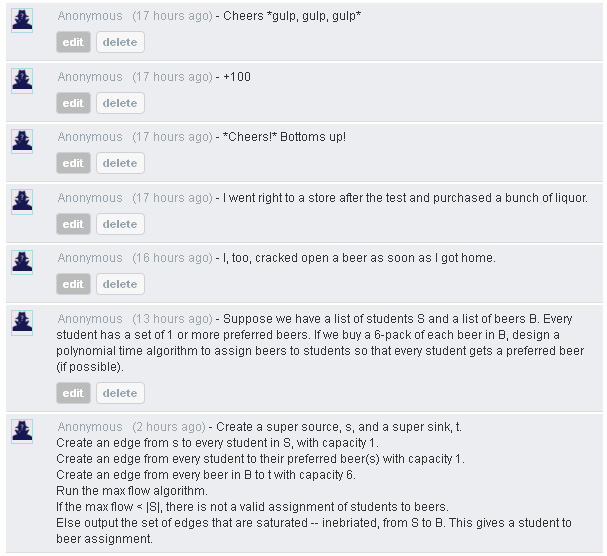
I guess I should be proud of at least one of them.  Here is the post-final-exam discussion on the class message boards:

anup

Larry Ruzzo adds:

We need to amend the catalog description:  “Must be 21 with valid Washington ID by time of final.” Read more →

Wired: “Google Hires Brains that Helped Supercharge Machine Learning”

hinton1Wired reports on Google’s acquisition of DNNresearch, Geoff Hinton’s University of Toronto spinoff, quoting UW CSE’s Ed Lazowska:

“‘Deep learning, pioneered by Hinton, has revolutionized language understanding and language translation,’ said Ed Lazowska, a computer science professor at the University of Washington. In an email interview, he said that a pretty spectacular December 2012 live demonstration of instant English-to-Chinese voice recognition and translation by Microsoft Research chief Rick Rashid was ‘one of many things made possible by Hinton’s work.'”

Read the Wired article here.  It includes a video of Rashid’s amazing demo. Read more →

Google to double Seattle presence, targeting cloud services

Google-Kirkland-rendering2Various media report an announcement by Google on Tuesday that the company plans to double the size of its Kirkland engineering facility, one of two Google sites in Seattle.  Xconomy quotes UW CSE’s Ed Lazowska:

“’20 years ago, the tech industry here could have been described as ‘Microsoft and the 499 dwarfs.’  Now we have a really robust tech ecosystem with companies of all sizes reinforcing each other – large numbers of great startups, great mid-size companies and great major companies.  Some were born here.  Some chose to locate here or move here.  Some are major branches of companies headquartered elsewhere.  Some have been acquired but still have a major Seattle presence.  Together they’re creating an incredibly vibrant region.'”

Xconomy hereNY Times hereSeattle Times here. Read more →

« Newer PostsOlder Posts »