 Help celebrate Seattle as an entrepreneurial hub! Find out more here. Read more →

“We Make Seattle” on Kickstarter
CSE’s Shyam Gollakota wins SIGCOMM “Doctoral Dissertation” and “Best Paper” awards
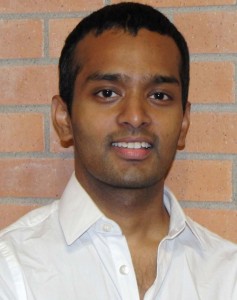 UW CSE professor Shyam Gollakota has just been honored twice by SIGCOMM, the ACM Special Interest Group on Data Communication.
Shyam’s 2012 MIT doctoral dissertation “Embracing Interference in Wireless Systems” (advised by Dina Katabi) was recognized with the 2012 SIGCOMM Doctoral Dissertation Award, given annually to the outstanding Ph.D. thesis in computer networking and data communication. Shyam’s dissertation had previously been honored with the 2012 ACM Doctoral Dissertation Award for the top Ph.D. dissertation in all of computer science.
In addition, the research paper “Ambient Backscatter Communication: Wireless Communication Out Of Thin Air” – co-authored by UW CSE’s Vincent Liu, Aaron Parks, Vamsi Talla, Shyam Gollakota, David Wetherall, and Josh Smith – received the 2013 SIGCOMM Best Paper Award. Shyam also received the SIGCOMM Best Paper Award in 2011 and 2008!
Sheesh! Read more →
Matt Reynolds to join UW CSE+EE
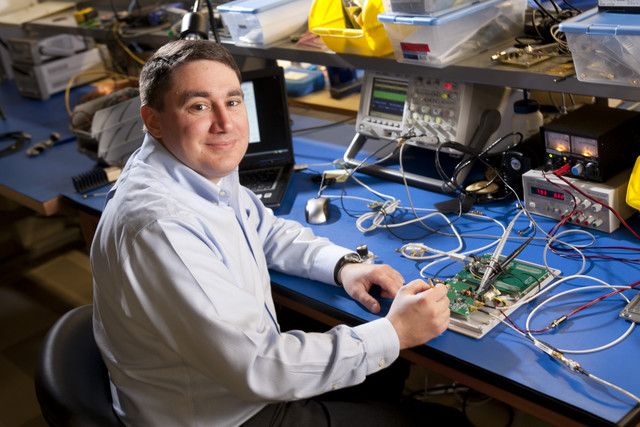 Matt Reynolds, currently Nortel Networks Assistant Professor in Electrical and Computer Engineering at Duke University, will be joining UW this fall with a joint position in Computer Science & Engineering and Electrical Engineering.
Matt’s research, which has resulted in 5 best paper awards, focuses on ultra-low power sensing and computation, RFID, wireless power transfer, biomedical applications, and smart materials and surfaces. Matt holds 12 patents and has co-founded three companies. He received his S.B., M.Eng., and Ph.D. degrees from MIT.
Matt joins Maya Cakmak, Shayan Oveis Gharan and Zach Tatlock as new additions to the CSE faculty. Matt, Maya, and Zach will be arriving this fall (along with 2012 hire Jeff Heer), while Shayan will join us following a one-year Miller Fellowship at UC Berkeley.
Matt is the 4th hire in the UW College of Engineering ExCEL program (“Experimental Computer Engineering Lab”) for joint hires between CSE and EE. ExCEL has yielded remarkable hires: Shwetak Patel, Georg Seelig, and Josh Smith in addition to Matt. Read more →
CSE’s Saleema Amershi wins UW Graduate School 2013 Distinguished Dissertation Award!
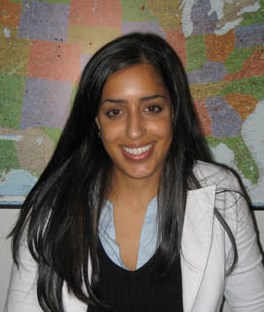 Saleema Amershi, a 2012 UW CSE Ph.D. alumna who is now a Researcher in the Computer Human Interactive Learning (CHIL) group at Microsoft Research, has received the University of Washington Graduate School’s 2013 Distinguished Dissertation Award.
Saleema’s research interests are at the intersection of human-computer interaction and machine learning. She is interested in designing effective end-user driven machine learning for a variety of real-world applications. Her dissertation – “Designing for Effective End-User Interaction with Machine Learning,” was advised by UW CSE professor James Fogarty.
Congratulations Saleema! Read more →
Breakthrough in detecting DNA mutations from CSE’s Georg Seelig
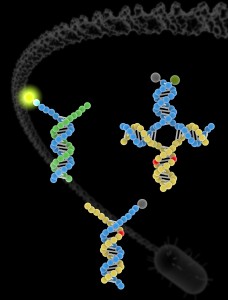 Georg Seelig – UW professor of CSE and EE – working with David Zhang of Rice University and Sherry Chen, a UW EE doctoral student, this week unveiled a groundbreaking new method for detecting minute changes known as single nucleotide polymorphisms (SNPs) in the human genome. The human genome has more than 6 billion base pairs, and one of the revelations of modern genomics is that even the slightest change in the sequence – a single-nucleotide difference – can have profound effects.
The new SNP genotyping technique, dubbed “double-stranded toehold exchange,” is described in a new paper in Nature Chemistry. The method is markedly different – in both form and performance – from any of the dozen-plus methods already used to detect SNPs.
“There are two axes of performance in SNP detection – read length and specificity,” said Zhang. “We’re at least an order of magnitude better on each axis. In fact, in terms of specificity, our theoretical work suggests that we can do quadratically better, meaning that whatever the best level of specificity is with a single-stranded method, our best will be that number squared.”
Read more here: UW News, Health News, Science Daily, nanowerk. Read more →
July 27 in CSE: Emily + Carlos … Hélène + Yaw
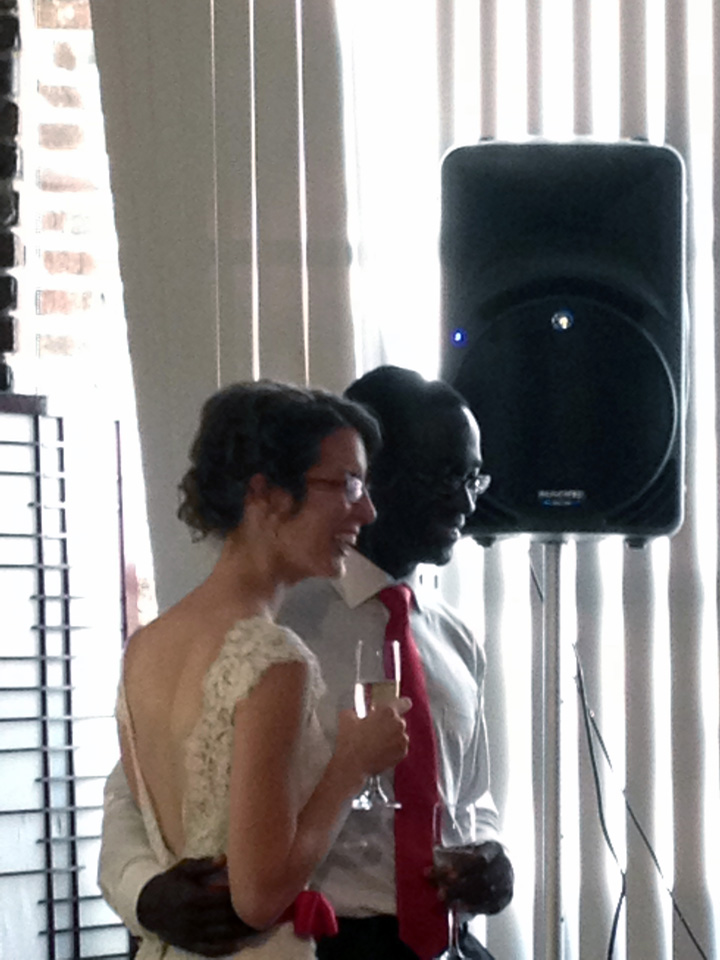
Hélène Martin + Yaw Anokwa

Emily Fox + Carlos Guestrin
July 27 … a big day for UW CSE weddings …
Adjunct CSE faculty member (and Amazon Professor of Machine Learning in Statistics) Emily Fox + Amazon Professor of Machine Learning in Computer Science & Engineering Carlos Guestrin …
CSE Lecturer (and CSE bachelors alumna) Hélène Martin + CSE Ph.D. alumnus (and co-founder of the software startup Nafundi) Yaw Anokwa …
Congratulations one and all! Read more →
UW/MSR Summer Research Institute 2013: Understanding Situated Language in Everyday Life
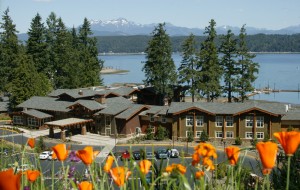 The 18th UW/MSR Summer Research Institute in Computer Science was held this week at Alderbrook in Union, WA.
Each summer UW Computer Science & Engineering and Microsoft Research co-organize a summer research institute that brings together dozens of the world’s top researchers to discuss an important emerging topic. This year’s topic was “Understanding Situated Language in Everyday Life” – organized by Luke Zettlemoyer (UW CSE) and William Dolan (MSR). Quoting from the overview:
“Robust natural language understanding systems have the potential to completely revolutionize our interactions with computers. From Apple’s Siri to Google Now and Microsoft’s XBox Kinect, we now talk to our computers, phones, and entertainment systems on a daily basis. Similarly, as we interact with social media we constantly watch, comment on, and otherwise caption massive streams of image and video data. Recently, there has been growing interest in approaches that learn to understand these rich data sources, with a common focus on studying how language use is grounded in the physical or a virtual world.”
The Institute gathered 40 top researchers from across the world whose research focus included natural language processing, speech, computer vision, robotics, and cognitive science. The goal was to provide a forum for identifying common research themes and challenges across all of these disciplines.
Learn more about this year’s UW/MSR Summer Research Institute here. Learn about previous Institutes here. Read more →
Today’s rankings …

Washington Monthly ranks UW 7th among all U.S. “national universities.” (The criteria are “social mobility,” “research,” and “service” – UW got killed in the latter category.)
Forbes ranks UW among the top 10 public colleges and universities in the nation for its undergraduate programs. (The ranking includes both public and private colleges and universities … and it ranks Pomona above Princeton … so caveat emptor …)
Movoto ranks Seattle as America’s hardest working city. (Doubtless due to the combination of coffee and precipitation …)
Forbes ranks Seattle among the world’s 15 most inventive cities. (Suggesting that hard work isn’t everything …)
Affordable Colleges ranks UW #11 in the nation in terms of “bang for the buck.” Read more →
Computer Science for High School Teachers: UW CSE CS4HS 2013
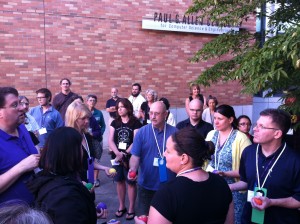
CS4HS participants learn about deadlock from Tom Cortina
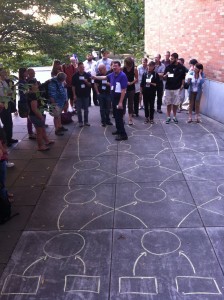
Tom Cortina walks CS4HS participants through a sorting network
Seven years ago, three universities – the University of Washington (Ed Lazowska), Carnegie Mellon University (Jeannette Wing), and UCLA (Deborah Estrin) – approached Google about sponsoring a 3-day summer workshop on computer science for middle school and high school teachers of math and science.
Today the program – CS4HS – is sponsored by Google at 62 universities in the US and Canada, 20 in China, 15 in Australia and New Zealand, and 28 in Europe, the Middle East, and Africa – 125 universities in all! (And although Jeannette and Deborah have pulled the ripcord, Ed still proudly teaches at the University of Washington!)
This week marks UW CSE’s 7th annual CS4HS. More than 50 teachers from the Puget Sound region, elsewhere in Washington, and several other states have joined us for 3 days of exploring the magic of computer science. This also marks the 7th year in which Tom Cortina, Assistant Dean for Undergraduate Education in CMU’s School of Computer Science, has traveled to Seattle to assist with our program.
Learn more about UW CSE’s CS4HS offering here. Learn about the worldwide Google program here. Learn about UW CSE’s many K-12 outreach programs here. Read more →
UW CSE “DawgBytes” summer day camp on “physical computing”
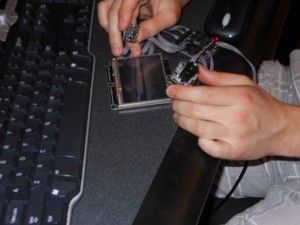

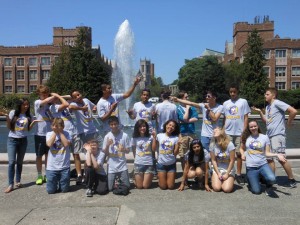 July 16-19 marked UW CSE’s 4-day summer co-ed day camp on “physical computing.”
More and more, computing is moving off desks and into pockets and devices spread across our world. A great group of students got a chance to learn about physical computing from Brett Wortzman, a fantastic local high school teacher.
Microsoft donated 12 .NET Gadgeteer Kits for use by the students – carried across the Atlantic with two days to spare by Scarlet Schwiderski-Grosche from Microsoft Research in Cambridge UK, who was visiting Seattle for the Microsoft Research Faculty Summit.
UW CSE is hosting eight summer day camps this year: two week-long day camps for high school girls, two week-long day camps for middle school girls, three co-ed day camps focused on building apps for Android phones (3-day and 5-day camps for middle school students, and a 3-day camp for high school students), plus this 4-day co-ed day camp for high school students focused on physical computing. In addition, we are hosting CS4HS, a 3-day workshop for middle school and high school math and science teachers.
Learn more about our summer day camp program here.
Learn more about DawgBytes, UW CSE’s outreach program, here. And follow the action as it happens on the DawgBytes Facebook page here.