 The UW Daily memorializes UW CSE professor David Notkin:
“David Notkin was known by many as a willing mentor and a leader in the field of software engineering. His bushy beard and wide smile made him a face of the department.
“His talent, charisma, and investment in his students made him an integral part of the UW Computer Science & Engineering community.
“Notkin passed away last Monday at the age of 58 after a long battle with cancer.”
Read more here. Read more →
 The work of Josh Smith (UW CSE and EE) is described:
“But how do you charge something so small? ‘The vision of blanketing the world with smart sensors is very compelling,’ says Joshua Smith, head of the Sensor Systems Laboratory at the University of Washington in Seattle. ‘But a lot of sensor networks researchers found themselves surrounded by mountains of depleted batteries and dead sensor nodes.’
“So, like microscopic Robinson Crusoes, the motes will live off the power they can scavenge from their surroundings. A mote near a light source might use a tiny solar panel, while a mote running somewhere with greater temperature extremes can be built to tap into that, by converting the heat energy that flows between hot and cold into electricity.”
Read more here. Read more →
 OneBusAway began as a student project at the University of Washington. It became so widely used by transit commuters that after the students graduated, three area agencies (King County Metro, Sound Transit, and Pierce Transit) contracted with the University of Washington to continue running the service. There are now over 100,000 users per week in Puget Sound. At the same time, instances of OneBusAway have been brought up in other regions, including Atlanta, Detroit, and Tampa; the OneBusAway Enterprise system (derived from the core OneBusAway) is the basis for the BusTime system in the greater New York region.
In mid-May, Sound Transit will be taking over running it. (Sound Transit already has an experimental version of OneBusAway running in parallel with the production system.) We hope that the transition will be relatively seamless.
Read more here. Try OneBusAway here.
Read more →
 Belkin today launched Echo Electricity and Echo Water – technologies licensed from the lab of UW CSE and EE professor Shwetak Patel that provide single-point-of-attachment fully-disaggregated monitoring of the electricity and water consumption in a home or business.
Read a GigaOM post here. Wall Street Journal here. Echo Electricity information here. Echo Water information here. Read more →
 Today is the final day to vote in the GeekWire Awards.
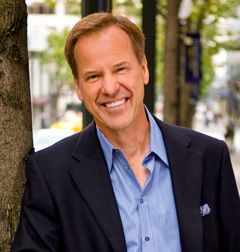
In addition to voting for UW CSE professor Oren Etzioni as “Geek of the Year” here (see earlier post below), please vote for UW CSE alum and UW CSE startup CEO Jeremy Jaech as “Hire of the Year” here.
“We thank you for your support.” Read more →
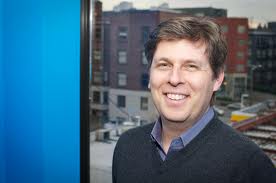 UW CSE’s Oren Etzioni is one of five nominees for GeekWire’s “Geek of the Year” – to be presented at the GeekWire Awards event on May 9 at EMP.
Please vote for Oren here!
And remember, only one vote per IP address. (How many IP addresses do you have?) Read more →
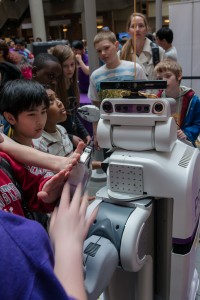 Friday and Saturday April 26 and 27 marked UW’s Engineering Discovery Days. More than 9,000 guests – school-age students, plus parents and teachers – visited UW … and it sometimes sounded as if they were all in the Allen Center at once!
See photos here. Read more →
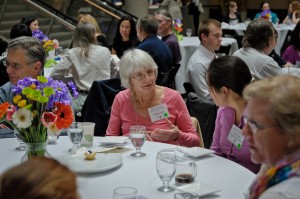 April 25 marked the annual UW CSE Scholarship and Fellowship Recognition Luncheon, where the donors of our endowed undergraduate scholarships and graduate fellowships meet the students they are supporting. It’s always a happy event!
Undergraduate scholarships enable top students to obtain a UW CSE education, regardless of means – of ever-increasing importance in these days of relentlessly rising tuition. Graduate fellowships enable CSE to compete successfully with the nation’s other premier programs for the top graduate students from across the nation and around the world.
Thanks to the many friends, alumni, and companies that support UW CSE’s extraordinary students!
Meet the donors and students here. View photographs of the event here. Read more →
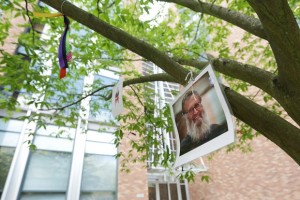
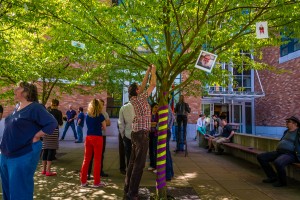 On Thursday April 25, members of the UW CSE community joined David Notkin’s family in decorating the trees on the plaza outside the Allen Center. Photographs here. Read more →
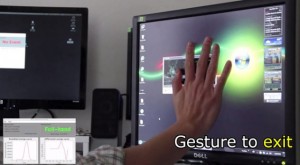 UW CSE’s uTouch technology is featured in a number of recent tech posts.
“Researchers at the University of Washington’s aptly named Ubiquitous Computing Lab can turn any LCD monitor in your house into a touchscreen, with nothing more than a $5 sensor that plugs into the wall and some clever software.
“The technology, called uTouch, works by measuring the electromagnetic interference (EMI) caused by your hand when it moves near or touches an LCD monitor. This might sound a little bit crazy, but I’ll explain. Basically, the electricity running through the wires in your house has a unique electromagnetic signature. There is the “carrier wave,” provided by the power company and your nearby substation, and then every single kink and switch along the way modulates the EM signature until it is quite unique. What most people don’t realize, though, is that every device that is plugged into a wall outlet also changes your EM signature. Your TV doesn’t just suck power from your house — it’s a two-way street, with the electronic components in the TV producing interference that change your house’s EM signature.”
Read more here and here.
Lots of subsequent news coverage: here, here, here, here, here, here, and here. Read more →