 GeekWire describes new UW CSE startup WatchFrog:
“WatchFrog, which is in the process of raising cash, is building off of Patel’s research as well as the research of Duke University assistant professor Matt Reynolds and UW PhD student Gabe Cohn. The first engineers will start at the company October 1.
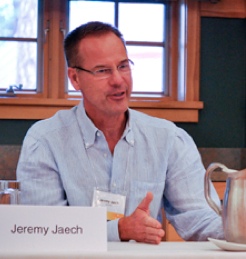
“Jaech tells GeekWire that WatchFrog’s ultra-low-power sensing technologies, currently in the prototype phase, could be used to monitor conditions around the home; and detect home hazards such as radon or carbon monoxide. The sensors are designed to last up to 50 years, far longer than other technologies.
“Jaech, who was just named to the Board of Regents at the UW, has been hanging around the computer science department at his alma mater for about a year.”
Read more here. Read more →
 UW CSE’s SpiroSmart is featured by Futurity.
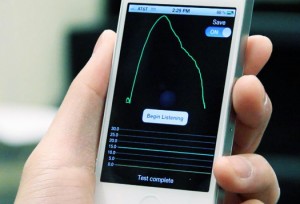
SpiroSmart is a mobile phone platform that acoustically analyzes lip reverberation, making it possible to monitor pulmonary ailments such as asthma, chronic obstructive pulmonary disease, and cystic fibrosis. Accuracy is within 5% of expensive purpose-built commercial devices, meeting the medical community’s standards for accuracy.
Read the Futurity post here. Learn more about SpiroSmart here. Read more →
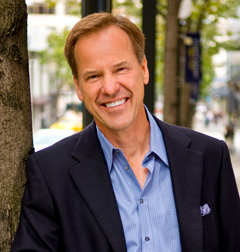 UW CSE alum Jeremy Jaech has been named to the University of Washington Board of Regents by Governor Christine Gregoire, replacing Bill Gates Sr., whose term expires at the end of the month.
Jeremy is our region’s leading serial software entrepreneur. He co-founded Aldus Corporation – the inventor of desktop publishing – which was acquired by Adobe. He then co-founded Visio Corporation – constraint-based drawing – which was acquired by Microsoft. He currently serves as co-founder and CEO of WatchFrog, which uses sensor technology developed by UW CSE’s Shwetak Patel and his students to monitor home hazards.
Jeremy received the UW College of Engineering’s Diamond Award for Entrepreneurial Excellence in 2006, and the UW Computer Science & Engineering Alumni Achievement Award in 2011. He recently concluded a term as chair of the Technology Alliance, a civic organization formed by Bill Gates Sr. to encourage strategic approaches to education, research, and entrepreneurship in our state.
Read a Seattle Times article here. Read more →
 On September 23-25, NBC News hosted its third “Education Nation” National Summit, convening more than 300 of the country’s thought leaders in education, government, business, philanthropy and media to discuss successful examples of innovation in education.
In an amazing feat, UW CSE’s Center for Game Science created and launched a brand new educational game in less than 48 hours, based on specifications provided by the audience at the Summit. NBC Nightly News anchor Brian Williams closed the Summit with a segment on the game.
 “The Center for Game Science (CGS) at the University of Washington aims to revolutionize the educational and scientific discovery process by engaging learners to become experts through personalized learning games that adapt to each person. Recently, CGS games have enabled game-developed experts to solve biochemical structures that baffled scientists for 13 years. Led by Professor Zoran Popovic, the Center is currently working on applying the same techniques to address key bottlenecks in K-12 math and science education.”
Check out the game on the NBC News website here. Listen to the NBC News interview with UW CSE’s Zoran Popovic here. Learn more about the Center for Game Science here. Read more →
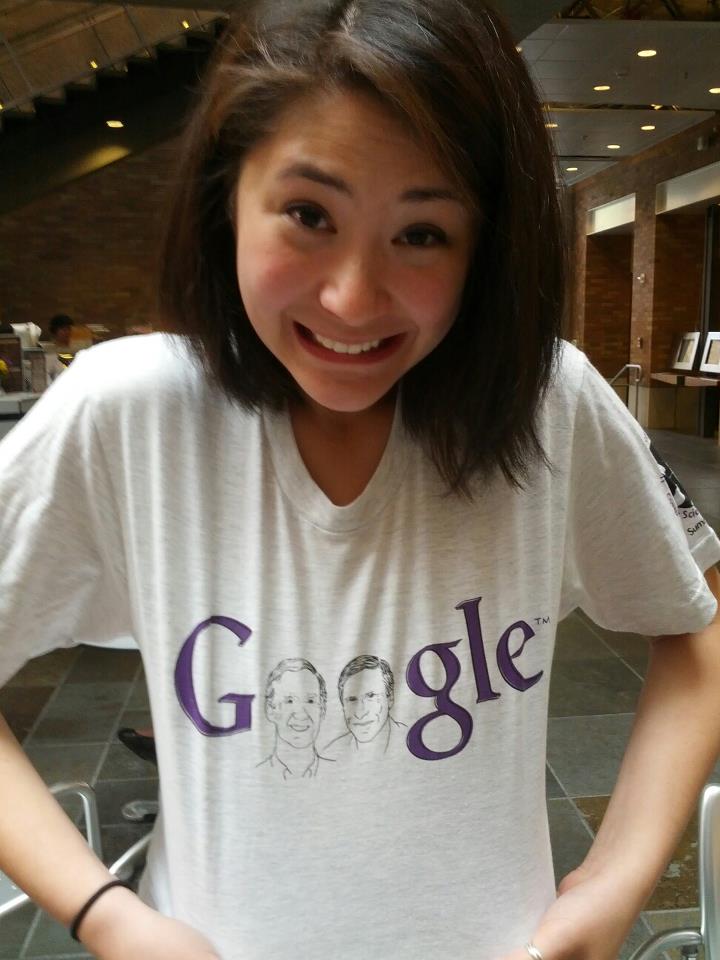 Zorah Lea Fung models the 2012 Google Seattle summer intern t-shirt, featuring Ed Lazowska and Hank Levy as the two O’s! “How cool is that?” say Ed and Hank!
Nice GeekWire post here: “It is typical to see star athletes immortalized in this way on campus, but pretty rare for the geeks to get their due. We’re not sure who made the shirt, but seeing Lazowska and Levy in the middle of the Google logo certainly cracked us up.” Read more →
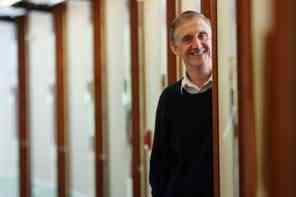 An article on MOOCs (Massive Open Online Courses) in the Seattle Times Pacific NW Magazine leads with UW CSE alum Greg Linden and quotes UW CSE professor Ed Lazowska:
“Seattle tech entrepreneur Greg Linden … decided to go to college – without leaving home.
“Through Stanford University, he took a class on robotic-car programming from professor Sebastian Thrun, who led the team that designed Google’s self-driving car.
“He also scarfed down a class on computer program design from Google Research director Peter Norvig, who used to oversee computational sciences at NASA. And he gobbled up a class on machine learning from another Stanford professor who directs the university’s Artificial Intelligence Lab.
“All the classes were online, open to anyone. Linden didn’t have to fill out an application or send in his transcripts …
“In July, the UW became one of 12 top-tier universities that joined one of the online startups, Coursera, launched by two computer-science professors at Stanford. The UW’s free classes are expected to begin this fall …
“Ed Lazowska, who holds the Bill & Melinda Gates Chair in Computer Science & engineering at the University of Washington, says advanced technology can be a powerful tool in helping educate large numbers of people and, just as importantly, figuring out how people learn best.”
Read more here. Read more →
 A terrific Seattle Times opinion piece – a companion piece to the article cited in the previous post:
“A modest proposal: Stop gutting one of the state and region’s most important competitive assets: higher education, especially the University of Washington.”
Read it here. (See a post on a related article here.) Read more →
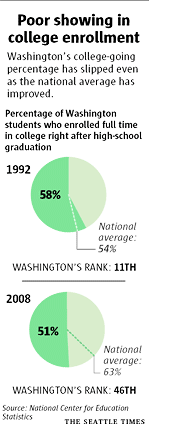 This excellent (if depressing) article in the Seattle Times exposes the gaps in Washington’s education system:
“We think of ourselves as a well-educated state, and in many respects we are. More than half of Seattle adults 25 and older hold a bachelor’s degree, making it one of the most well-schooled cities in the nation.
“So it may come as a surprise that only about one in four public-school students from Washington’s high-school class of 2009 will finish college by 2015, according to a Seattle Times analysis of recent trends.
“While the percentage of high-school graduates who went to college jumped by nine points in the United States over the past two decades, the percentage of college-going high-schoolers in Washington fell.
“We were once well above the national average for the percentage of high-school students who go on to a two- or four-year college. But today, by some measures, we are one of the lowest states in the country …
“As University of Washington computer science professor Ed Lazowska says: ‘We are creating great jobs, and they’re going to other people’s children.'”
Read the article here. Learn additional facts about STEM education in Washington State here. (See a post on a related opinion piece here.) Read more →
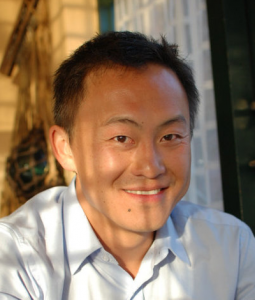 Captricity, a service that wants to make the paper-to-digital conversion faster and cheaper, was co-founded by UW CSE bachelors alum Kuang Chen. (Kuang recently received his Ph.D. from UC Berkeley advised by Joe Hellerstein and UW CSE Ph.D. alum Tapan Parikh.) Writes PandoDaily:
“The service is a result of cofounder Kuang Chen’s trip to Tanzania, where he worked at an HIV treatment center. After being tasked with finding patients that had started on anti-retrovirals, but for one reason or another had stopped taking them, Chen had to work his way through scattered papers and attempt to gather as much data as possible from them. He decided that it was time to bring digitization that would be powerful enough for enterprise customers but cheap enough for third-world organizations, and Captricity was born.”
Read the post here. Read more →
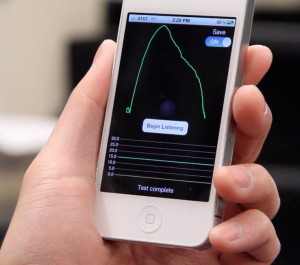 “Is there anything a smartphone app can’t do? Researchers at the University of Washington, UW Medicine and Seattle Children’s hospital have figured out how to let people measure their own lung health by breathing in the direction of the standard microphone on a smartphone, without any specialized attachments.
“Here’s the cool part: The results from the app are within 5 percent of those from commercial spirometers that run into the thousands of dollars. That level of accuracy means the app is already meeting medical standards.
“The app, called SpiroSmart, analyzes the sound waves from a strong exhale to judge the health of the person’s lungs.”
Read the post here. Read a UW News release here. Read the SpiroSmart research paper here.
Related articles: KOMO TV News video here. C|net here. New York Daily News here. Read more →