 The CHI Academy is an honorary group of individuals who have made extensive contributions to the study of Human Computer Interaction and who have led the shaping of the field.
This year seven new members were elected to the CHI Academy, including UW CSE’s James Landay. James’s citation reads:
“James Landay is the Short-Dooley Professor of Computer Science & Engineering at the University of Washington. His research over the past two decades has included contributions in the areas of automated usability evaluation, demonstrational interfaces, ubiquitous computing, user interface design tools, and web design. As a graduate student at Carnegie Mellon University, he began creating tools to support fluid user interface design and development through sketching. From 1997-2003, he was a professor at UC Berkeley, where he was tenured after creating a strong HCI research community and continuing to develop tools for non-programmers that explored the then-novel design spaces of web site, pen and speech interaction. He moved to Seattle in 2003 to join the faculty in CSE at UW and to direct the Intel Research Seattle lablet, which focused under his leadership on technologies and applications of ubiquitous computing. He has continued his leadership in developing tools for designers, adding to his long list of publicly available design tools through the investigation of location-aware computing, activity-based computing and ubicomp in the home. He was a founding member of the cross-university DUB Group at UW, which under his leadership has quickly become an international power in HCI research. He is currently helping to establish an HCI research center at Microsoft Research Beijing. He has also had success in commercialization efforts. His research contributions and those of his current and former students are alone worthy of election into the CHI Academy. But James’ most lasting legacy will be his outstanding ability to create communities of HCI researchers (Berkeley, Intel Research Seattle, Washington) with international prominence and lasting impact.
Congratulations James! Learn more about his research here. Learn about UW’s cross-campus DUB research group here. Read the CHI Academy citation here.
Read more →
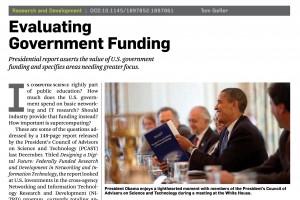 Communications of the ACM reports on the report of the Presidents Council of Advisors on Science and Technology concerning the Federal Networking and Information Technology Research and Development Program. (UW CSE’s Ed Lazowska co-chaired the Working Group that advised PCAST on the report.)
“An example of high payback was given at the report’s public release by Akamai founder Tom Leighton. He related a story of Defense Advanced Research Projects Agency funding he received in the 1990s to study ‘highly mathematical and highly theoretical subjects … the living example of high-risk research.’ When the research was finished, Internet companies weren’t interested in the results – even for free.
“‘So we started a company called Akamai Technologies,’ Leighton says. ‘We [now] carry over a third of Web traffic … and are probably paying over $100 million in taxes this year. But it wasn’t the kind of research that companies fund.'”
Read the article here. Read more →
 Our friends at Madrona Venture Group, working with a number of top Seattle technology companies, have introduced the Cascadia Innovation Fellowship.
The Cascadia Innovation Fellowship is targeted at computer science undergraduate and graduate students from across the nation. If selected, students receive a paid summer internship, plus a $5,000 scholarship. The Seattle technology community will support the fellows and provide them with networking, education, and insights that will benefit them as they finish school and well beyond into their career.
Applications are due by March 10. Learn more about this great opportunity here. Read more →
 UW CSE’s Open Data Kit (ODK), a collection of free and open source tools, in use around the world, that make data collection easier and more flexible, has received the 2011 Washington Technology Industry Association Industry Achievement Award for Best Use of Technology in Government, Non-Profit, or Education.
ODK began as a collaboration between UW CSE and Google.
Learn more about ODK here. Learn more about the WTIA Industry Achievement Awards here.
UW CSE’s Living Voters Guide was another of the three finalists in the Best Use of Technology in Government, Non-Profit, or Education category of the WTIA Industry Achievement Awards. Read more →
 TechFlash interviews UW CSE’s Oren Etzioni:
“The folks at University of Washington Computer Science & Engineering have been watching IBM’s Watson computer on ‘Jeopardy!’ this week with even more interest than the rest of us. They even hosted a viewing party last night on campus, followed by expert commentary. We followed up today with one of those experts, computer science professor Oren Etzioni, the director of the UW Turing Center, to get his take on the whole thing. Continue reading for excerpts from our conversation.”
The interview is here. Read more →
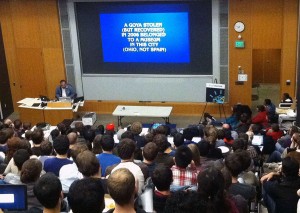
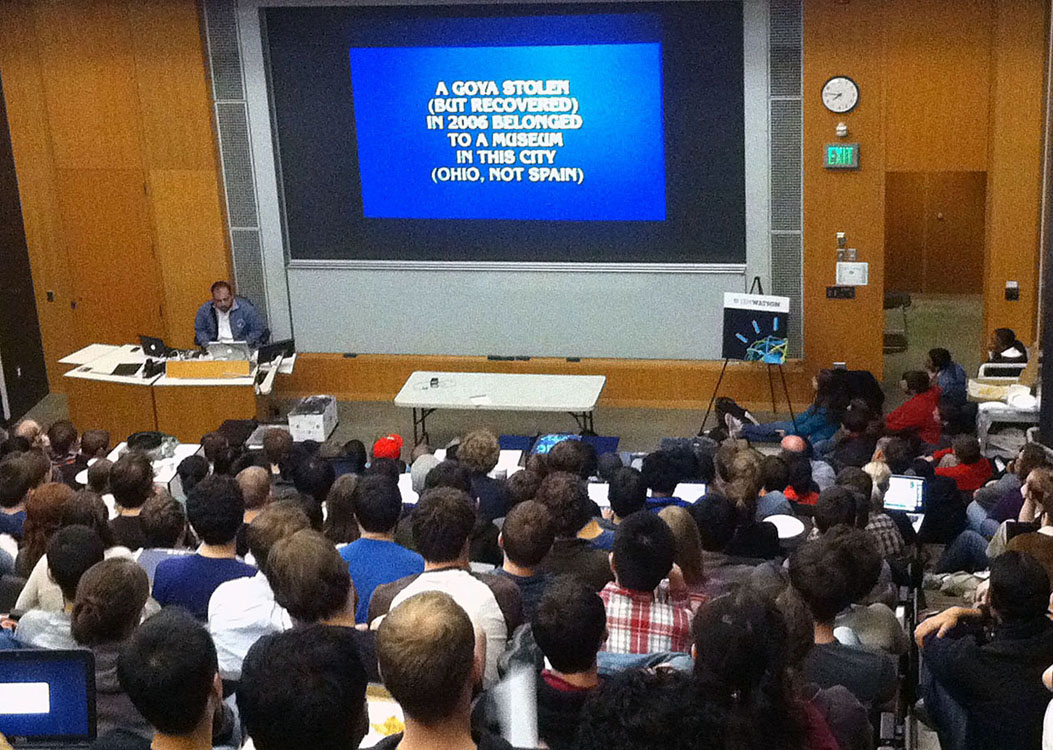
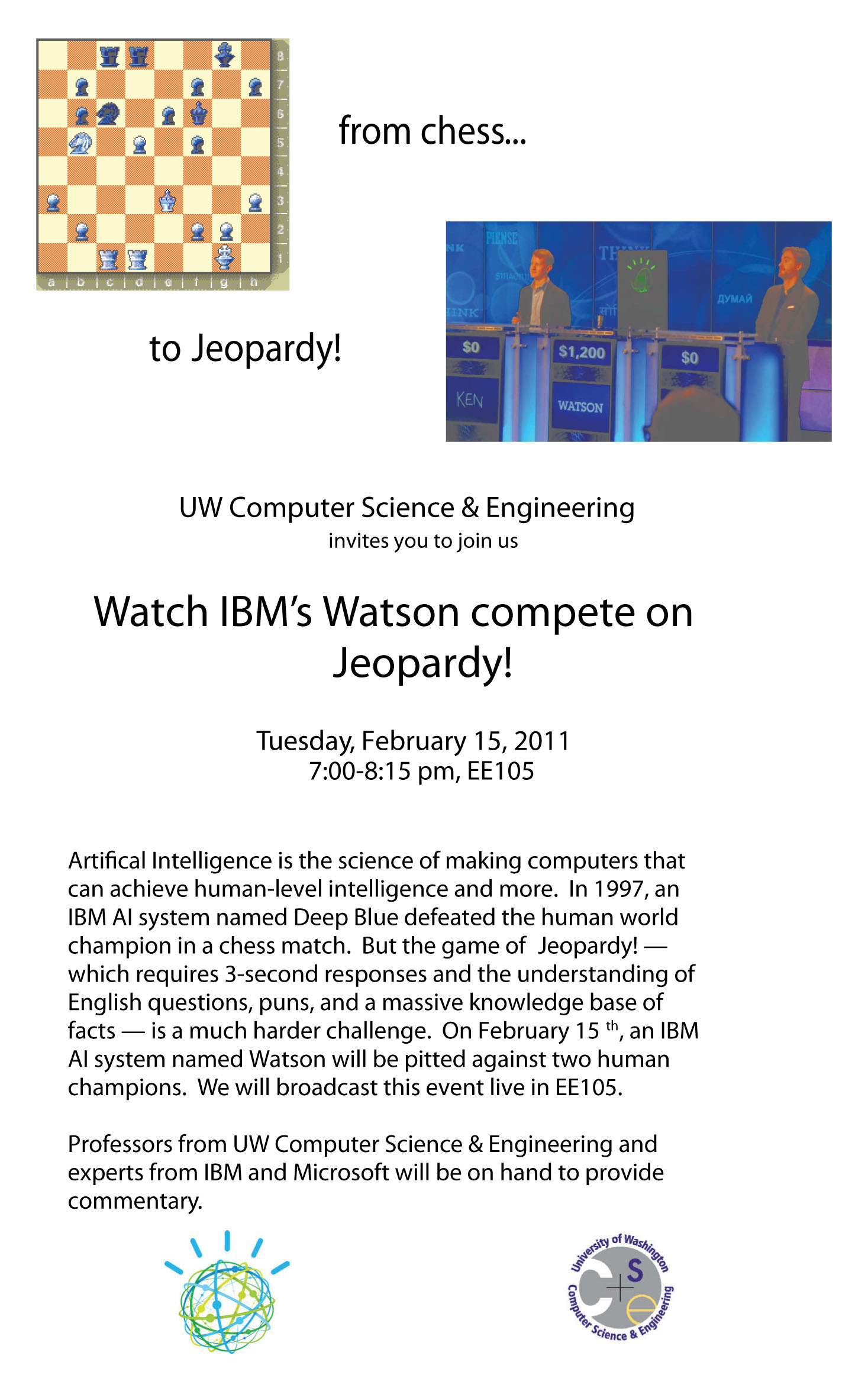
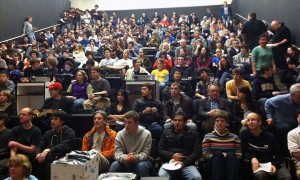 On February 15, UW CSE and IBM hosted a viewing of the second of three Jeopardy! matches pitting IBM’s Watson Artificial Intelligence system against two human champions.
More than 250 fans, ranging in age from 7 to 70, turned out! Commentary was provided by UW CSE’s Oren Etzioni, Ed Lazowska, and Luke Zettlemoyer, Microsoft Research’s Eric Horvitz, and IBM’s Greg Dietzel.
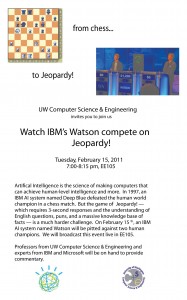 There are some wonderful background videos on the IBM Watson website, here.
And don’t miss “Watson, The Jeopardy! Supercomputer, Sizes Up One of His Opponents Before the Show.”
Then there’s Conan. Read more →
 “‘It is, in my mind, a historic moment,’ says Oren Etzioni, director of the Turing Center at the University of Washington, Seattle. ‘I watched Gary Kasparov playing Deep Blue. This absolutely ranks up there with that.'”
Read the complete interview here. Read more →
Georg Seelig
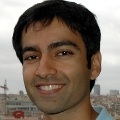
Anup Rao
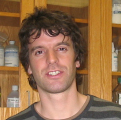
CSE’s Anup Rao and Georg Seelig have been selected to receive 2011 Alfred P. Sloan Research Fellowships, among the most selective awards for young scientists.
Rao, an expert in the theory of computation, joined CSE in 2010, following graduate work at the University of Texas and postdocs at the Institute for Advanced Study and Princeton. His interests include finding mathematical explanations for why some computational problems are fundamentally harder than others, and discovering the limitations of efficient computational processes. These kinds of questions can sometimes lead to strange and unexpected revelations – for example, a recent sequence of work that he was involved with led to the discovery of the most economical shape for soap bubbles.
Seelig, a synthetic biologist, joined CSE and EE in 2009. He received a Diploma in Physics from the University of Basel in 1999 and a Ph.D. in theoretical physics from the University of Geneva in 2003. Before coming to UW he was a postdoc at Caltech working with Erik Winfree and Michael Elowitz. He is interested in understanding how biological organisms process information using complex biochemical networks, and how such networks can be engineered to program cellular behavior. Engineered circuits and circuit elements are being applied to problems in disease diagnostics and therapy.
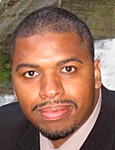
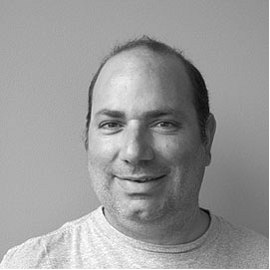
Hakim Weatherspoon
Rao and Seelig are the sixteenth and seventeenth UW CSE faculty members to be honored with Sloan Research Fellowships.
UW CSE Bachelors alumnus Hakim Weatherspoon, now a faculty member at Cornell University, also received a Sloan today.
See the UW press release here. Read more →
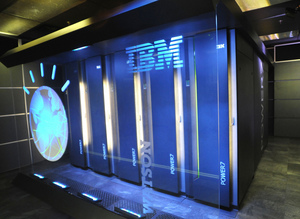 UW CSE’s Oren Etzioni was interviewed today on NPR’s “Morning Edition” regarding the forthcoming Jeopardy match pitting IBM’s Watson AI system against two human champions.
“Artificial intelligence experts say that even with the occasional error, Watson has what it takes to perform very well against humanity’s best. Etzioni expects to see a Watson win in the competition, which will air Feb. 14, 15 and 16. ‘Does that mean that it’s ‘Game Over’ for humans, that robots will keep us as pets? Absolutely not,’ Etzioni says. ‘But it does mean it’s a demonstration that we’ve significantly expanded the envelope of what computers can really achieve.'”
Listen to the interview here. Read a transcript here. (Former UW CSE faculty member Henry Kautz is also quoted.)
Related: An interesting New York Times article by John Markoff on “Artificial Intelligence” vs. “Intelligence Augmentation,” dating back to John McCarthy vs. Doug Engelbart, mentions UW CSE’s Foldit protein folding game. Read more →
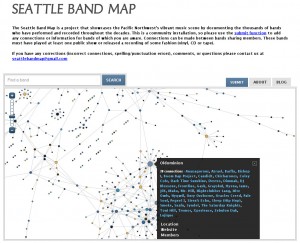 UW CSE undergraduate Golf Sinteppadon, in collaboration with KEXP’s Rachel Ratner and musician Keith Whiteman, has released Seattle Band Map, an interactive website that showcases the Pacific Northwest’s vibrant music scene by documenting the thousands of bands who have performed throughout the decades, and exploring how these bands are interconnected through personal relationships and collaborations. Read more →