“Meet the Growbots”

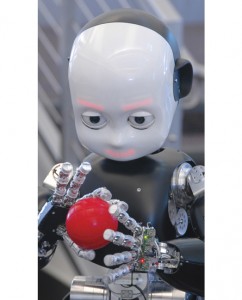
ScienceNews profiles the research of UW CSE professor Raj Rao.

“Boldly going where most computer scientists fear to tread, Rajesh Rao watches intently as 1-year-olds lock eyes with their mothers in a developmental psychology lab at the University of Washington in Seattle. Time after time, tiny upturned heads tilt in whatever direction the caretakers look. Naturally, Rao thinks of robots.”

Read the article here.  Learn more about Rao and his research here. Read more →

Computing Research News discusses PCAST NITRD report

Computing Research News discusses the recent assessment of the Federal Networking and Information Technology Research and Development Program, carried out by the President’s Council of Advisors on Science and Technology.  UW CSE’s Ed Lazowska co-chaired the Working Group that advised PCAST on the report.

“Backed by strong support from the White House, the President’s Council of Advisors on Science and Technology (PCAST) released a biennial report about the status and direction of the nation’s 14-agency, $4.3 billion Networking and Information Technology Research and Development (NITRD) program last month.  The report emphasized the critical role of advances in networking and information technology (NIT) to U.S. economic competitiveness, and called on the nation to ‘continue to innovate more rapidly and creatively than other countries in important areas of NIT’ in order to sustain and improve overall quality of life.”

Read the CRN article here.  Learn about the  report here. Read more →

Corensic in Wall Street Journal

UW CSE startup Corensic – founded by professors Luis Ceze and Mark Oskin – was featured in today’s Wall Street Journal.

“Software built in the era of multi-core processors is getting more difficult to test.  For the last five or six years processor companies like Intel Corp. and Advanced Micro Devices Inc., running up against the limits on their ability to shrink chip sizes, have been boosting performance by adding multiple processor cores to each chip.

“To get the most out of these improvements, software developers have to build code that can run simultaneously on different cores.  That means timing is now an issue in testing for bugs, compounding the number of possible errors and extending the time needed to test new software and the time the software can operate before those errors reveal themselves, said Peter Godman, Corensic’s chief executive.”

Read the article here. Read more →

Foldit has children!

The New York Times reports on EteRNA, an online game that allows non-biologists to design complex new ribonucleic acid (RNA) molecules, as well as to receive quick feedback on the biological function of their designs.  EteRNA is in the spirit of Foldit, the widely admired and pioneering protein folding game created by UW researchers.

EteRNA was designed by UW CSE (and Foldit) alum Adrien Treuille, now a faculty member at Carnegie Mellon University, along with colleagues at CMU and Stanford.

It’s a superb article.  Read it here.  Play EteRNA here.  Play Foldit here. Read more →

UW CSE’s Raj Rao at TED2011

UW CSE’s Raj Rao will speak at TED2011 on Friday March 4.  On the other hand, David Brooks is speaking too, showing that the selection criteria are not uniformly excellent.  See the program here. Read more →

OpenDataKit and Living Voters Guide are WTIA Industry Achievement Award Finalists

Two UW CSE research projects – OpenDataKit (ODK) and the Living Voters Guide – are two of three finalists in the “Government, Non-profit or Educational Sector” category of the 2011 Washington Technology Industry Association Industry Achievement Awards.  The awards recognize Washington State companies, organizations and individuals who best demonstrate technology and service innovation and excellence.

OpenDataKit (ODK), led by a team of UW CSE researchers that includes Gaetano Borriello, Yaw Anokwa, Waylon Brunette, and Carl Hartung, is a free and open-source set of tools which help organizations author, field, and manage mobile data collection solutions.  The Living Voters Guide, designed by UW CSE’s Alan Borning and Travis Kriplean (as part of the research conducted by the Engage project), promotes civic engagement by bringing together Washington voters to discuss and explore their positions on the statewide ballot measures for 2010.

The winner will be announced at the WTIA IAA awards event on February 24. Read more →

UW CSE’s Shwetak Patel on KUOW’s “The Conversation”

UW CSE and EE professor Shwetak Patel was interviewed on “The Conversation,” a news and information program on Seattle’s NPR station, KUOW.

“University Of Washington Innovator Shwetak Patel:  Seattle Business Magazine recently named a UW computer science professor Seattle’s Top Innovator of 2010, and the technology news website TechFlash named him Newsmaker of the Year.  Shwetak Patel came up with a device that monitors how much energy your appliances use.  He joins us.”

Listen to the interview here.  Learn more about Shwetak and his work here. Read more →

He walks … he talks … he tells bad jokes …

Long-time UW CSE faculty member David Notkin made a guest appearance today following a rearrangement of his plumbing by UW Medicine.  He looks great!  Congratulations, David – we’re thinking of you! Read more →

“Freedom to Tinker” profiles UW CSE professor Shwetak Patel’s research

“Recent ‘gee whiz’ research by Professor Shwetak Patel’s group at the University of Washington provides a really elegant solution.  Every appliance you own – your refrigerator, your flat-screen TV, your toaster – has a different ‘electrical noise signature’ that it draws from the wires in your house.  When you turn it on, this signal is (inadvertently) sent through the electric wires to the circuit-breaker box.  It’s not necessary to buy ‘smart appliances’ that send purpose-designed on-off signals; your ‘dumb’ appliances already send their own noise signatures.”

Read the full post here.  Learn more about the research here. Read more →

CSE’s Yoshi Kohno interviewed on BBC World Service

“Currently, once an email is sent, it has the potential to exist somewhere online forever, even if you delete it.  What if there were way of scrubbing data from the internet so that it could never be found?  Tadayoshi Kohno, professor of computer science at the University of Washington in Seattle, has been working on just such a project.”

Listen to the interview here.  Learn more about the project here. Read more →

« Newer PostsOlder Posts »