 The Flashies have been awarded! One winner in each of 15 categories, chosen by reader balloting among a half dozen candidates.
In the “Newsmaker of the Year” category, who was the winner?
- Was it Paul Allen, who “recovers from non-Hodgkin Lymphoma, sues some of the Internet’s biggest names for patent infringement, and pledges along with other billionaires to give the majority of his fortune to charity”?
- Was it Steve Ballmer, who “attempts to reverse the company’s mobile fortunes, build momentum in video games and shore up its core software franchises while funding the campaign against a state income tax and announcing plans to sell up to $2 billion in stock”?
- Was it Jeff Bezos, under whose leadership “Amazon.com posts a 44 percent increase in employment in one year, expands its Kindle business, acquires Woot.com and reaches a deal to buy Diapers.com, while coming under intense criticism for its handling of the discovery of a pedophile guidebook in the Kindle store”?
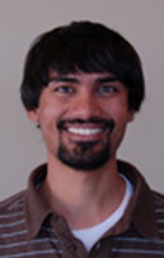
- Was it Andy Sack, who “cements his role as a chief instigator and motivator on the Seattle startup scene — leading initiatives including Founder’s Co-op, TechStars and RevenueLoan”?
- Was it Ben Huh, who “continues to expand the Cheezburger empire of comedy websites; takes on Meg Whitman and the Associated Press; makes a public attempt to acquire the Reddit social news service; and stirs controversy over startup wages”?
Nope! It was Shwetak Patel, “a 28-year-old assistant professor in the UW Department of Computer Science & Engineering [who] sells home energy monitoring startup Zensi to Belkin and separately develops a novel method of using electrical wiring as a wireless antenna system, spawning another startup.”
See all the winners here. See Shwetak bathed in Disco Red here.
“We thank you for your support!“ Read more →
Advances in information technology have some companies dreaming of a wo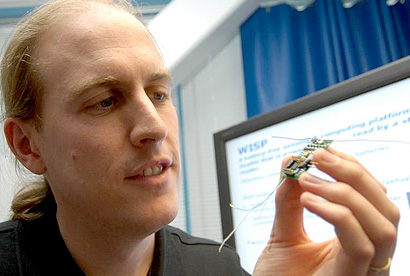 rld abuzz with sensors, some of which could reduce carbon emissions. How to power these sensors is one of the problems to be tackled. UW CSE associate professor Josh Smith, who recently moved from Intel Labs Seattle, has been working on this issue.
“‘That’s been a real problem for sensor units: People can build these sensor networks that send data wirelessly, but their battery only lasts a couple minutes,’ said Josh Smith.”
With some others, Smith has developed two technologies called WARP and WISP to combat this problem. He is the principal investigator of Intel’s WREL (Wireless Resonant Energy Link) project, which aims to transfer tens of watts wirelessly. He also leads a project called WISP (Wireless Identification and Sensing Platform). WISP is a battery-free platform for sensing and computation. It consists of a fully-programmable, 16-bit microcontroller that is powered wirelessly by radio waves: it harvests all the energy it needs from a standards-compliant UHF RFID reader. It also receives data from and sends data to the RFID reader.
Read the New York Times article here. Read more →
 The RGB-D project is a joint research effort between Intel Labs Seattle and University of Washington Computer Science & Engineering. The goal is to develop techniques that enable future use cases of depth cameras. Using the Primesense depth cameras underlying the Kinect technology, we’ve been working on areas ranging from 3D modeling of indoor environments to interactive projection systems and object recognition to robotic manipulation and interaction.
A number of interesting demonstration videos are linked here. Read more →
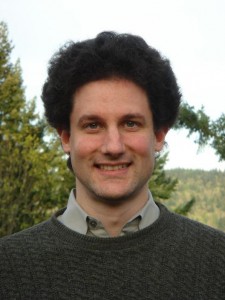 Steve Seitz has been named a Fellow of the Institute of Electrical and Electronics Engineers “for contributions to three-dimensional computer vision.”
Steve’s research interests include many aspects of computer vision and computer graphics, particularly capturing the structure, appearance, and behavior of the real world from digital imagery. Steve was twice awarded the David Marr Prize for the best paper at the International Conference of Computer Vision, and has received an NSF Career Award, an ONR Young Investigator Award, and an Alfred P. Sloan Research Fellowship. His work on PhotoTourism (with graduate student Noah Snavely and Microsoft researcher Rick Szeliski) was central to Microsoft’s Photosynth offering. He currently is on leave at Google Seattle working on a computer vision project.
Steve is the twelfth CSE faculty member to be named a Fellow of IEEE.
Congratulations Steve! (CSE professor Gaetano Borriello and Ph.D. alumna Fran Berman (currently Vice President for Research and Professor of Computer Science at Rensselaer Polytechnic Institute) also were named IEEE Fellow today.) Read more →
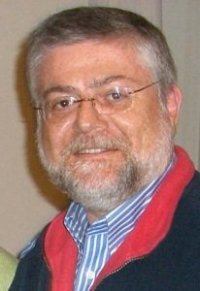 Gaetano Borriello, the Jerre D. Noe Professor of Computer Science & Engineering, has been named a Fellow of the Institute of Electrical and Electronics Engineers “for contributions to embedded computing devices and systems.”
Gaetano’s research interests include ubiquitous computing, sensor systems, and embedded systems. An Adjunct Professor in Electrical Engineering, Human-Centered Design and Engineering, and the Information School, and the Founding Director of Intel Labs Seattle, Gaetano most recently led the development of Open Data Kit (ODK), a free and open-source set of tools that help organizations author, field, and manage mobile data collection solutions.
Gaetano is the eleventh CSE faculty member to be named a Fellow of IEEE.
Congratulations Gaetano! (CSE professor Steve Seitz and Ph.D. alumna Fran Berman (currently Vice President for Research and Professor of Computer Science at Rensselaer Polytechnic Institute) also were named IEEE Fellow today.) Read more →
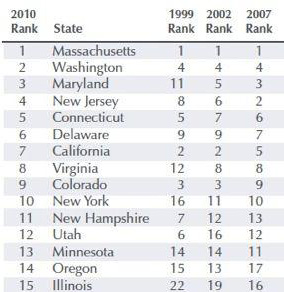 A new report out this week from the Ewing Marion Kaufman Foundation and The Information Technology and Innovation Foundation – the 2010 State New Economy Index – ranks Washington second among the 50 states.
The State New Economy Index is a detailed study which analyzes 26 indicators in the five categories of knowledge jobs, globalization, economic dynamism, digital economy and technological innovation capacity.
“Washington scores high due not only to its strength in software (in no small part due to Microsoft) and aviation (Boeing), but also because of the entrepreneurial hotbed of activity that has developed in the Puget Sound region, and very strong use of digital technologies by all sectors,” according to the authors of the report.
Read a TechFlash post here. Read more →
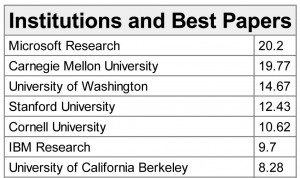 Here’s a ranking we can get behind!
A recent assessment of “Best Paper Awards” over the past decade at major conferences in AI, HCI, and data management ranks UW third in the nation, behind Microsoft Research and CMU.
(The conferences were WWW, SIGIR, CIKM, AAAI, CHI, KDD, SIGMOD, ICML, VLDB, IJCAI, and UIST. See the tally here.) Read more →
 It’s time to vote for the TechFlash “Newsmaker of the Year.” There are six nominees — five guys you’ve never heard of, and UW CSE’s Shwetak Patel.
“Shwetak Patel, a 28-year-old assistant professor in the UW Department of Computer Science & Engineering, sells home energy monitoring startup Zensi to Belkin and separately develops a novel method of using electrical wiring as a wireless antenna system, spawning another startup.”
Vote here! Read more →
 UW CSE Ph.D. alumnus Li Zhang, now on the faculty at the University of Wisconsin – Madison, was the only computer scientist to win a 2010 Packard Fellowship in Science and Engineering from the David and Lucile Packard Foundation.
Zhang – who has also won an NSF CAREER Award and a Sloan Research Fellowship – studied with Steve Seitz in UW’s superb Graphics and Imaging Laboratory. Zhang’s research supported by the award will seek to restore stereo 3D vision for blind people by developing new computational imaging and vision techniques that work with artificial retinas. His recent related projects include high-performance low light imaging using micro-cameras, and modeling stereopsis using sparse graphs and its application in video stabilization.
Congratulations Li! See the Packard announcement here. Read more →
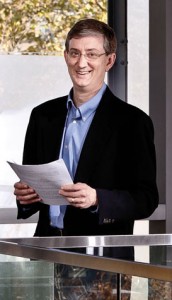 A terrific article in the Princeton Alumni Weekly on the Center for Information Technology Policy, directed by UW CSE Ph.D. alumnus Ed Felten.
“The center’s interests extend well beyond voting machines. CITP’s director and driving force is Ed Felten, an affable, boyish-looking 47-year-old who holds joint appointments in computer science and public affairs. One of his claims to fame came in 2000, when he testified that Microsoft’s Internet Explorer Web browser could be detached from the Windows operating system, thereby assisting the U.S. government in its historic antitrust case. More recently, he and his graduate students have shaken up the computer-security world with a string of striking papers. In 2006, they demonstrated that a method Sony was using to protect its DVDs from piracy introduced security risks in users’ computers. In 2008, they showed that hackers could steal information from a laptop even when it was turned off.”
Read the full article here. Read more →

