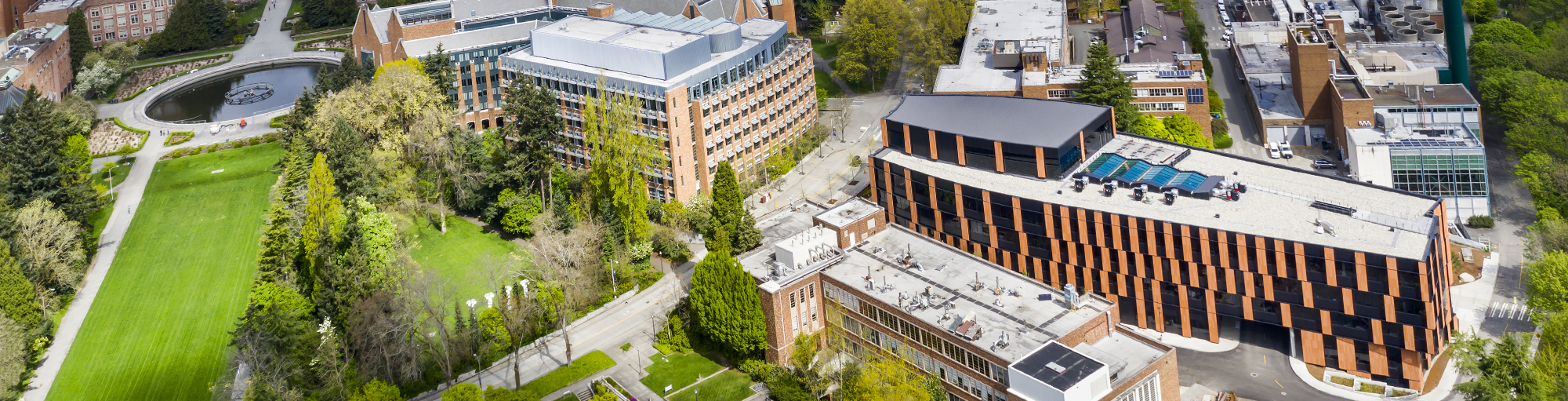
 CSE professor Josh Smith treats his new (and as yet unnamed) Willow Garage PR2 humanoid robot to a trip to Reboot. Read more →

There’s a new caffeine addict in town!
“Undergraduates’ low-cost ultrasound system wins Gates Foundation grant”
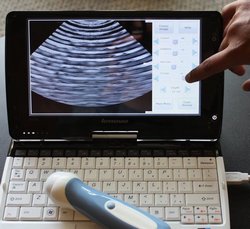 An effort by students and faculty from CSE, Human-Centered Design and Engineering, and the Information School to design a low-cost portable ultrasound system for use in the rural developing world has received a $100,000 “Grand Challenges Explorations” grant from the Bill & Melinda Gates Foundation – one of 65 grants awarded among more than 2,400 applicants.
Read the UW press release here. Read about the project and its participants here. Learn about Change, the cross-campus collaboration under which dozens of remarkable projects such as this take place, here. There’s a nice video describing the project here. Read more →
PCAST approves NITRD report
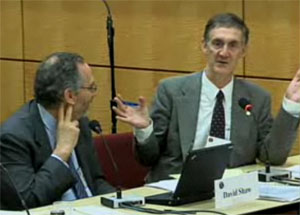 On Thursday, the President’s Council of Advisors on Science and Technology (PCAST) unanimously approved a report reviewing the 14-agency, $4.3 billion Networking and Information Technology Research and Development (NITRD) Program, representing the Nation’s entire unclassified R&D portfolio in computer science and related fields.
The 14-person Working Group assisting with the review was co-chaired by Ed Lazowska and David Shaw, who discussed the report on Thursday.
In summarizing the Findings, Lazowska noted:
“America’s NIT R&D efforts have been hugely successful. This is amply evident, and authoritatively documented, with impacts ranging from accelerating the pace of discovery in nearly all other fields, to driving our economic competitiveness …
“This impact arises from a deep tradition of research, in which the Federal government plays an essential role …
“Recent technological and societal trends place the further advancement and application of NIT squarely at the center of our Nation’s ability to achieve many of our most important priorities, in areas such as improved health care, improved energy efficiency, improved transportation systems, national security, education, and open government.”
A video of the presentation is available here. A rough transcript of Lazowska’s remarks is available here. Posts regarding the PCAST session may be found here and here. Read more →
Yahoo! expands university M45 research initiative
 As scientists at the top US universities extend their research initiatives to the new frontiers of computing, Yahoo! has announced the expansion of its Hadoop-based M45 academic research initiative to include four additional US universities, including the University of Washington. Launched in November 2007, the M45 program is providing universities with the opportunity to conduct research otherwise impossible without the power and speed of a large-scale supercomputing resource. M45 consists of approximately 4,000 processors with 1.5 petabytes of storage.
Examples of academic research conducted on the M45 includes one of the world’s largest knowledge acquisition research projects — UW CSE’s KnowItAll.
Read the Yodel Anecdotal post here. The Register here. Read more →
Ed Felten Named FTC’s Chief Technologist
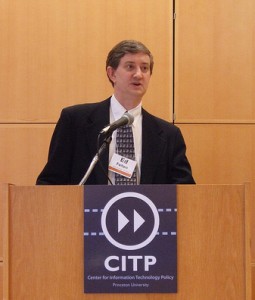 UW CSE PhD alum Ed Felten was named as the US Federal Trade Commission’s first Chief Technologist. In this new position, Dr. Felten will advise the agency on evolving technology and policy issues. Felten is currently the Director of Princeton University’s Center for Information Technology Policy (CITP), a cross-disciplinary effort studying digital technologies in public life. His research interests include computer security and privacy, and public policy issues relating to information technology. Specific topics include software security, Internet security, electronic voting, cybersecurity policy, technology for government transparency, network neutrality and Internet policy.
Congratulations, Ed!
Read the press release here. Slashdot story here. Read more →
Stanford President John Hennessy in UW CSE Distinguished Lecturer Series
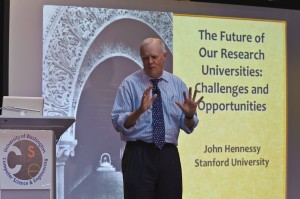 Stanford President John Hennessy spoke to a packed house on November 2 in the UW Computer Science & Engineering Distinguished Lecturer Series on “The Future of Our Research Universities: Challenges and Opportunities.”
Talk video linked here. Photographs here. Read more →
“Intel Labs Seattle open house: Invasion of the depth sensors”
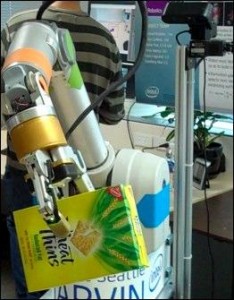 TechFlash reports on the Intel Labs Seattle open house, held on November 1.
“I’ve never seen so many 3D depth-sensors in my life.
“That’s what struck me on Monday afternoon as I snooped around Intel Labs Seattle, near the University of Washington campus. …
“Intel Labs Seattle operates in cooperation with the University of Washington, with Intel researchers and UW students working closely together on projects that explore the potential for ‘context-aware, sensor driven systems.’ Dieter Fox, an associate professor in the UW Department of Computer Science & Engineering, is the latest member of the UW faculty to serve a three-year term as director of the Intel lab.
“Intel has two other similar labs in the United States, at UC Berkeley and Carnegie Mellon University. The labs are focused on research, not product development, but the idea is to show what could be possible in future generations of shipping technology.”
Read the full TechFlash post here.
Seattle Times video here. Read more →
UW CSE’s Emo Todorov in NY Times
 Emo is extensively quoted in the article “Seeing the Natural World With a Physicist’s Lens.” Read the article here. Read more →
UW CSE’s Bruce Hemingway at MOmA
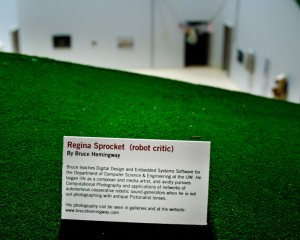 UW CSE’s Bruce Hemingway’s sculpture “Regina Sprocket (robot critic)” was recently displayed at the Seattle Museum of miniature Art (Kirkland Arts Center). Wonderful photographs here. Read more →
Zoran Popovic, Most Influential!
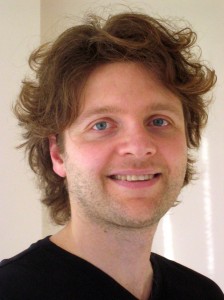 Seattle Magazine has named UW CSE’s Zoran Popovic and his UW Biochemistry collaborator David Baker among its 2010 “Most Influential” for their collaboration on the protein folding game Foldit.
“’We’re involving people in science in a way that produces results that you can’t get any other way,’ says Popovic. ‘It’s democratizing science.’”
Read the article here. Play Foldit here. Read more →