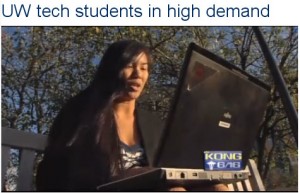
UW CSE student Kim Nguyen
KING 5 News discusses the phenomenal job prospects of UW Computer Science & Engineering grads.
“The job market may be tough for most, but not if you’re a University of Washington computer science student. As KING 5’s Chris Daniels reports, the expertise of computer science majors is a hot commodity.”
Watch the video here.
(If only we had the capacity to offer a UW CSE education to more great students …) Read more →
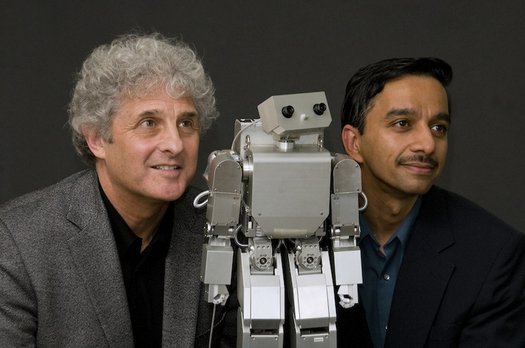 What causes a baby to decide a robot is more than bits of metal? As it turns out, it takes more than humanoid looks— babies that witness a robot engaged in social interaction with adults are much more likely to themselves treat it as a social entity. UW CSE professor Rajesh Rao and UW psychologists published the study starring the Rao lab robot Morphy. Rao’s team designed the computer programs that make Morphy appear social.
Read the UW News article here. Popular Science also covered this research here. Slashdot discussion is here. Read more →
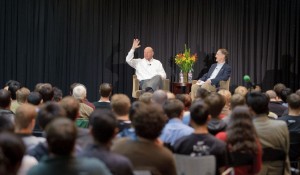 Microsoft CEO Steve Ballmer headlined the UW Computer Science & Engineering Distinguished Lecturer Series on October 14.
See a Seattle PI summary here.
Watch the video here.
Photographs here.
CIO Magazine. PCWorld. The Register. TechFlash. Read more →
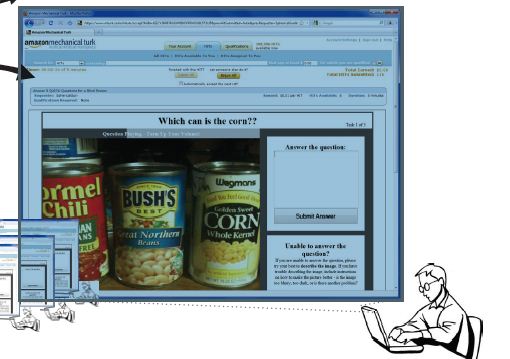 UW CSE Ph.D. alum Jeff Bigham (now at Rochester), UW CSE grad student Chandrika Jayant, and their co-authors received the best paper award at this year’s ACM Symposium on User Interface Software and Technology (UIST) for their paper VizWiz: Nearly Real-Time Answers to Visual Questions.
Visual information pervades our environment. Vision is used to decide everything from what we want to eat at a restaurant and which bus route to take to whether our clothes match and how long until the milk expires. Individually, the inability to interpret such visual information is a nuisance for blind people who often have effective, if inefficient, work-arounds to overcome them. Collectively, however, they can make blind people less independent. VizWiz is an iPhone application aimed at enabling blind people to recruit remote sighted workers to help them with visual problems in nearly real-time. Users take a picture with their phone, speak a question, and then receive multiple spoken answers. VizWiz is designed to have low latency and low cost, making it both competitive with expensive automatic solutions and much more versatile.
More information on UIST 2010 may be viewed here. Read more →
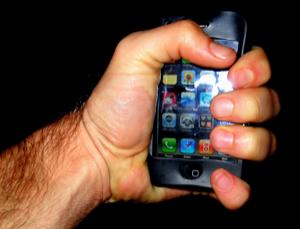 The smartphone of the future might lose its sleek, solid shell. UW CSE’s Shwetak Patel, working with CSE grad Sidhant Gupta, ME undergraduate Tim Campbell, and CSE PhD alum Jeffrey Hightower (now at Intel Labs Seattle), have developed a squeezable cellphone – called SqueezeBlock – which uses tiny motors built into the casing to mimic the behavior of a spring. This novel feedback system changes its ‘shape’ to signal an alert to its user where visual and audible cues won’t suffice.
“‘You can imagine squeezing the phone to give you a little bit of information on its status – ring level, messages – without having to look at it,’ says Patel.”
This work was presented at ACM’s UIST 2010 last week in New York.
Read the full NewScientist article here. Popular Science here. Read more →
The data reported by NRC on “Faculty Awards” appears, not surprisingly, to be no more accurate than the data reported elsewhere in the assessment. Further information here. Previous post on this unhappy topic here. Read more →
 UW CSE Professor Alan Borning and CSE grad student Travis Kriplean, as part of the research conducted by the Engage project, have unveiled a new website devoted to promote civic engagement. It’s based on their open-source ConsiderIt platform.
The Living Voters Guide, funded by the National Science Foundation, lets citizens discuss and share information by letting them work together to write their own voters guide. Its purpose is to help Washington voters to make decisions about the many and complex statewide initiatives on the ballot this November. The Living Voters Guide provides an interactive online platform for all Washingtonians to express their values and concerns, read contrasting ideas, weigh pros and cons, and reach decisions that are informed by community wisdom.
Read the press release here. Washington News Council here. Seattle Times here. UW’s The Daily here. Read more →
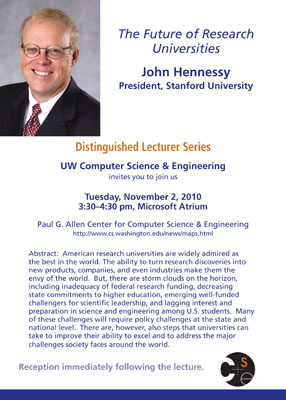 Join us on Tuesday November 2 at 3:30 in the Microsoft Atrium of UW’s Paul G. Allen Center for Computer Science & Engineering for a presentation by Stanford President John Hennessy on “The Future of Research Universities.”
American research universities are widely admired as the best in the world. The ability to turn research discoveries into new products, companies, and even industries make them the envy of the world. But, there are storm clouds on the horizon, including inadequacy of federal research funding, decreasing state commitments to higher education, emerging well-funded challengers for scientific leadership, and lagging interest and preparation in science and engineering among U.S. students. Many of these challenges will require policy challenges at the state and national level. There are, however, also steps that universities can take to improve their ability to excel and to address the major challenges society faces around the world.
Read more →
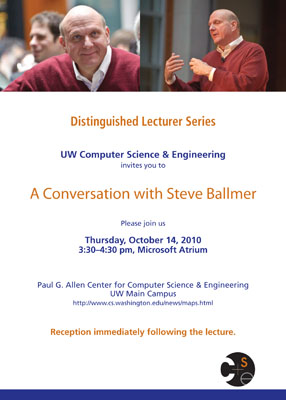 Join us on Thursday October 14 at 3:30 in the Microsoft Atrium of UW’s Paul G. Allen Center for Computer Science & Engineering for “A Conversation with Steve Ballmer.” Read more →
 Congratulations to the dub team!
* Ubicomp 2010 Best Paper Award
ElectriSense: Single-Point Sensing Using EMI for Electrical Event Detection and Classification in the Home, Sidhant Gupta, Matt Reynolds, Shwetak Patel.
ElectriSense is a new solution for automatically detecting and classifying the use of electronic devices in a home from a single point of sensing. It relies on the fact that most modern consumer electronics and fluorescent lighting employ switch mode power supplies (SMPS) to achieve high efficiency. These power supplies continuously generate high frequency electromagnetic interference (EMI) during operation that propagates throughout a home’s power wiring. We show both analytically and by in-home experimentation that EMI signals are stable and predictable based on the device’s switching frequency characteristics. Unlike past transient noise-based solutions, this new approach provides the ability for EMI signatures to be applicable across homes while still being able to differentiate between similar devices in a home. We have evaluated our solution in seven homes, including one six-month deployment. Our results show that ElectriSense can identify and classify the usage of individual devices with a mean accuracy of 93.82%.
* Ubicomp 2010 Best Paper Honarble Mention
SNUPI: Sensor Nodes Utilizing Powerline Infrastructure, Gabe Cohn, Erich Stuntebeck, Jagdish Pandey, Gregory D. Abowd, Brian Otis, Shwetak Patel
The SNUPI paper presents the design and implementation of small ultra-low-power 27 MHz sensor nodes that transmit their data by coupling over the powerline to a single receiver attached to the powerline in the home. We demonstrate the ability of our general purpose wireless sensor nodes to provide whole-home coverage while consuming less than 1 mW of power when transmitting (one order of magnitude lower than existing nodes), and our custom CMOS transmitter consumed only 65 ?W (two orders of magnitude lower than existing nodes). This is the lowest power transmitter to date compared to those found in traditional whole-home wireless systems. (See earlier media coverage here.) Read more →