“Engineering Pathway is proud to announce that Classroom Presenter has been named the Premier Courseware of 2008! Classroom Presenter, by Richard Anderson, Ruth Anderson, Natalie Linnell, Craig Prince and other members of the development team from the University of Washington, is a Tablet PC-based interaction system that supports the sharing of digital ink on slides between instructors and students.”
Read the article here. Read more →
An NPR report on research by CSE’s Schwetak Patel on intelligent air conditioning systems that save power.
Schwetak Patel on intelligent air conditioning systems (MP3 audio file). Read more →
“Computerworld recently asked nine high-tech luminaries [including UW CSE’s Ed Lazowska and Microsoft’s Rick Rashid] to offer their advice to the next U.S. president. Their answers appear below.”
Picked up by Xconomy, Crosscut.
Read the article here. Read more →
“This year UW Engineering has attracted thirteen outstanding new faculty members to our departments. We are excited to have these distinguished professors join our community of innovators.”
Amongst the thirteen: new CSE faculty members Michael Ernst, Shwetak Patel (joint with EE), George Seelig (joint with EE), and Emanuel “Emo” Todorov.
Read more at the College of Engineering site here. Read more →
 Read the article at the Seattle Times here.
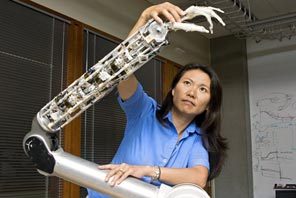
“While markets crashed and investors sobbed, certified genius Yoky Matsuoka and 140 of her friends were … brainstorming how to make the region a world center for neural engineering.
“Their efforts could make Seattle the hub for developing brain-controlled robotic systems that may someday help amputees, stroke victims and people with spinal-cord injuries. Think of the ‘Bionic Man’ or the prosthetic hands used by Luke Skywalker and Darth Vader in ‘Star Wars.’
“Matsuoka is researching this sort of thing at the University of Washington. She’s also leading efforts to create a research institute – the Pacific Northwest Center for Neural Engineering – focused on the intersection of robotics and neuroscience.” Read more →

UW CSE alumna Anne Dinning and her husband Michael Wolfe have created three new Endowed Professorships in Computer Science & Engineering. Anne and Michael named the professorships to recognize Bob Dinning (Anne’s father and a UW EE alumnus), Jean-Loup Baer (who taught Anne her first course as a UW CSE major), and Richard Ladner (supervised Anne’s senior project).
Photos of the event are here. Read more →
Read the article in Xconomy here.
A report on the opening session of the 2008 Workshop on Neural Engineering sponsored by the Pacific Northwest Center for Neural Engineering.
“The goals of this effort, called the Pacific Northwest Center for Neural Engineering, are to foster more collaboration among the region’s engineers, physicists, biologists, computer scientists, and neuroscientists. About 145 people signed up for the conference, including Microsoft co-founder Paul Allen, although I didn’t see him last night. Too bad– he missed out on a fascinating talk about neuroscience of insects, specifically moths, by UW researcher Tom Daniel.” Read more →
Read the article at the IEEE Computer Society site here.
With nearly 100,000 members, the IEEE Computer Society is the world’s largest organization of computer professionals. Founded in 1946, it is the largest of the 39 societies of the Institute of Electrical and Electronics Engineers (IEEE). Read more →
Read the article in Xconomy here.
CSE’s Ed Lazowska on the presidential election in Xconomy:
“Washington’s economy is one of the most technology-intensive in the nation. Software. Precision agriculture. Aerospace. Biomedicine. E-tailing. New media. Alternative energy. Public and private research institutions. Even narrowly defined, the technology sector is responsible, directly or indirectly, for nearly 50 percent of the jobs in Washington. East to west, north to south, we are driven by innovation. It benefits all of our citizens. It defines our future.
“That’s why this year’s Presidential election, and tonight’s debate, are so important to Washington. There are stark differences between how John McCain and Barack Obama would steer our nation’s science and technology enterprise and how those differences will affect our economy …” Read more →
Read the article at UW News here.
“The new Pacific Northwest Center for Neural Engineering will host the 2008 Workshop on Neural Engineering— co-sponsored by the University of Washington, Microsoft Research, and the National Science Foundation— from Thursday October 9 through Saturday October 11 on the Microsoft campus.” Read more →