Read the article here.
 “A group at the University of Washington has developed software that for the first time enables deaf and hard-of-hearing people to use sign language over a mobile phone. UW engineers got the phones working together this spring, and recently received a National Science Foundation grant for a 20-person field project that will begin next year in Seattle …” Read more →
Read the article here.
CSE’s Ed Lazowska writes: “How can we work together to establish, articulate, and pursue compelling visions for our field – visions that will shape the intellectual future of the field, that will catalyze research investment and public support, and that will attract the best and brightest minds of a new generation? The National Science Foundation asked the Computing Research Association to create the Computing Community Consortium (CCC) to address this challenge. The mechanics of the CCC have been described elsewhere; in this column, I focus on the substance …” Read more →
Read the article here.
Press coverage of the SIGCOMM paper “Interactive WiFi Connectivity for Mobile Vehicles” by John Zahorjan (UW), Ratul Mahajan (UW Ph.D., now at Microsoft Research), and Aruna Balasubramanian, Brian Neil Levine, and Arun Venkataramani (UMass Amherst).
“‘Today’s Wi-Fi handoff protocols are incredibly fragile in outdoor environments and mobile environments,’ Mahajan said in an interview. Under existing approaches, he explained, computers and devices are ‘artificially limited to talking to only one access point, or only one base station at a time, even though there may be other base stations’ in the area.” Read more →
Read the article here.
Seattle Weekly profiles Anu Taranath, wife of CSE faculty member Raj Rao, in their annual “Best of Seattle” feature: “‘Brilliant and inspirational.’ ‘An incredible woman.’ ‘Amazing’: just a few of the things former students have written about the tiny, quiet, and very pregnant woman sitting at a Lake City bakery table. Dr. Anu Taranath is the highest-rated member of the University of Washington English faculty on ratemyprofessors.com – despite having one of the lower ‘easiness’ ratings.” Read more →
Read the article here.
 UW’s Adeona project garnered lots of press and blog coverage after a presentation at Gnomedex.
See additional coverage here. Read more →
Read the article here.
“More than the content, deliverables and events, Stephen says he most enjoys working with the members of our community, from volunteers to contributors to contractors. With this award, we collectively and formally reciprocate by expressing how much we enjoy working with Stephen, and to give him the recognition he never expects but so clearly deserves.” Read more →
Read the article here.
“The project, known as the Vocal Joystick, is designed to allow someone to control a computer cursor using nothing more than their voice … Malkin demonstrated the software in real-time, showing how it is used in conjunction with a simple game where a player controls a fish swimming around trying to catch other fish. He proceeded to sound out vowel after vowel, and sure enough, on-screen, his fish moved around dexterously, chomping up snack after snack. The Gnomedex crowd went wild.”
Vocal Joystick is a collaboration between UW Electrical Engineering and Computer Science & Engineering. Read more →
Read the article here.
“When I saw Photosynth for the first time about two years ago, it joined a small handful of new products that really captured my attention. The software arranges sets of photos in 3-D context and allows viewers to navigate fluidly from image to image, moving their gaze from a building’s facade to a detail shot of a specific fresco, for example.
“Photosynth is a distinctly Seattle invention. It emerged from a collaboration of University of Washington graduate student Noah Snavely and computer science professor Steven Seitz, with Microsoft researcher Richard Szeliski, as well as a Ballard startup Microsoft acquired. Now at least part of that team is at it again.
“In a paper presented at this week’s SIGGRAPH (a meeting of the world’s top computer graphics researchers), the UW/Microsoft team described the next iteration of their work …” Read more →
Read the article here.
The National Medal of Technology honors America’s leading innovators. Cutler is best known for his contributions to operating systems: RSX-11/M, VAX/VMS, VAXeln, and Windows NT. CSE’s Ed Lazowska, in his letter of support for Bill Gates’s nomination of Cutler, wrote: “Cutler … has an incredible facility for creating designs that will work, for leading teams that implement these designs according to spec – correct, on-time, within budget, and meeting performance goals – and for building the most critical and challenging aspects himself … Project after project, for more than 30 years, Cutler has succeeded at accomplishing the impossible (or at least the highly unlikely) through insight, talent, skill, leadership, and force of will. The result, as the nomination states, is ‘fundamental contributions to computer architecture, to compilers, to operating systems, and to software engineering’ that ‘enabled a trillion dollars of industry revenue.'” Read more →
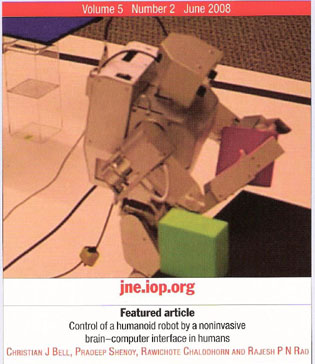
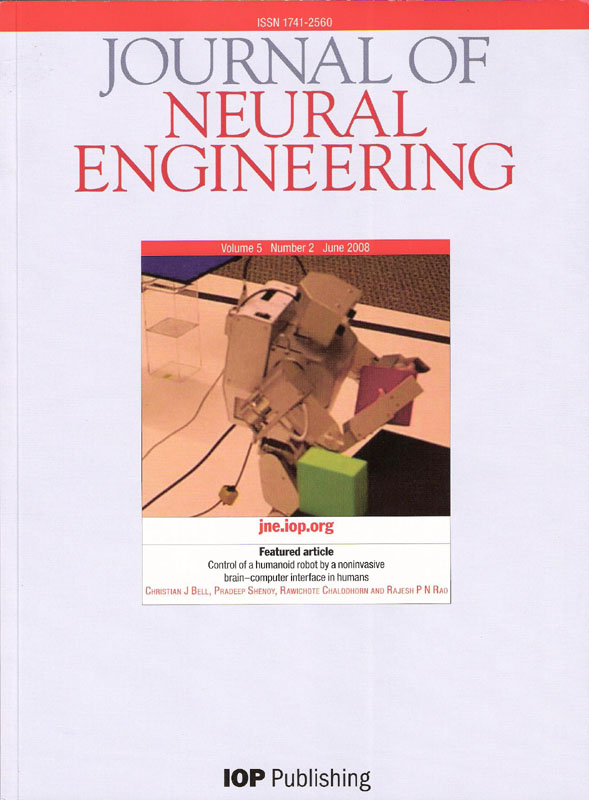
 Christian Bell, Pradeep Shenoy, Rawichote Chalodhom, and Raj Rao’s paper “Control of a humanoid robot by a non-invasive brain-computer interface in humans” was the featured article in the most recent issue of the Journal of Neural Engineering.
Full cover. Read more →