“Washington State Attorney General Rob McKenna wants to better protect computer users from spyware. He’s called for legislation to close loopholes in existing law. KUOW’s Joshua McNichols has more.”
Article here. Read more →

“Washington State Attorney General Rob McKenna wants to better protect computer users from spyware. He’s called for legislation to close loopholes in existing law. KUOW’s Joshua McNichols has more.”
Article here. Read more →
Read the article here.
UW CSE, UW Oceanography, and Microsoft Research are collaborating to create an  “Ocean Scientists’ Workbench” in connection with the NSF Ocean Observatories Initiative. This work was featured prominently in press coverage of the 2008 Microsoft Research TechFest.
UW oceanographers Debbie Kelley and Mark Stoermer appeared in ComputerWorld. CSE’s Keith Grochow and Microsoft’s Jared Jackson appear in Microsoft’s own coverage of the event. Other coverage in Scientific American, AppScout, and CosmicLog. Read more →
Read the article here.
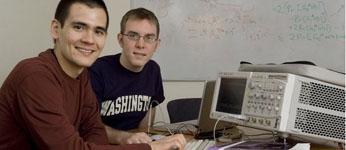 “A Seattle computer scientist who helped expose how hackers can mess with electronic voting machines is part of a team that has shown how new, wireless cardiac devices implanted in thousands of heart patients also are vulnerable to electronic attack … “[UW CSE’s Yoshi] Kohno and others have shown they can wirelessly extract personal medical information from an implantable cardiac defibrillator as well as reprogram or disrupt the device. The team includes Harvard University cardiologist Dr. William Maisel and Kevin Fu of the University of Massachusetts-Amherst, also a computer scientist.”
Additional information here
UW press release here
New York Times here
Wall Street Journal here
Boston Globe here
Science Daily here
University Week here
The Osgood File (CBS Radio) here
Australian Broadcasting Corporation here Read more →
Read the article here.
“‘Our goal is to ask what benefits can we get out of this technology and how can we protect people’s privacy at the same time,’ says Magda Balazinska, the project leader and assistant professor of computer science and engineering at UW. ‘We want to get a handle on the privacy issues that will crop up if these systems become a reality.'” Read more →
Read the article here.
 “A common new technology for monitoring defibrillators is vulnerable to hacking and even to reprogramming that could stop the devices from delivering a lifesaving shock …” Read more →
Read the (pdf) article here.
“Alexei Czeskis … is one of the initial recipients of the new Students First fellowships — the Hacherl Endowed Graduate Fellowship established by alumnus Don Hacherl (’85) … Czeskis is now immersed in computer security research under the mentorship of Assistant Professor Yoshi Kohno, who last fall was recognized by Technology Review as one ofthe nation’s top 35 innovators under age 35.” Read more →
Read the article here.
Wired riffs on CSE professor Yoshi Kohno’s undergraduate computer security course. “Good engineering involves thinking about how things can be made to work; the security mindset involves thinking about how things can be made to fail … I’ve often speculated about how much of this is innate, and how much is teachable … Which is why CSE 484, an undergraduate computer-security course taught this quarter at the University of Washington, is so interesting to watch. Professor Tadayoshi Kohno is trying to teach a security mindset …” Read more →
Read the article here.
The Chronicle of Higher Education interviews UW CSE professor Richard Ladner. “Disabled students face a host of challenges. Mr. Ladner, a professor of computer science and engineering at the University of Washington, has spent much of his career trying to improve their opportunities for success in the discipline. The Computing Research Association recently gave him its A. Nico Habermann Award for advancing underrepresented groups.” Read more →
Read the article here.
 “Junior Koshal Thirumalai, from India, is majoring in computer engineering at the UW. ‘It doesn’t make sense to go anywhere else if you are into computers,’ he says.” Read more →
Read the article here.
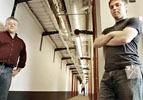 “Some University of Washington students, faculty and staff are being tracked as they move about the computer-science building, with details of where they’ve been, and with whom, stored in a database.
“Professor Gaetano Borriello checks a computer to find graduate student Evan Welbourne’s last location: on the fourth floor, outside room 452 at 10:38 a.m. Wednesday. He opens another screen to reveal the building’s floor plan, and a blinking green dot representing Welbourne shows him walking down the hall.
“If it seems a bit like Big Brother, that’s the intention. The project is meant to explore both positive and negative aspects of a world saturated with technology that can monitor people and objects remotely.
“‘What we want to understand,’ Borriello said, ‘is what makes it useful, what makes it threatening and how to balance the two.'” Read more →