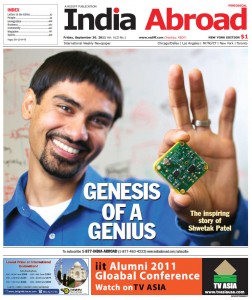
 An India Abroad cover story on UW CSE/EE’s MacArthur Award winner Shwetak Patel discusses Shwetak’s formative years in Birmingham, Alabama. Then there’s the bit about how he proposed to UW HCDE and iSchool professor Julie Kientz:
“He proposed to her at a ski resort in January of 2009, near Mt Rainier. The two sat down on the side of the slope overlooking Mt. Rainier.
“‘He then popped the question; he still had his snowboard gear on, so there wasn’t much kneeling involved,’ she added. ‘He didn’t have the real ring yet, since his dad had just come back from India with it, so he had secretly grabbed a ring from my jewelry box to propose with. Little did he know, it was actually a toe ring! How romantic!'”
Read more here (pdf)!
(Will this be our final 2011 post about Shwetak? Stay tuned …) Read more →
 Prism, the flagship publication of the American Society for Engineering Education, features the teaching of UW CSE/EE’s Shwetak Patel:
“The 50 students who enrolled in Shwetak Patel’s Embedded Microcomputer Systems class last winter could not have expected to draw a public spotlight. But once they rose to his challenge, building and programming controllers for a fleet of remotely piloted quadrocopters, a video of their drones’ successful flight leapt from YouTube into the local media.
“Engaging students in exciting practical applications is the best way to teach advanced engineering concepts, argues Patel, a three-year assistant professor of computer science and electrical engineering at the University of Washington. Taking cues from his own research, … Patel overhauled the traditional platform for an embedded systems class. Instead of working with small motors and LEDs, he had students tackle the four-rotor helicopter drones project… Captivated, the students taught themselves concepts outside the scope of their coursework – a professor’s dream come true.”
Read more of this terrific article here. Read more →
 MSNBC asks readers to vote among “11 scientific twists from 2011.”
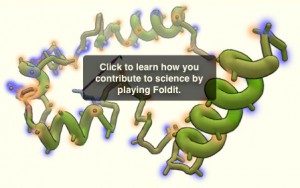
Two are from the field of computer science: Watson’s Jeopardy! triumph, and the cracking of a decade-old AIDS-related protein structure problem by players of UW CSE’s Foldit game.
Read the article here. And vote! Read more →
 As a New Year’s exercise, Xconomy asked a select group of Xconomists to answer this question: “What’s the craziest idea out there that just might succeed?”
UW CSE’s Ed Lazowska answers:
“That technology can actually play a significant positive role in education. The false promises go back at least 100 years – to extravagant claims by Thomas Edison. Certainly ‘computers in the classroom’ have contributed relatively little to this point …
“But one has to believe that there is hope, in the next 10 years, for advanced adaptive tutoring systems, and for games that embody entirely new approaches to interactive learning.”
Read a bit more here. Read more →
 “The break-in is one of the boldest known infiltrations in what has become a regular confrontation between US companies and Chinese hackers.
“Bradley Shear, George Washington University professor and Attorney At Law with the Law Office of Bradley S. Shear, LLC, Alexei Czeskis, Security and Privacy Research Lab with the Department of Computer Science & Engineering at the University of Washington, and Paul Rosenweig, Principal with Red Branch Consulting and a visiting fellow at Heritage, talk about this complex operation, which involved at least 300 internet addresses.”
Listen to the story here. Read more →
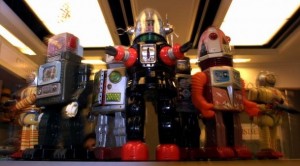 “Look, I’m not trying to freak you out here. Well, OK, maybe a little. But think about it: We have computers all over the place. Your laptop or desktop PC; maybe you have a tablet too, maybe a smartphone. And it doesn’t stop there. Your car might be computerized, your kitchen, the toys your kids got for Christmas. If any of those computers are connected to any kind of network, there exists an issue of security …
“Yoshi Kohno is an associate professor of computer science and engineering at the University of Washington. He and his team figured out how to break into a car’s internal, computer network. They were able to control the brakes and turn the car on and off. They also fiddled around with a commercially available toy robot. ‘One of the things we found is that as soon as we turned this toy robot on, it advertises a wireless ad hoc network that anyone can connect to,’ Kohno says …
“Kohno’s team has been looking into something far more serious than a toy robot: implanted medical devices. ‘We found that a person using their own equipment could wirelessly communicate with a pacemaker or defibrillator and change its settings, turn on and off therapies, and in fact make it issue a large shock,’ he says.”
Listen to the full story here. Read more →
 GeekWire honors UW CSE’s Hélène Martin in their “Geeks Who Give Back” feature:
“Hélène Martin taught hundreds of high-school students the power of computer programming during her two years teaching computer science at Garfield High in Seattle, inspiring many to pursue degrees in technology. Now a lecturer in the UW’s Computer Science & Engineering Department, she continues to shape the next generation of geeks.”
Read more here. Read more →
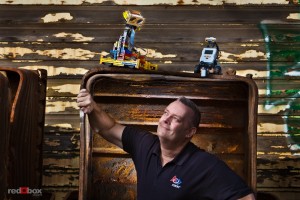 UW CSE alumnus Kevin Ross, a long-time Microsoft employee who is also the founder of Washington FIRST Robotics, is celebrated by GeekWire in their 2012 “Geeks Who Give Back” calendar.
“The founder of Washington FIRST Robotics has spent has spent countless hours building one of the largest statewide networks of robotics competitions, giving students from kindergarten through high school an exciting new way to learn science, math and programming, and to experience first-hand the potential of technology and teamwork.”
Congratulations Kevin! Read more here. Read more →
 Forbes highlights 30 superstars under the age of 30 in each of 12 fields: Art & Design, Energy, Entertainment, Finance, etc.
In the “Technology” field, two of the 30 are UW CSE’s Jake Appelbaum and Sidhant Gupta.
 Jake is highlighted as “Digital anonymity and crypto expert gained fame finding security bugs in software and consulting to WikiLeaks.”
 Sidhant is highlighted as “Developing new sensors and software for the home that conserve electricity, heat and gas.”
Forbes also recognized Cloudera’s Jeff Hammerbacher in the “Technology” field; Jeff co-founded Cloudera with UW CSE bachelors alumnus Christophe Bisciglia.
In “Science,” Forbes highlighted UW Biostatistics professor Daniela Witten, wife of Facebook Seattle director Ari Steinberg. Also UW Genome Science graduate student Sara Ng.
Read more →
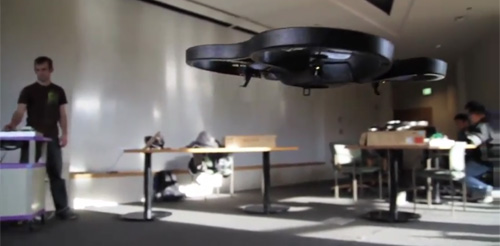 But that didn’t keep them from celebrating Shwetak Patel‘s EE472, “Embedded Microcomputer Systems”:
On the 12th day of lab, Patel gave to me …
- 12 shattered spirits
- 11 sleepless nights
- 10 colored papers
- 9 dented rotors
- 8 cracked hulls
- 7 missing tags
- 6 red LEDs
- 5 broken drones
- 4 rusty motors
- 3 frozen makeboards
- 2 crappy routers
- And some code that was written in C!
Watch the video here (be sure to turn captions on)!
Also, don’t miss “Geeks can’t dance” from a previous offering of this class, here!
Many photos from the class here.
Read more →